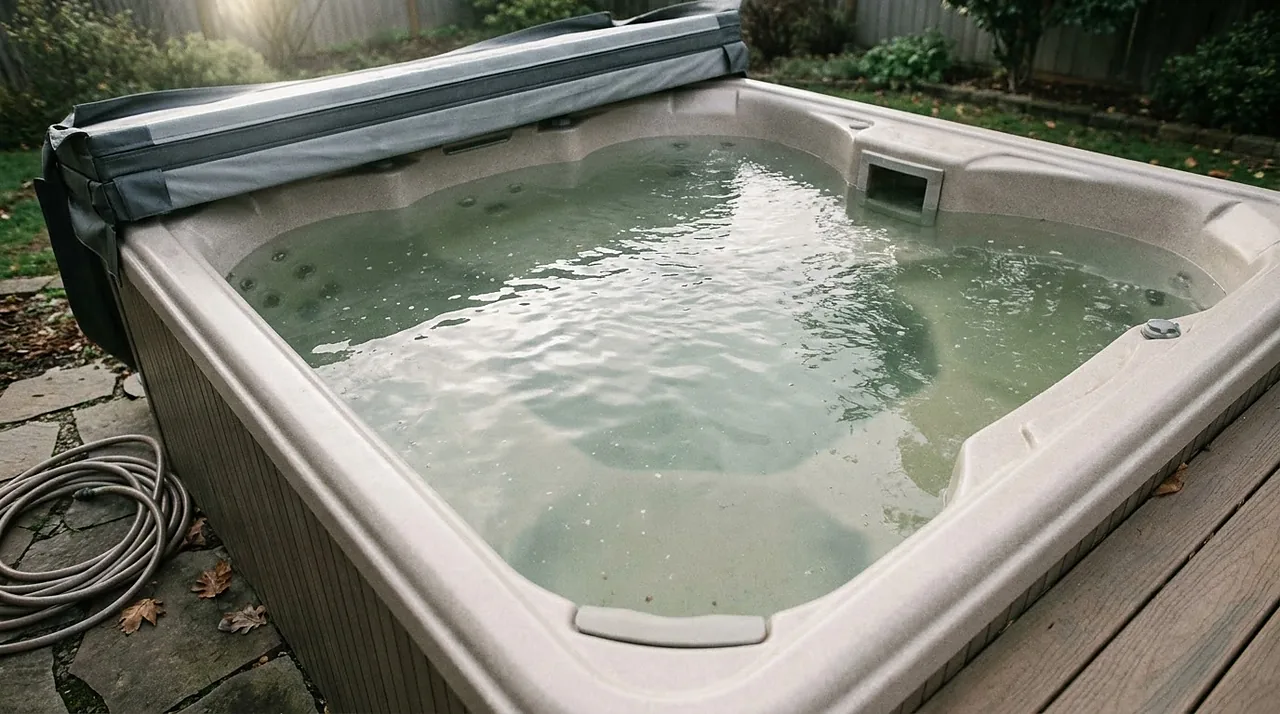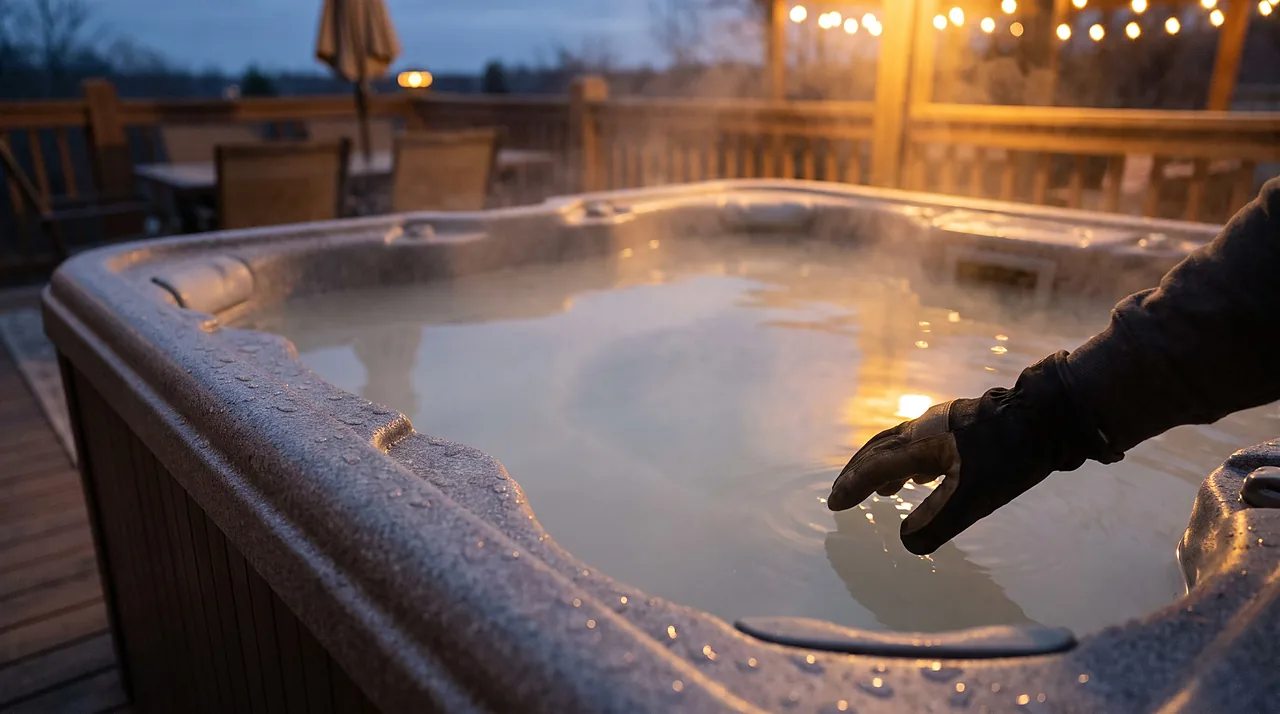
Guests arrive in two hours and the water looks like weak milk. Before you dump in a bottle of anything, work through the causes in the order they actually happen, cheapest and fastest first. Most cloudy spells trace back to one of five things, and four of the five cost nothing more than a test strip and ten minutes to rule out.
Here is the order that matches how often each cause actually shows up in practice: sanitizer running low, a filter that has quietly clogged, total alkalinity or pH drifted out of range, body products and organic load overwhelming the water, and, last and least common, biofilm living in the plumbing. Work top to bottom. Do not shock the water and hope before you have checked which one you actually have.
If it has to be clear tonight
- Test the water with a test strip or kit so you know your current baseline readings before adding any chemicals.
- Balance total alkalinity first, then adjust pH, and wait about 20 minutes between chemicals so the adjusters do not fight each other or cloud the water.
- Bring sanitizer into range (free chlorine 3-5 ppm or bromine 3-5 ppm) so active sanitizer can immediately begin breaking down organic contaminants.
- Rinse the filter cartridge thoroughly with a hose to clear out trapped debris and restore proper circulation.
- Shock the spa with the cover off and jets running on high for 20-30 minutes to burn off chloramines and let off-gas escape.
- Run the pump and filtration continuously until the water clears, which often takes 4-8 hours of repeated circulation through the clean filter.
- Add a clarifier only after completing the previous steps if fine suspended particles still remain, helping the filter capture the smallest debris.
If it is still hazy tomorrow, go to the section "Chemicals test fine but the water is still cloudy."
Check these in order, cheapest first
This is the sequence. Each row has a two-minute check you can run standing at the tub, and a rough sense of what fixing it costs.
| Likely cause | 2-minute check | Fix tonight | Rough cost |
|---|---|---|---|
| Sanitizer too low or all combined (chloramines) | Test strip: free chlorine under 3 ppm, or combined chlorine reading above 0.5 ppm | Dose to 3-5 ppm free chlorine (or 3-5 ppm bromine); if combined chlorine is high, shock instead of just adding more daily sanitizer | $0-10 |
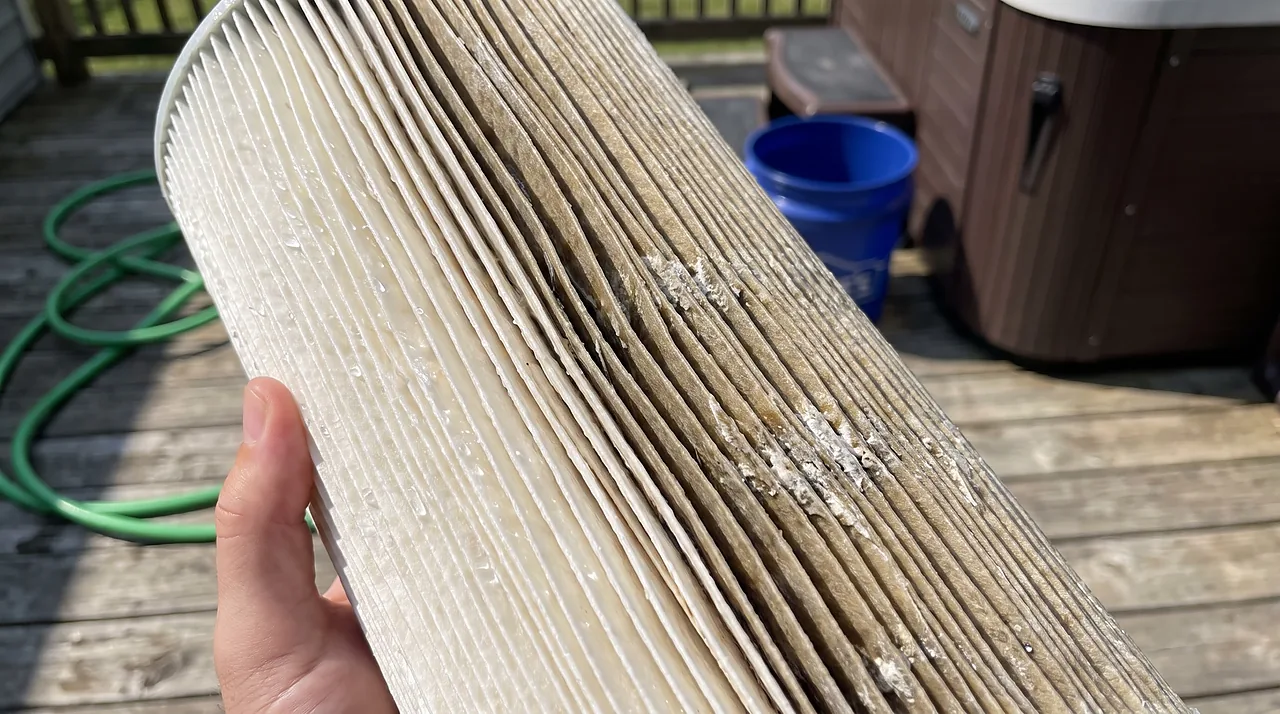
| Filter clogged or packed with fine debris | Pull the cartridge; pleats look gray, matted, or flattened, and flow feels weak at the jets | Hose-rinse between the pleats top to bottom; if it has not been chemically soaked in over a month, soak it overnight | $0, or $10-15 for cleaner |
| Total alkalinity or pH out of range | Test strip: TA outside roughly 80-120 ppm, or pH outside 7.2-7.8 | Fix TA first with baking soda (sodium bicarbonate, the same stuff sold as branded "increaser"), then dial in pH | $5-10 |
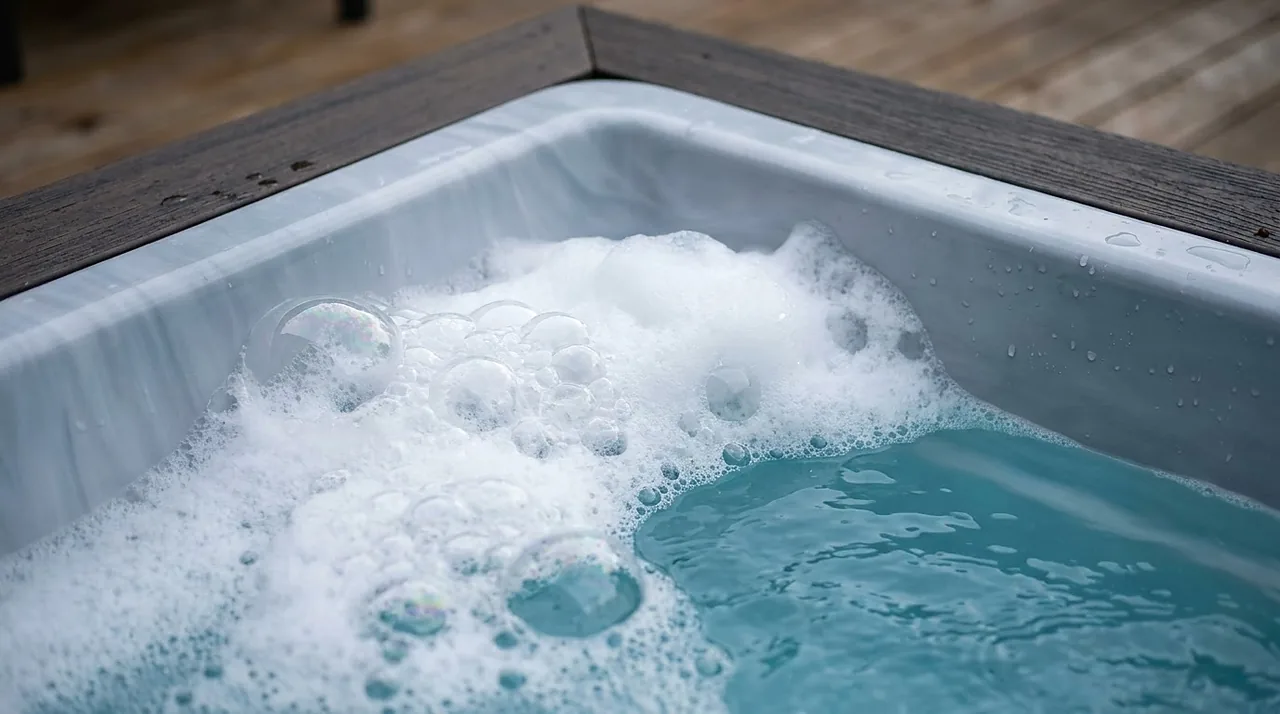
| Body products, oils, or heavy organic load | Foam that will not settle, a slight film on the surface, water hazy right after a soak with lotion or hair product | Rinse off before soaking, run the pump longer, add a small dose of enzyme/clarifier only after sanitizer and filter check out | $0-10 |
| Biofilm in the plumbing (jets, heater, internal lines) | Cloudiness or foam returns within a day or two of a proper shock, even with chemistry dialed in and a clean filter | A dedicated pipe-purge product, then drain and refill | $15-30 |
If row one or two fixes it, you are done for tonight. If you get through rows one and two and the water is still hazy, keep reading, because that is a different conversation.
Low or exhausted sanitizer, the most common cause

Free chlorine below about 3 ppm, or bromine below 3 ppm, is the single most common reason water turns cloudy between soaks. Bacteria, skin oils, and fine organic particles that a properly dosed sanitizer would oxidize on contact just sit suspended in the water instead, scattering light and giving it that milky look. The test strip or liquid kit you already own answers this in under a minute.
Here is the part that trips people up: a strong chemical smell does not mean too much sanitizer. It means too little free chlorine and too much combined chlorine, the chloramine byproduct left over when chlorine has already reacted with sweat, lotion, and other organic waste and has nothing left to sanitize with. A well-balanced tub barely smells like anything. If yours smells sharp and the water looks cloudy, do not cut back on chlorine, since that is backwards. Shock it to burn off the combined chlorine and rebuild a clean free-chlorine reserve, then keep an eye on the split between free and total on your next few tests.
Owners running dichlor tablets or granules should know it carries cyanuric acid along for the ride, roughly 0.9 ppm of CYA for every 1 ppm of free chlorine dosed. In a large pool that is a slow drift; in a 300 to 500 gallon spa it piles up fast, and once CYA climbs, chlorine loses bite even when the test strip still shows a number. That is the whole logic behind alternating dichlor with plain unscented bleach, or draining on a shorter interval if dichlor is your only sanitizer. If chlorine keeps testing fine on paper but the water still looks tired, cyanuric acid buildup is worth a specific test.
A dirty or undersized filter

The filter is doing physical work a chemical test cannot see. Pull the cartridge and look at it edge-on. Pleats that are matted flat, gray instead of white or tan, or crusted with a waxy film are not straining fine particles out anymore, and those particles are exactly what makes water look cloudy rather than clear. A weekly rinse and a monthly chemical soak keep a cartridge working; most need full replacement every 12 to 24 months depending on bather load. Full steps for both the quick rinse and the deep soak live in the filter cleaning guide.
Two filter mistakes cause cloudiness specifically: running the pump on too short a cycle so water never fully passes through the filter media, and reinstalling a cartridge that is the wrong micron rating or size for the tub, which lets fine particulate slip past the pleats entirely. If a fresh, correctly rinsed filter does not clear things up within a full filtration cycle or two, the filter was probably not the actual cause.
Total alkalinity and pH out of range
Total alkalinity is the buffer that keeps pH from swinging every time chemicals go in, and it is worth fixing first, before touching pH at all. Low TA lets pH bounce unpredictably; high TA drags pH upward and can start precipitating dissolved minerals out of solution as tiny cloudy particles, especially in tubs with harder fill water. The fix for low TA is baking soda, sodium bicarbonate, which is the identical compound sold at a markup as branded "alkalinity increaser." There is no premium version. Lowering TA that has crept too high takes dry acid added in small doses with some aeration, not a single big dump.
Once TA sits in the commonly cited 80-120 ppm window, dial pH to 7.2-7.8, ideally 7.4-7.6. Full step-by-step sequencing, including which to test first and how big a dose to add for a typical tub size, is in the alkalinity guide and the pH guide.
Adding several chemicals at once or in the wrong order, especially alkalinity or pH adjusters in big doses, can itself cloud the water for a few hours. Add one chemical at a time, wait, and retest.
Body products, lotions, and organic load
Sunscreen, lotion, hair product, deodorant, and plain sweat all add oils and organic compounds that a hot tub's small water volume cannot dilute the way a pool can. This shows up as persistent foam that will not settle, a thin film on the surface, or water that clouds within an hour of a soak even though it tested clean before anyone got in. A quick rinse in the shower before soaking removes most of the load at the source, which is cheaper than treating it chemically after the fact. If foam is the dominant symptom rather than haze, check whether that foam is a real problem before assuming it needs a product fix.
Chemicals test fine but the water is still cloudy

This is the branch that actually needs a different answer than "add more chemical." If free chlorine or bromine sits in range, combined chlorine is low, TA and pH both check out, and the water is still hazy, the cause is almost always one of two things: a filter that looks fine on the outside but is packed with debris deep in the pleats, or biofilm living inside the plumbing itself, in the jets, heater, and internal lines the filter never touches.
Sequence it this way. First, do a genuinely thorough filter clean, not the usual quick rinse, since matted inner pleats do not always look bad from the outside. If that does not clear it within a day, suspect biofilm. Biofilm is a slimy bacterial layer that colonizes the inside of pipework and jet bodies, sheds cloudiness or foam back into clean water, and simply cannot be shocked away because the sanitizer never touches what is inside the pipe wall. Any used or new-to-you tub, and any tub that keeps clouding back up shortly after a proper shock and clean filter, should get a dedicated pipe purge before draining. The full process is in the biofilm purge guide, and if foam keeps returning specifically, pink slime and related biofilm symptoms are worth ruling out at the same time.
A rough way to size how urgent a drain is: take the tub's gallon capacity, divide by 3, then divide again by the average number of people using it per day. A 500-gallon spa averaging two bather-uses a day works out to 500 divided by 3, divided by 2, or about 83 days, just under three months. For most residential spas that formula lands somewhere between six weeks and four months depending on how many people use it and how often. Full drain-and-refill steps are worth having ready before you start, since a biofilm purge is normally step one, drain and refill is step two.
Cloudy right after a refill or a deep clean
Fresh fill water carries dissolved minerals and sometimes metals that can react as soon as the water warms up. Run the pump for a full day with the filter in place so suspended particles begin filtering out. Balance total alkalinity and pH first, and then add your sanitizer once those baseline numbers settle. If fill water brings high calcium that tests above the standard 150-250 ppm range for spas, dissolved calcium can fall out of solution and cloud the tub, which points to the hard-water answer in the FAQ below.
When cloudy is actually something else
A few symptoms get mistaken for plain cloudiness and deserve their own answer instead of another round of chemicals. If the haze has a distinct green tint, that is algae or metal staining behaving differently from ordinary turbidity, and the fix is different; see green hot tub water for that specific cause and cure. And if cloudiness shows up specifically after you just finished balancing chemistry, rather than building up over days, cloudy right after balancing covers why that happens and whether it is normal.
If you shocked heavily right before guests arrived and the water went milky instead of clear, that is its own pattern too, usually oxidized organic material clouding before it filters back out; milky water after shock walks through the timeline for when that should clear on its own versus when it will not.
Brown or tea-colored water right after shocking usually means dissolved metals (iron or copper, often from well or fresh fill water) that the shock oxidized. A metal sequestrant and the filter clear it. Do not keep shocking, since adding more sanitizer will only continue to oxidize the metals.
Is it safe to get in while it is cloudy
Do not soak until the water is clear and sanitizer tests in range, with free chlorine at 3-5 ppm or bromine at 3-5 ppm. Cloudiness with low sanitizer is the real risk, since bacteria and organic contaminants can multiply without an active sanitizer reserve. Even when chemistry appears close, keep the visibility test in mind: if you cannot see the bottom of the tub or count on one hand held underwater, do not get in until it clears, since you cannot confirm the drain or intake area is unobstructed. For the fuller answer on what readings make a soak a bad idea, see is hot tub water safe to sit in. If a musty or mildew smell rides along with the cloudiness, treat that combination as a signal to check for mold, since that pairing needs its own fix and does not clear with a plain chemistry adjustment. Retest the water after whichever fix you make before getting in.
How to keep it clear
- Test 2-3 times a week to keep sanitizer, pH, and alkalinity in range.
- Rinse the filter every 1-2 weeks with a garden hose.
- Give the filter cartridge a chemical soak monthly.
- Replace the filter cartridge roughly every 1-2 years.
- Shower before soaking to keep lotions, oils, and cosmetics out of the water.
- Shock after heavy use to break down organic buildup quickly.
- Drain on schedule: tub gallons divided by 3, divided by daily bathers, gives the days between drains (typically 3-4 months).
- Purge lines before a drain if foam or haze keeps returning.