Test the water Tuesday morning and it reads a clean 7.6. Test it again Thursday night after three soaks with the jets running and it's pushing 8.0, maybe higher. Nothing was added in between except people, bubbles, and time. This climb is what hot tub water does by default. Once you know why, you stop chasing the number every single day and start managing it on a schedule instead.
The working target is 7.2 to 7.8, with 7.4 to 7.6 as the tighter zone where sanitizer works best and skin and eyes stay comfortable. That range comes from the Model Aquatic Health Code, the CDC-backed standard that public pool and spa operators are built around, and it applies just as well to a backyard tub. Below 7.2, water turns corrosive to heater elements, jets, and vinyl. Above 7.8, chlorine's active form weakens, scale starts forming on the shell and plumbing, and cloudiness gets more likely. Neither end is dramatic on day one. Both punish you slowly if you leave the water sitting there.
Signs your pH is off
- High pH: cloudy water, scale or a rough line at the waterline.
- High pH: chlorine that seems weak, dry or itchy skin.
- Low pH: stinging eyes, a sharp feel on skin.
- Low pH: corrosion or discoloration on metal fittings.
The signs only hint, a test decides.
Why hot tub pH drifts up almost by itself

A hot tub is small, hot, and constantly agitated, and all three of those work against a stable pH. Jets and air blowers whip carbon dioxide out of the water into the air (the same reaction that makes a shaken soda go flat), and losing dissolved CO2 pushes pH upward. A pool the size of a swimming pool loses CO2 slowly because its surface area is large relative to its depth and it usually isn't aerated on purpose. A four-person spa with air jets running for an hour a day is doing the opposite: constant micro-bubbles, constant surface turnover, constant outgassing. Add fresh fill water that already sits above 7.5 in a lot of municipal supplies, plus dichlor or a bromine feed that nudges pH up slightly with each dose, and the default direction for a hot tub is always up, not down. Anyone hunting for a way they're causing this daily is usually just watching normal chemistry. The mechanics of how sanitizer, pH, and alkalinity interact are laid out in full in the water chemistry rundown for hot tub owners, which is worth reading once so the vocabulary here makes sense.
Fix alkalinity before you touch pH, or you'll be back tomorrow
Total alkalinity is the water's resistance to pH change. Low alkalinity means a small dose of anything, chlorine, a bather's sweat, a splash of rain, swings pH hard in either direction. High alkalinity means the water actively resists your pH-down dose and creeps back up within a day. The code range is wide (60-180 ppm), but the working target for a spa is 80-120 ppm. That range and the buffering concept behind it come from the same pool and spa industry standards used for total alkalinity dosing.
Here's the part owners skip: if alkalinity is out of range, dosing pH alone is a losing game. Add acid, watch pH drop, walk away, come back in two days and it has crept most of the way back up. That's alkalinity pulling it there. Get alkalinity into its working band first, and pH becomes something you nudge occasionally instead of something you fight daily. The full arithmetic for raising or lowering total alkalinity for your exact gallon count, including how it interacts with calcium hardness and the Langelier balance, lives in a dedicated breakdown at the alkalinity math for hot tubs; this article covers only what pH needs from it.
- Alkalinity under 80 ppm, pH bouncing (low one day, high the next)
- What's actually happening: No buffer. Small additions swing pH hard in both directions. Fix order: Raise alkalinity first with sodium bicarbonate, then dial pH once it settles for a day.
- Alkalinity 80-120 ppm, pH steady at 7.8 or higher
- What's actually happening: Buffer is fine. pH is genuinely high from aeration, fresh fill water, or the sanitizer you're using. Fix order: Lower pH directly. No alkalinity change needed.
- Alkalinity over 130-150 ppm, pH climbs back within a day of dosing
- What's actually happening: The buffer itself is holding pH up. This is the "chasing it forever" trap. Fix order: Lower alkalinity first with dry acid and an aeration break, then finish with a small, separate pH-down dose.
- Alkalinity over 180 ppm
- What's actually happening: Outside the workable band entirely. pH will not hold no matter what you add. Fix order: Partially drain and dilute with fresh water, then rebuild alkalinity correctly from there.
How to actually bring pH down

Two products do this: dry acid (sodium bisulfate) and muriatic acid (liquid hydrochloric acid). Dry acid is easier to handle and store in a small spa equipment bay; muriatic acid works faster but splashes and fumes, and it will also pull alkalinity down harder per dose, which is sometimes exactly what you want if alkalinity is also high. Whichever you use, the routine is the same: dose, circulate, wait, retest. Do not stack a second dose on top of a first one within the same evening. pH takes time to fully react and distribute, and overdosing on impatience is how owners land at 6.8 instead of 7.4.
A worked example makes the cadence concrete. Take a 387-gallon spa, a size that's common for a mid-range six-to-seven-jet model. It reads pH 8.0 with alkalinity already inside its comfortable band, so this dose is a pH-only correction, not an alkalinity fix. Before you measure anything, know that the number below is a starting estimate. Always confirm the actual scoop or capful against your specific product's own dosing chart for your gallon count before treating it as a rule of thumb. The dosing rate for dry acid is roughly 1.6 lb per 10,000 gallons to shift alkalinity, and pH along with it, about 10 ppm. Scaled down to a 387-gallon spa, that works out to 1.6 x (387/10,000), or about 0.062 lb, which is roughly 1 ounce of dry acid. In practical kitchen terms, that's about two level tablespoons of product for a single 10 ppm step, not the rounded single tablespoon it might look like at a glance.
- 1
- Action: Confirm alkalinity is already in range (skip straight to alkalinity fix if not). Wait before retesting: N/A.
- 2
- Action: Turn off jets and air blower, dose pH-down per the label's chart for your gallons. Wait before retesting: N/A.
- 3
- Action: Let the pump circulate on low or standard filtration cycle. Wait before retesting: 4 to 6 hours, or overnight for a small dose.
- 4
- Action: Retest pH (and alkalinity if you touched it). Wait before retesting: Before adding anything else.
- 5
- Action: If still above 7.8, repeat from step 2 with a smaller dose. Wait before retesting: Same 4 to 6 hour window each time.
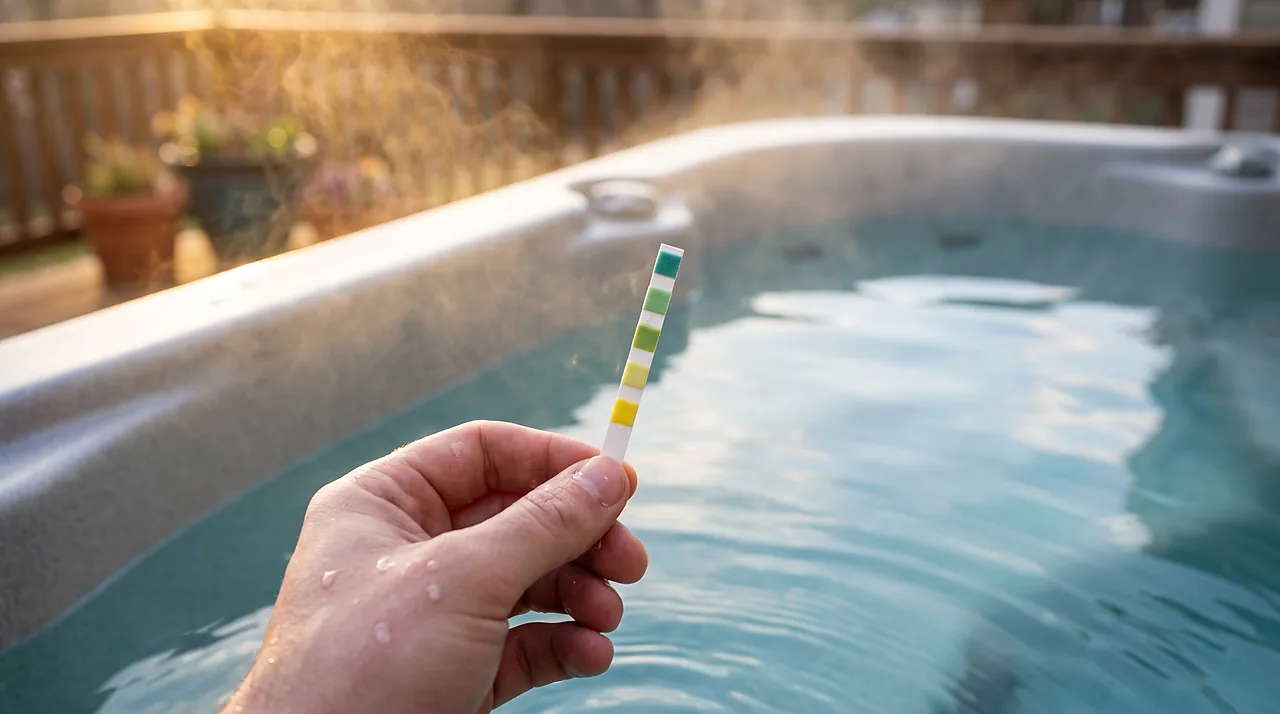
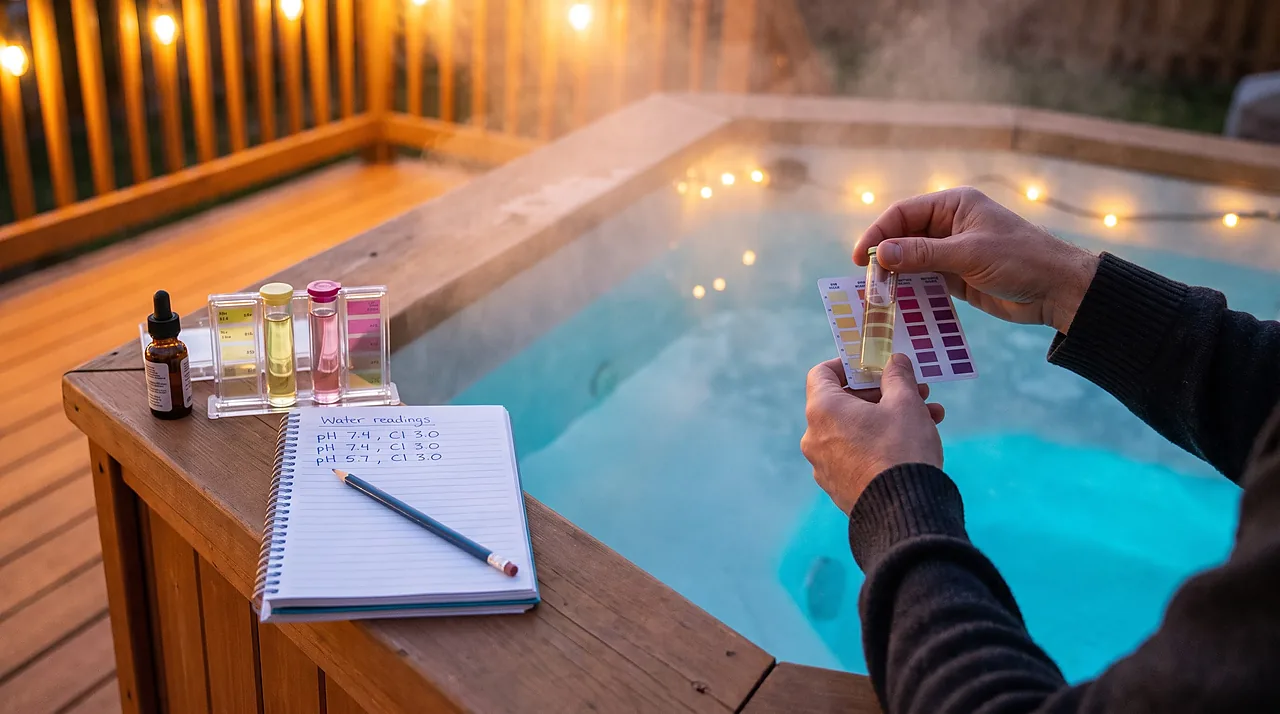
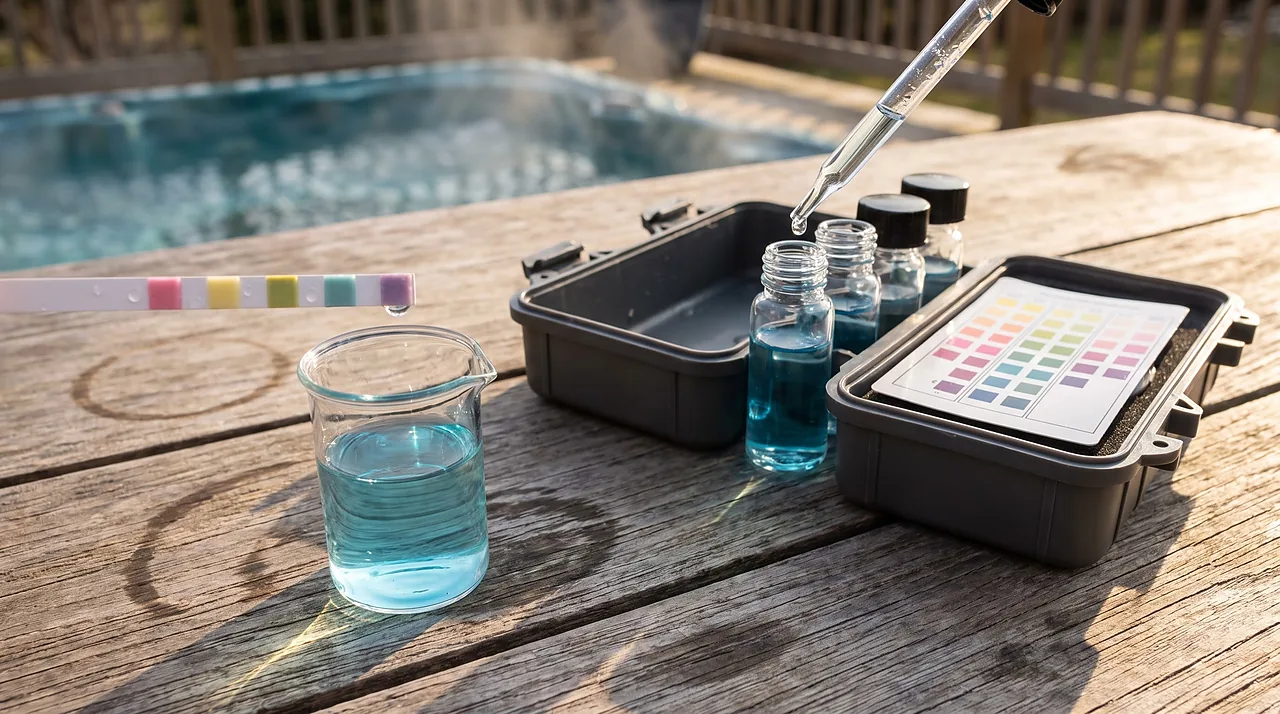
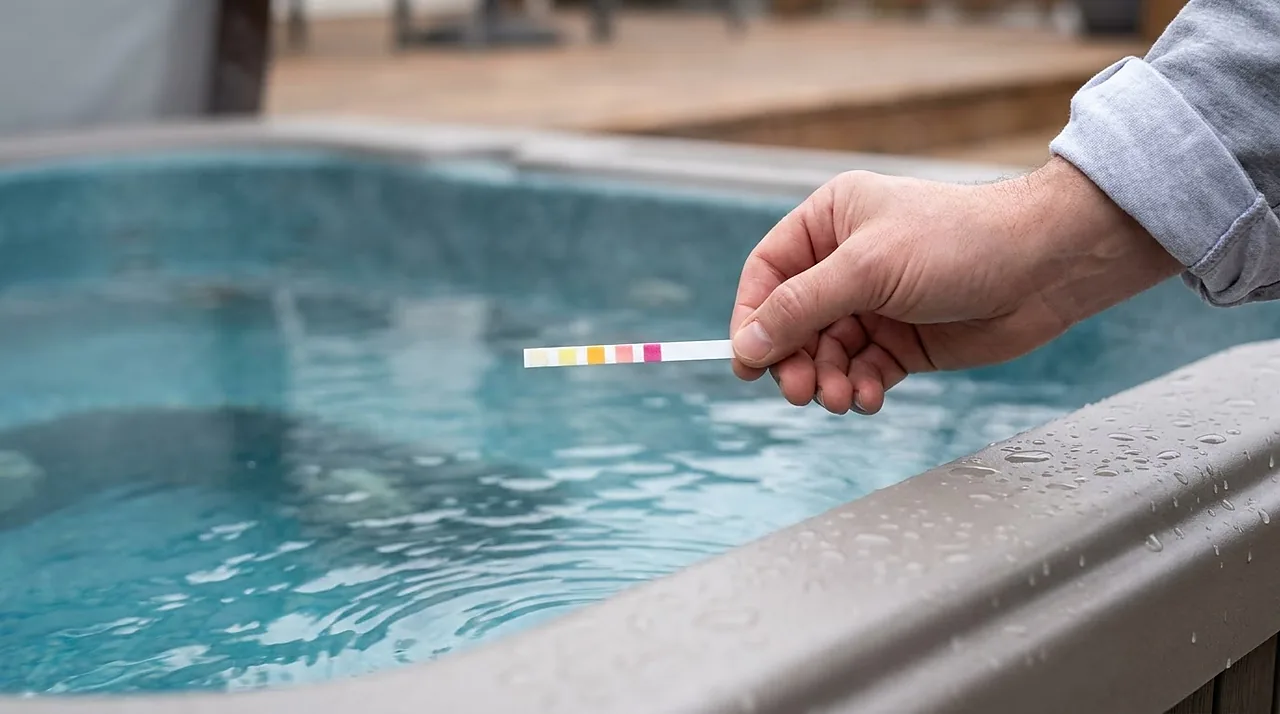
Skip the wait and you'll overshoot. A test strip or liquid kit read ten minutes after dosing is reading acid that hasn't finished reacting yet, and the number you see is not the number the water will settle at. Good testing habit matters as much as the dose itself; a full walkthrough of strips versus liquid reagent kits and how often to test is covered separately in the testing routine guide.

When the number is low instead of high
Everything above assumes the common direction, drifting up. A spa that reads under 7.2 usually points to a different cause entirely, often high bather load with certain sanitizers, or a fill source on the acidic side, and the fix runs the opposite way with sodium carbonate (soda ash) or plain baking soda rather than acid. If pH is low but alkalinity is already fine, aeration (jets and air on, cover open for a few hours) raises pH without raising alkalinity. It is the gentlest fix for a small correction. That situation gets its own full treatment, including why it's less common and easy to overcorrect, in the article on low pH in a hot tub.
A word on the "increaser" bottle
If you buy a bottle labeled "alkalinity increaser" or "pH increaser" at the pool store, check the ingredient line to know which one you hold. Alkalinity increaser is almost always sodium bicarbonate (baking soda); pH increaser is usually sodium carbonate (soda ash), which raises pH much more per dose. There is nothing wrong with buying the branded jar if the price is close, but knowing the ingredient means you're never stuck without a fix on a Sunday when the pool store is closed.
Safety around acid and sanitizer, together
Never combine chlorine products and acid in the same container, bucket, or scoop, and never add both to the water back to back without letting the first fully dissolve and circulate. The reaction between chlorine and acid releases chlorine gas, a genuine respiratory hazard, and it's the single most preventable spa-chemical injury on record. Store dry acid and any chlorine or bromine product in separate containers, on separate shelves, and always add chemicals to water, never water to concentrated chemical. Add one product, wait for it to fully dissolve and the water to look clear, then move to the next.
What to expect once alkalinity is dialed in
Once alkalinity sits inside its comfortable band for your sanitizer, pH stops swinging wildly. Instead it drifts slowly upward between soaks, the normal aeration effect described earlier. At that point a small pH-down dose every one to two weeks, checked with a real test kit, is a completely normal maintenance rhythm. If you find yourself testing and dosing every single day, that is a signal to look back at alkalinity first.