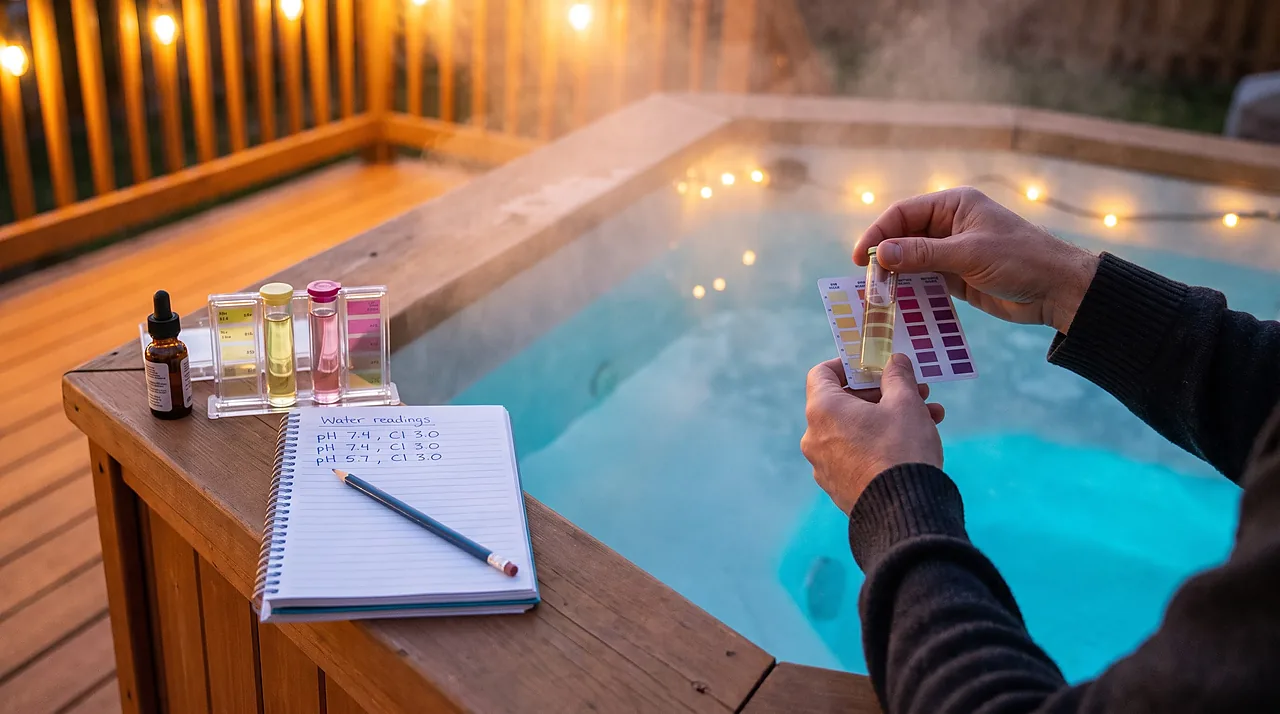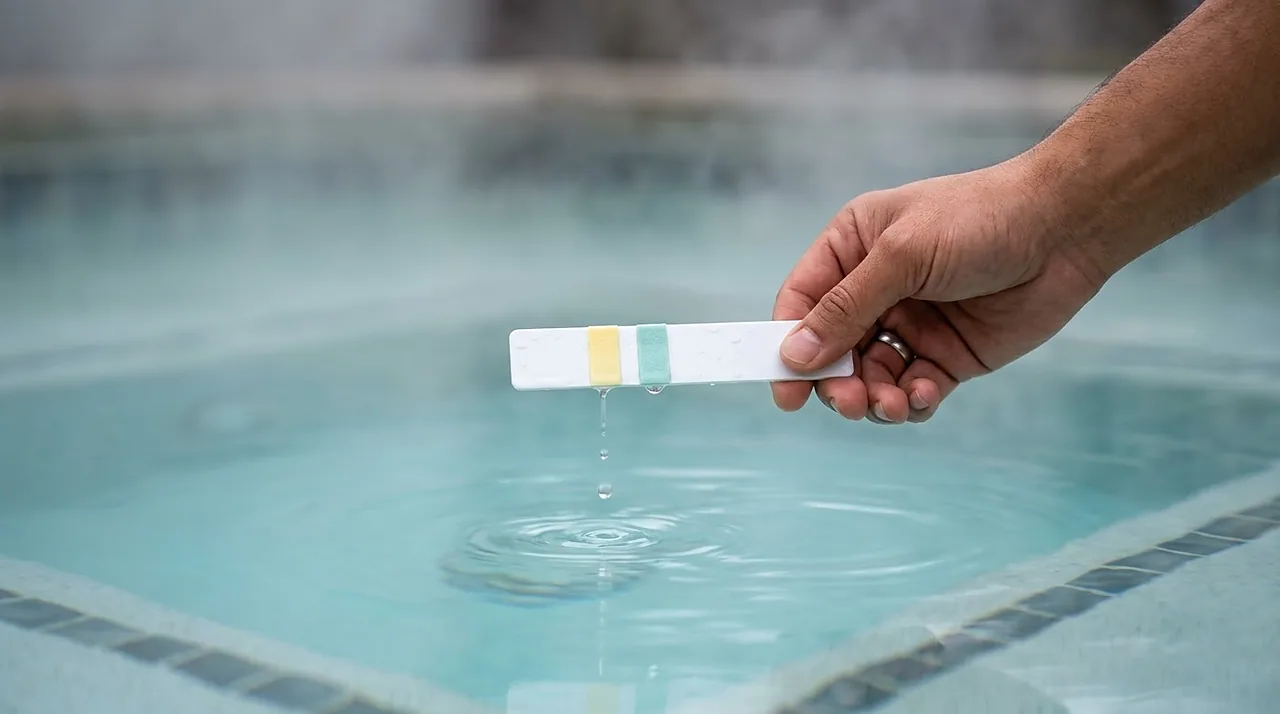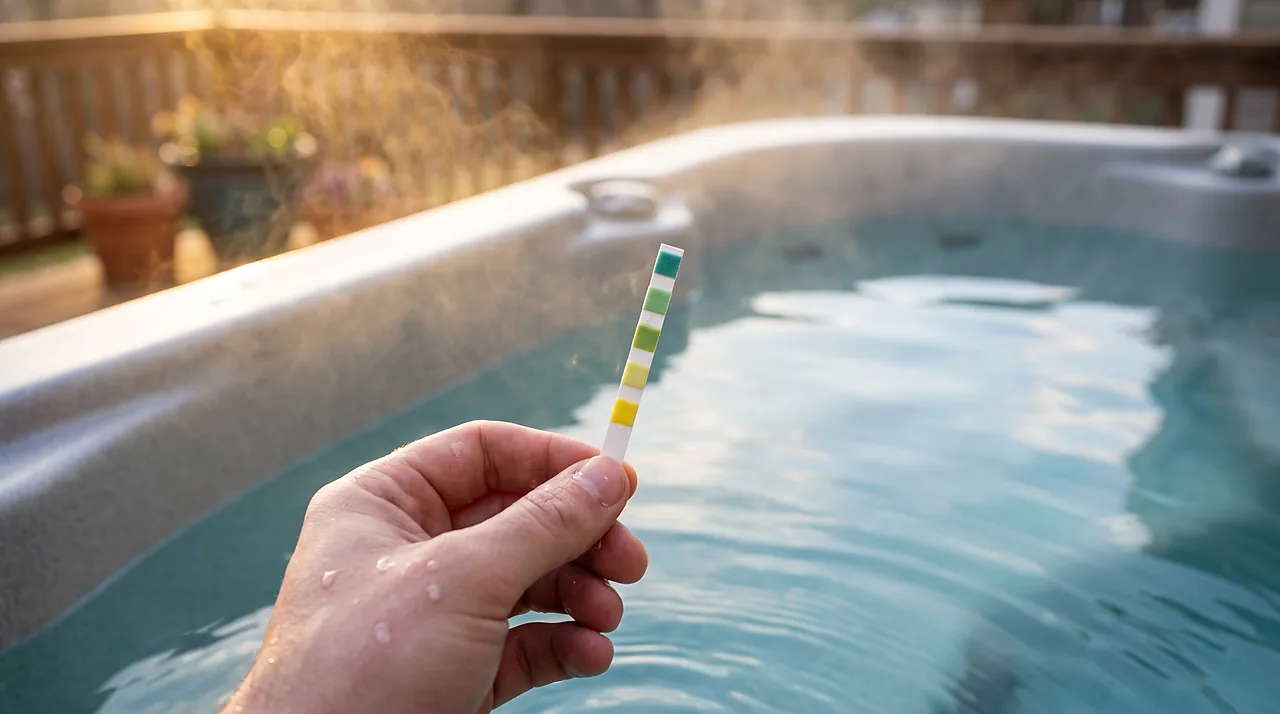
A strip dipped in cloudy, slightly stinging water comes back reading a cheerful "fine," every pad in the safe zone. That result is not a lie exactly, but it is not the whole truth either, and a strip that stays green while the water clearly is not behaving is one of the most common and most confusing moments in spa ownership.
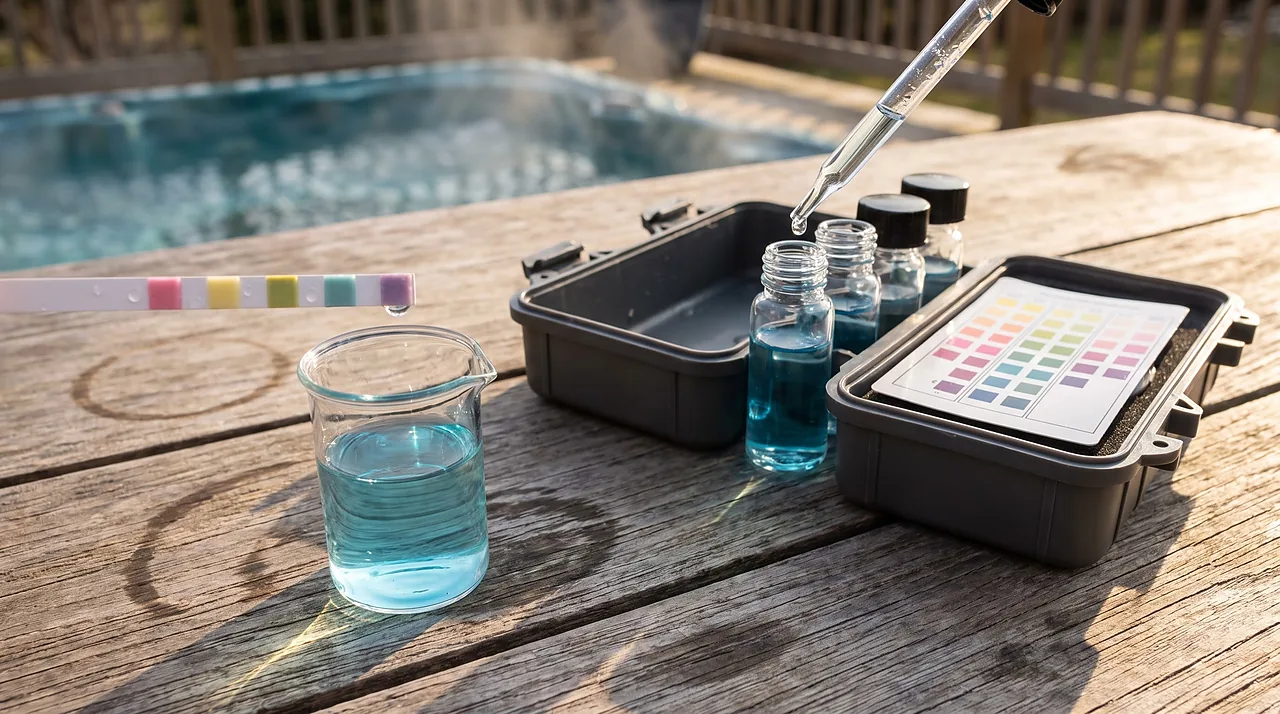
The short version: a test strip is a smoke alarm. It is fast, cheap, and good at telling you something is wrong. A reagent drop kit built around FAS-DPD titration, such as the Taylor K-2006, is the diagnosis. It gives you an exact number instead of a color guess, and it is the only way to know what is really happening when the strip's answer does not match what you are seeing, smelling, or feeling in the water. Both belong on the short list of chemicals and test gear a tub needs.
Why a strip can say "fine" while the water is clearly not

Strips work by soaking up water and letting a chemical pad change color, which you then compare to a printed chart. That comparison step is the weak link. Human eyes are bad at judging fine gradations of pink, yellow, or blue under bathroom light, porch light, or a phone flashlight, and every strip has some tolerance built in around each color block.
There is a second, sneakier failure mode: at high sanitizer concentrations, the same DPD-type chemistry used in both strips and liquid drop tests gets overwhelmed. Excess chlorine or bromine reacts with the pink DPD indicator and bleaches it back to colorless, according to a technical breakdown from AQUA Magazine aimed at pool and spa service techs. That bleaching pushes the reading lower, not higher, so a strip sitting in genuinely high sanitizer can flash a normal or even low number while chlorine is actually spiking. The magazine notes the effect typically starts kicking in around 5 to 10 ppm and becomes serious above 10 ppm, which is well within range for a tub that was just shocked or one where a dosing pump is stuck open.
The tell on a strip is a thin blue line separating the wet section from the dry part of the pad, a sign the sample overwhelmed the chemistry rather than measuring it. Most owners never notice that line because nothing on the packaging tells them to look for it.
What a strip is actually good for
None of this makes strips useless. They are the right tool for a fast daily or every-other-day glance: pH drifting, sanitizer present or absent, alkalinity roughly in the ballpark. Read a strip properly and it earns its keep:
- Dip once, briefly, and pull it out. Do not swirl it or leave it soaking.
- Hold it level for the full wait time on the bottle, usually 15 to 30 seconds, and read every pad at the same moment rather than staggering the check.
- Compare under neutral light, not yellow indoor bulbs or direct sun, which both shift color perception.
- Use a fresh bottle. Strips absorb humidity through the cap every time it is opened, and a jar that has sat half-used for a year reads unreliably regardless of technique.
- Treat any reading near a strip's top color block as a flag to confirm with something more exact, not as a pass.
A strip's real job is triage, deciding whether today needs a closer look. It was never built to hand you the exact free chlorine number you need before adjusting a stubborn pH or chasing why chlorine will not hold.
Are all test strips the same?
No, test strips are not all the same. Strips come as 3-way, 4-way, 5-way, or more, and the pads differ. A bromine tub needs strips that read bromine, not free chlorine, and some strips add total hardness or cyanuric acid pads. Check the label so each pad matches what your tub runs on, and drop kits likewise come in chlorine and bromine versions.
What a drop kit measures that a strip cannot

A reagent kit built around FAS-DPD titration works on a completely different principle. Instead of a color chart, you add reagent drops one at a time and count exactly how many it takes to shift the sample from pink to clear. Each drop represents a fixed, known amount of chlorine, commonly 0.2 or 0.5 ppm per drop depending on the reagent set, so the final number is a count, not a guess. Taylor Technologies, whose K-2006 kit is the benchmark most service techs reach for, points out that this titration method separates free chlorine from total chlorine directly, something older test chemistries could never do, and reads accurately from 0.2 ppm up to 20 ppm without needing to eyeball a color match.
That distinction between free and total chlorine is the whole reason a drop kit exists. Free chlorine is the sanitizer that is still active and available to kill what needs killing. Total chlorine is free chlorine plus combined chlorine, the spent byproduct (mostly chloramines) left behind after chlorine reacts with sweat, oils, and other organics. A strip usually reports one blended number, or reports free and total on separate pads with the same limited color precision. A drop kit gives you both figures with enough resolution that the gap between them, the combined chlorine, actually means something you can act on.
Reading each test correctly
- Speed
- Test strip: 15-30 seconds, one dip. FAS-DPD drop kit: 2-5 minutes per parameter.
- Precision
- Test strip: Color blocks, usually in steps of 0.5 to 2 ppm. FAS-DPD drop kit: Exact count, often to 0.2 ppm.
- Free vs total chlorine
- Test strip: Rarely separated with any real precision. FAS-DPD drop kit: Measured separately and reliably.
- Behavior at high sanitizer
- Test strip: Bleaches out, can under-read badly above roughly 10 ppm. FAS-DPD drop kit: Dilute the sample and retest; still accurate.
- Ongoing cost
- Test strip: Cheap per test; a bottle lasts weeks to months. FAS-DPD drop kit: Higher upfront, roughly $60-90 for a kit, cents per test after that.
- Best use
- Test strip: Quick daily check between soaks. FAS-DPD drop kit: Weekly confirmation, and any time the strip and the water disagree.
The prices above move with the market, so treat them as a general planning range rather than a quote.
When to trust the strip and when to reach for drops

Run a strip for the quick daily read. Reach for the drop kit whenever any of these happen:
- The strip reads normal chlorine but the water smells sharp, stings eyes, or looks hazy. That combination is the classic sign of a bleached-out strip sitting in genuinely high sanitizer, or of high combined chlorine that a low-resolution strip pad cannot separate from free chlorine.
- You just shocked the tub. Post-shock levels routinely run well above what a strip can read accurately, and dosing decisions right after a shock matter more than usual.
- You are troubleshooting cloudy or foamy water and need a real alkalinity or calcium hardness figure rather than "in range."
- Something changed unexpectedly: a new bather load, a filter that just came out of a chemical soak, or a tub that sat closed for a couple of weeks.
- The reading sits right at the edge of a color block and the decision (dose more sanitizer or not) actually matters.
If a drop kit reading looks too high to make sense, dilute the sample with distilled water at a known ratio (say one part spa water to one part distilled) and retest, then multiply the result back out. That sidesteps the bleaching problem entirely, something a strip has no equivalent fix for.
The numbers a spa is actually held to
The Model Aquatic Health Code, developed with the CDC for public and semi-public pools and spas, sets pH at 7.2 to 7.8, ideally 7.4 to 7.6. Its chlorine minimums are not the same for pools and spas: a pool can run as low as 1.0 ppm free chlorine without cyanuric acid (CYA), or 2.0 ppm with it, but a spa's minimum is higher and stands on its own at 3.0 ppm free chlorine (without CYA), with the same 10 ppm ceiling; spa bromine has to sit at 4.0 ppm or higher, also capped at 10 ppm. Current MAHC guidance also advises against using cyanuric acid in a spa at all, so treat CYA as a pool additive, not something that lets a hot tub get by on a lower chlorine number. Those commercial-facility figures are minimums and maximums, not a target zone. A tighter band, commonly cited around 3-5 ppm free chlorine or 3-5 ppm bromine for a home tub, is common industry practice rather than a cited regulatory standard, but it is the range most residential guides converge on, since it keeps sanitizer active without excess bleaching risk or skin irritation.
For total alkalinity, the working spa target is 80-120 ppm within the wide 60-180 ppm code range. Alkalinity is the buffer that keeps pH from swinging, so fixing total alkalinity is the first move whenever pH will not hold, not the other way around. Calcium hardness is a separate number entirely: per Taylor Technologies' water-chemistry guidance, spas target 150-250 ppm, lower than a pool's 200-400 ppm. Go below that range and the water turns aggressive toward gaskets, heater elements, and shell surfaces; go well above it and the water tends toward scale instead.
Every one of those numbers, and how they interact, is covered in more depth in a broader look at hot tub water chemistry. This piece is narrower: it is about which tool actually gives you those numbers reliably.
A quick example: doing the math on one test
Say a FAS-DPD free chlorine drop test takes 11 drops before the sample clears, and the reagent set in that kit is calibrated at 0.2 ppm per drop. Eleven drops means 2.2 ppm free chlorine, below the common 3 ppm floor for a home tub. Dichlor products are commonly around 56% available chlorine, so check the label. Using the dichlor formula from the water chemistry guide, dichlor 56% (oz) = 0.024 x (gallons / 100) x ppm rise, a 350-gallon spa short by about 1 ppm needs roughly 0.08 oz, dissolved in a bucket first, added with the pump running, then confirmed with a retest. That is the kind of dose decision a strip's color block simply cannot support, because the strip cannot tell 2.2 ppm from 3.5 ppm; a drop kit can.
Dichlor is worth flagging here because it carries a hidden cost: it adds cyanuric acid along with chlorine, and in a small volume of water like a spa, that cyanuric acid builds up fast with every dose. Many experienced owners switch to unscented liquid bleach for routine dosing once CYA climbs, using dichlor only occasionally, a pattern often called dichlor-then-bleach among hobbyists who track their water closely. A drop kit is what tells you when CYA has actually climbed enough to make that switch, since a strip's CYA pad is one of the least precise on the card.
FAQ
Can I just trust a strip if I test every single day?
Frequent testing helps you catch trends, but it does not fix the pad's limited resolution or its tendency to bleach out at high sanitizer levels. Daily strips plus a weekly drop-kit confirmation covers both speed and accuracy.
Why does my strip read low chlorine right after I shock the tub?
That is very likely bleaching, not an actual shortage. Shock pushes chlorine well above what a color-based pad can register accurately, and the reaction that overwhelms the indicator produces a falsely low reading. Wait for the sanitizer to drop into a normal range, or confirm with a drop kit and dilute the sample if needed.
Do I need both a strip and a drop kit?
Not strictly. If budget or patience is tight, a drop kit alone can cover both the daily check and the confirmation test, since accuracy is never the trade-off, only the extra couple of minutes. Strips earn their keep by turning a 2-5 minute drop-kit session into a 30-second dip, which matters most for a tub tested before every soak rather than once a week, or one used almost daily by multiple bathers, since heavier bather load swings chemistry fast enough that the extra daily data point catches problems before they show up as cloudy or smelly water.
How often should I replace my strip bottle?
Manufacturers generally print an 18-24 month shelf life on an unopened bottle, but that clock effectively resets to something much shorter the day the cap first comes off. A quick way to sanity-check a bottle in use: dip a strip in plain tap water, and the chlorine and pH pads should read at or near zero. If a strip shows any real color in plain water, the bottle has already gone bad regardless of what the printed date says, and that is the moment to replace it rather than keep trusting its numbers.
Is a drop kit hard to learn?
The steps are simple: add reagent one drop at a time, count, and stop at the color change. The learning curve is mostly getting comfortable with a small dropper bottle and reading a titration endpoint instead of a chart, which most owners pick up within a test or two.