Dump in pH down tonight, wake up to the same high reading tomorrow. That loop, chasing pH with acid or increaser and watching it snap right back within a day, almost always means the pH isn't the actual problem. Total alkalinity (TA) is, and until that number sits in a working range, pH will keep bouncing no matter how carefully it's dosed.
Total alkalinity is the water's buffer. It's the measure of dissolved carbonates and bicarbonates that resist a pH change, so a small splash of acid or a scoop of increaser doesn't send the water swinging from one extreme to the other. The Model Aquatic Health Code sets the accepted range at 60 to 180 ppm for pool and spa water generally, but that's a wide regulatory band written to cover everything from municipal pools to backyard spas. For a hot tub specifically, where the water volume is small, the heater runs constantly, and jets aerate the water every time it's used, most test strip charts and spa techs work to a tighter target: 80 to 120 ppm. Inside that band, pH stays where you put it. Outside it, especially below 80 ppm, pH drifts and refuses to settle no matter how much chemical goes in.
Why alkalinity has to be fixed before pH

Picture TA as the shock absorber and pH as the needle bouncing around on top of it. When TA is too low, there's nothing cushioning the water, so pH swings hard with every bather, every dose of sanitizer, even normal splashing. Add acid to bring pH down and it overshoots low, then climbs back up within hours. Add increaser to bring it up and it overshoots high just as fast. Neither adjustment holds, because the buffer that's supposed to hold it isn't there.
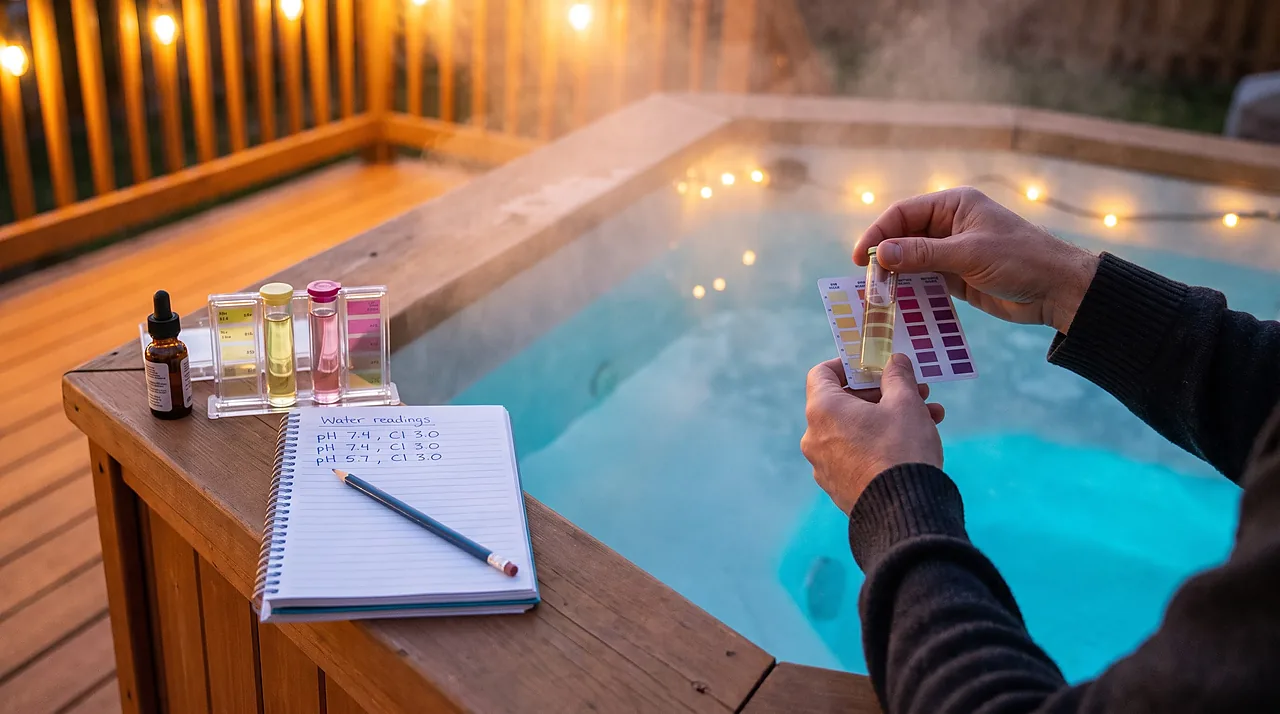
Low TA (usually under 80 ppm) shows up as pH that won't stay put, water that looks slightly hazy, and sometimes a metallic taste or the beginning of etching on plaster or acrylic surfaces as the water pulls minerals out of anything it touches. High TA (over 120 to 130 ppm) shows up differently: pH creeps upward on its own and gets stubborn to bring back down, scale starts forming on the shell and heater element, and the water can look cloudy even with sanitizer reading fine. A test strip or liquid kit reads both numbers in under a minute, and that reading always comes before touching either chemical; see how to test hot tub water correctly for the method that avoids a false reading from an old strip or a dirty sample cup.
- TA under 80 ppm, pH won't hold
- What's actually wrong: Not enough buffer. Fix first: Raise TA with baking soda. Then check: pH usually settles on its own within a day; adjust separately if not.
- TA over 120 ppm, pH creeping high
- What's actually wrong: Too much buffer, water resists downward correction. Fix first: Lower TA with dry acid + aeration. Then check: pH after TA settles in the 80-120 band.
- TA in range, pH still off
- What's actually wrong: Genuine pH problem, not a buffer problem. Fix first: Adjust pH directly. Then check: See balancing pH.
- Both TA and pH high
- What's actually wrong: Overcorrected increaser dose or fresh fill water. Fix first: Lower TA with acid; aerate to bring pH back partway. Then check: Fine-tune pH last.
How to raise alkalinity: it's baking soda, not a mystery powder

Every bottle labeled "alkalinity increaser," "alkalinity up," or a brand-specific name on a spa store shelf is sodium bicarbonate. That's baking soda, the same box in the grocery store's baking aisle. The manufacturer Arm & Hammer states it plainly: adding it "will raise both the pH and the alkalinity, improving stability and clarity," with no separate hot-tub formulation involved. There's no premium chemistry in the branded version, just a markup.
The dosing math scales down cleanly from the standard pool rule. About 1.5 lb of baking soda per 10,000 gallons raises TA by roughly 10 ppm. Scaled to a 100-gallon volume, that works out to a touch under half a tablespoon per 10 ppm of rise. A 350-gallon hot tub sitting at 60 ppm that needs to reach 100 ppm (a 40-ppm climb) needs roughly seven tablespoons, call it a scant half cup, dissolved in a bucket of warm water first and poured in near a running jet.
Do the price math once and the markup stops being invisible. A one-pound box of plain baking soda runs about a dollar at a grocery store. A branded two-pound spa alkalinity increaser commonly runs $12 to $16, verify current pricing where you shop, which works out to roughly six to eight dollars a pound for the identical compound. On the seven-tablespoon dose above, that's about $0.21 to $0.22 in grocery-store baking soda versus roughly $1.25 to $1.70 in the branded jar. Neither one works better; sodium bicarbonate doesn't know which container it came out of.
- Plain baking soda, grocery store
- Typical package: 1 lb box. Rough cost per lb: about $1.00. Cost for a 40-ppm raise (350 gal): about $0.21-0.22.
- Branded "alkalinity increaser," spa/pool store
- Typical package: 2 lb jar. Rough cost per lb: about $6-8. Cost for a 40-ppm raise (350 gal): about $1.25-1.70.
After adding it, run the jets for 20 to 30 minutes to circulate fully, then wait a few hours before retesting. Because baking soda nudges pH upward slightly along with TA, per Arm & Hammer's own product note, check pH again once TA settles rather than adjusting both at the same time; the deeper walkthrough for that half of the equation lives at getting pH itself dialed in.
How to lower alkalinity: acid first, then aeration

Lowering TA takes an extra step that raising it doesn't, because the same chemical that pulls TA down also drags pH down with it, often past the point you actually want. The two chemicals that lower TA are muriatic acid (liquid) and sodium bisulfate, sold as dry acid. Products sold as "alkalinity decreaser" or "pH decreaser" for spas are usually this same dry acid, so one product does both jobs. Trouble Free Pool's water-chemistry methodology, widely followed across the hobbyist and service side of the industry, lays out the fix for the pH overcorrection: bring TA down with acid, let pH crash low as an expected side effect, then aerate the water to bring pH back up without re-raising alkalinity.
Here's the sequence, worked for a 350-gallon spa reading 150 ppm TA that needs to come down to about 100 ppm, a 50-ppm drop:
- Test first. Confirm both TA and pH before adding anything; a reading taken right after someone used the tub, or from an old open strip, will send you dosing against a number that isn't real.
- Calculate the dose. Dry acid lowers TA by about 10 ppm per 2 lb per 10,000 gallons. Scaled to 350 gallons, that's roughly 1.1 oz of dry acid per 10-ppm drop. A 50-ppm drop calls for about 5.5 oz total, and that amount should be split into two doses rather than added all at once.
- Add it with the pump running, pouring slowly near a return jet so it disperses instead of pooling on the floor of the shell, where a concentrated puddle of acid can etch acrylic or damage a liner.
- Circulate 30 minutes, then wait 4 to 6 hours before retesting. TA drops; pH drops with it, often down into the 6.8 to 7.0 range. That's the expected result of this step.
- Aerate to bring pH back up without touching TA. Point return jets at the surface, run an air blower or a submersible air stone, or simply leave the cover off with the jets on for a few hours. Agitating the water lets dissolved carbon dioxide escape, and as it does, pH climbs back toward normal on its own, while TA stays right where the acid left it.
- Retest both. If TA is still above 120 ppm, repeat the acid-and-aerate cycle in smaller steps rather than trying to close the whole gap in one dose.
- Fine-tune pH last, once TA is sitting in the 80-120 ppm band and holding steady on its own.
Can you lower it without acid?
No chemical-free way exists. Aeration alone raises pH but leaves TA where it is, which is why it pairs with acid. The only other route is a partial drain and refill, which works when the fill water itself tests lower in alkalinity.
Never handle dry acid and chlorine or bromine products in the same scoop, bucket, or storage shelf, and never add more than one chemical to the water at a time. Mixing dry pool and spa chemicals, acids with chlorinating granules especially, is a genuine fire and reaction hazard on the product labels, not a theoretical one. Wear the gloves and eye protection the label calls for, work in a ventilated area, and let each chemical fully dissolve and circulate before the next one goes in.
Is it safe to soak while alkalinity is off?
Slightly high or low TA is not a health hazard on its own. The trouble is comfort and equipment: high pH that comes with high TA can irritate eyes and dry the skin and makes chlorine work poorly, while low TA lets pH swing and turns the water corrosive to metal parts. If pH is far out of the 7.2-7.8 range or sanitizer is below 3 ppm, fix that before getting in.
What this actually solves, and what it doesn't
Getting TA into range stops the daily chase. pH holds where it's set, sanitizer works the way the label promises instead of getting eaten alive by pH swings, and the shell, heater, and jets stop taking the slow damage that comes from water constantly out of range in one direction or another. It won't fix a pH problem that exists independent of TA. If alkalinity is already sitting comfortably at 80 to 120 ppm and pH still refuses to settle, the issue has moved past this buffer question entirely. The next step is a direct pH walkthrough; more acid or increaser at this point would only be aimed at a number that's already fine.
The broader picture, how alkalinity fits alongside sanitizer, calcium hardness, and the rest of the water-balance chain, is covered in the full water chemistry rundown, worth a look if TA is only one of several numbers reading off right now.