Stand in the pool-chemical aisle for the first time and you'll walk out with a full cart and no idea what half of it does. Clarifier, enzyme, scale inhibitor, scent beads, a "perfect balance" starter kit, three kinds of shock. A new owner staring at that shelf, or at a bucket of leftover bottles from the last owner, usually says some version of the same thing: it's a ton of different chemicals, and it's kind of overwhelming. It doesn't need to be. A hot tub runs on four or five real chemicals. Everything else is optional, and some of it is just markup on stuff you already own.
The honest shortlist

Every spa, regardless of brand or size, needs a way to sanitize the water, a way to oxidize what the sanitizer misses, two adjusters to keep the water from attacking your skin or your equipment, and a way to check all of it. That's the entire list, five categories in total.
- Sanitizer
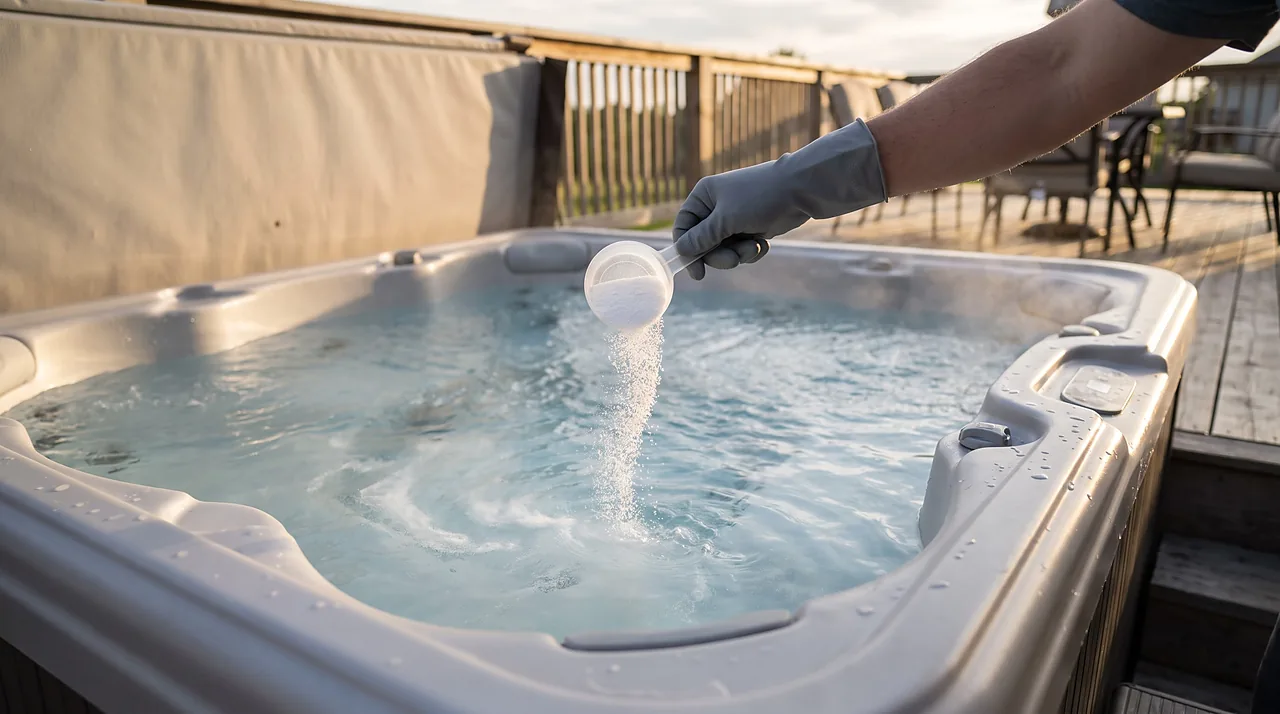
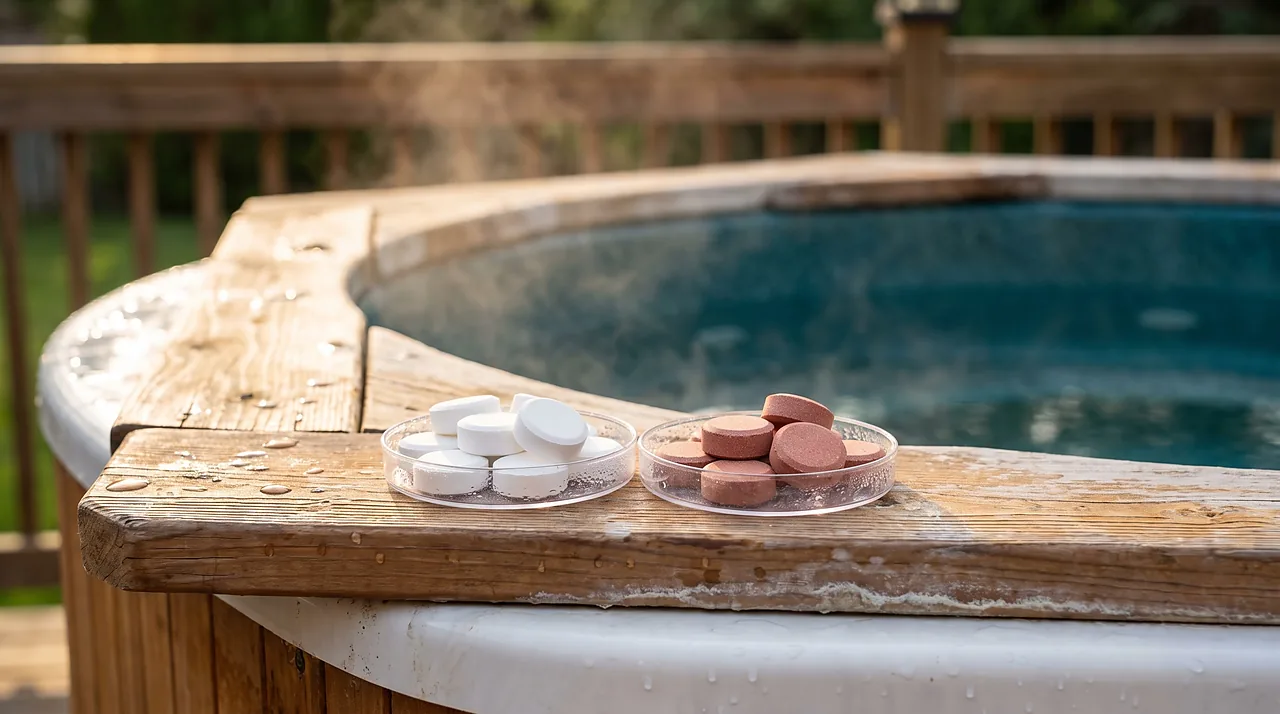
- What it does: Kills bacteria and viruses continuously. Common form: Dichlor granules, bromine tablets, or a salt/chlorine generator. Skip it?: No. Non-negotiable.
- Shock (oxidizer)
- What it does: Burns off body oils, lotion, and combined chlorine so the sanitizer keeps working. Common form: Non-chlorine (potassium monopersulfate) or a chlorine dose big enough to hit breakpoint. Skip it?: No. Water goes cloudy and smelly without it.
- pH adjuster
- What it does: Keeps water 7.2-7.8 so it doesn't sting eyes or corrode metal. Common form: pH increaser (soda ash) or pH decreaser (dry acid / sodium bisulfate). Skip it?: No, but you may only need one direction most fills.
- Total alkalinity (TA) adjuster
- What it does: Buffers pH so it stops swinging after every dose. Common form: Alkalinity increaser. Skip it?: No, and it's plain baking soda, sodium bicarbonate, at a markup.
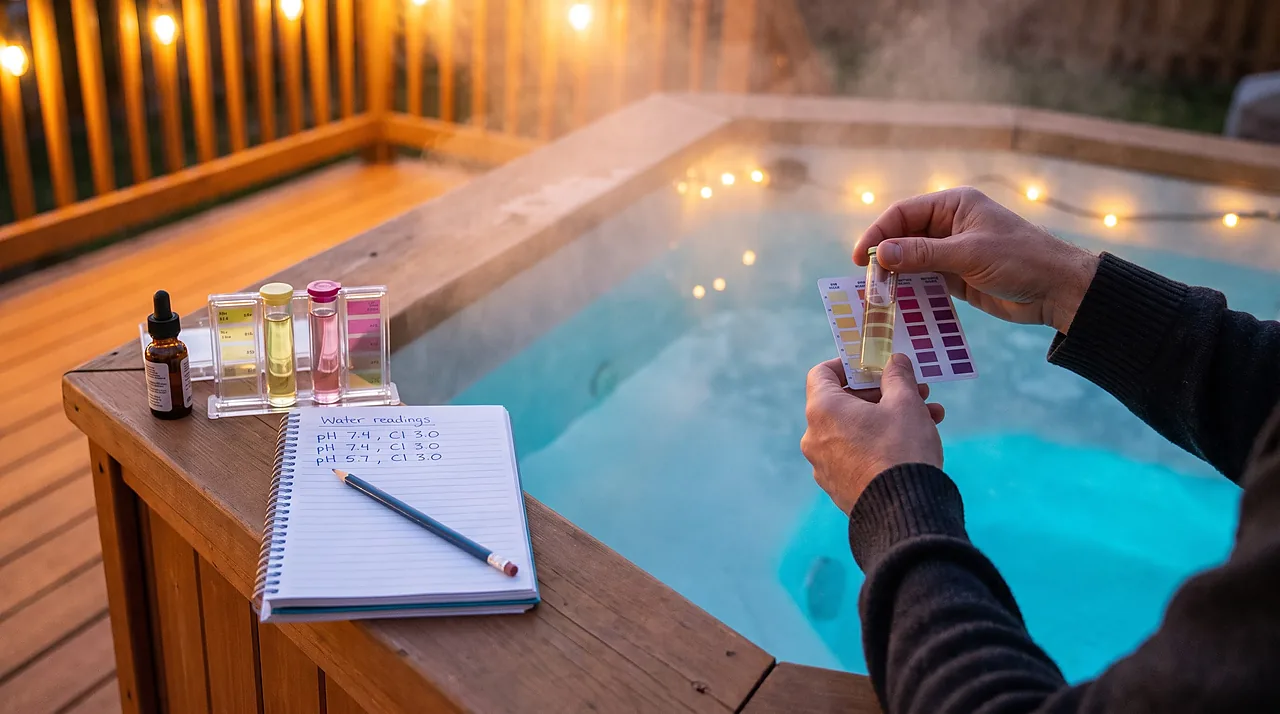
- Test strips or a liquid kit
- What it does: Tells you what to dose and how much. Common form: 5-way strips or a drop-based kit. Skip it?: No. Guessing wastes chemical and time.
That's the whole non-negotiable list. If you own those five things and a bottle of the right sanitizer, you can run a spa indefinitely. Which sanitizer and how to read your test results is its own topic; the full breakdown of chlorine versus bromine and how each behaves in a small, hot body of water lives at bromine vs chlorine for a hot tub, and the numbers behind every one of these five ranges are laid out at hot tub water chemistry, explained.
For most owners these basics run about $20-40 a month, depending on tub size, use and sanitizer (prices change, so check current ones). An inflatable spa needs the same list at smaller doses, see inflatable hot tub care.
The upsell shelf, rated honestly
Retailers stock a second wall of bottles that promise to fix things the five basics already handle, or that solve a problem you probably don't have yet. Here's where each one actually stands.
- Clarifier: Coagulates fine particles so the filter can catch them. Genuinely useful for water that's cloudy from suspended debris rather than a chemistry problem, but it's a band-aid. If the water clears and clouds right back up, the underlying issue is usually chemistry or a dirty filter that another dose of clarifier won't fix.
- Enzyme treatment: Breaks down oils, lotions, and other organics before they turn into scum lines or eat up your sanitizer. Worth it for a heavily used tub or one that runs foamy; skippable on a lightly used spa that's shocked on schedule.
- Scent / fragrance beads: Pure cosmetics. Some scented products also carry a mild clarifier or softener, but the fragrance itself does nothing for sanitation or balance. Buy it because you enjoy the scent, purely a personal preference call.
- All-in-one "perfect balance" packets: Convenient for a brand-new owner who wants to start somewhere, expensive per dose compared to buying pH up, pH down, and alkalinity increaser separately once you know your numbers.
- Metal sequestrant / stain-and-scale control: Genuinely earns its keep on well water or fill water with iron, copper, or high calcium; skip it if your tap water tests clean.
- Calcium hardness increaser: Situational, not upsell: needed when the fill water is soft or comes through a home softener and calcium hardness tests below 150 ppm, since low-calcium water pulls calcium from the heater and fittings; skip it if your fill water already tests in the 150-250 ppm range.
- Filter cleaner / degreaser: Not a water-chemistry product at all, but a real one. A saturated filter is a common reason chemistry won't hold no matter how carefully you dose.
Nothing on that second list is a scam exactly. Most of it does what the label says. It's just optional, situational, or a repackaged commodity chemical sold at a hot-tub markup.
Setting up a fresh fill

A brand-new fill, or the first fill after a drain, goes in a specific order because each step depends on the one before it. Skip the order and you'll waste chemical fighting a number that was never the real problem.
- Fill the tub and let the pump run and the heater bring it to temperature before testing anything. Cold, unmixed water gives false readings.
- Test total alkalinity first and adjust it into the 80-120 ppm range with alkalinity increaser (baking soda) or a small acid dose if it's high. TA is the buffer that keeps every later adjustment from bouncing.
- Test and adjust pH into 7.4-7.6, the comfortable middle of the 7.2-7.8 range, using pH increaser or decreaser.
- Test calcium hardness; if it is below 150 ppm (common with softened water), raise it toward 150-250 ppm with calcium increaser before adding sanitizer.
- Add your sanitizer and let it establish a baseline, usually 3-5 ppm free chlorine or bromine, before anyone gets in.
- Run a first shock dose even on brand-new water. It oxidizes any organics introduced during fill and gives you a clean read on how the sanitizer is holding.
- Test again in 24 hours. Fresh water shifts fast in the first few days as the fill water off-gases and the shell absorbs a bit of chemical; don't judge stability from day one.
If you're running dichlor as the sanitizer, know its one real drawback going in. Dichlor adds cyanuric acid every time you dose it, roughly 0.9 ppm of CYA for every 1 ppm of free chlorine added. In a 400-gallon spa dosed daily to replace consumed chlorine, that CYA climbs fast, sometimes into the 30-50 ppm range within three or four weeks, and CYA that high starts blocking chlorine's effectiveness even when the test strip still shows sanitizer present. The common fix among spa techs is a dichlor start, then a permanent switch to unscented liquid bleach once CYA reaches a reasonable level, since bleach adds none. A full walkthrough of that sequence and how to shock correctly either way is at how and when to shock a hot tub.
The one combination you never mix

Every other chemical decision here is about water quality. This one is about physical safety, and it doesn't bend for convenience. Never combine chlorine and bromine granules, whether that's pouring one on top of the other in the tub, storing them in the same feeder, or even letting the dust from one container settle near an open container of the other. The EPA's chemical safety alert on pool and spa chemicals is direct about what happens: intentional or accidental mixing of incompatible sanitizer chemicals can generate enough heat to ignite nearby combustible material, and it can release toxic, corrosive gas. The same goes for two different dry chlorine types: never let trichlor and dichlor touch in dry form.
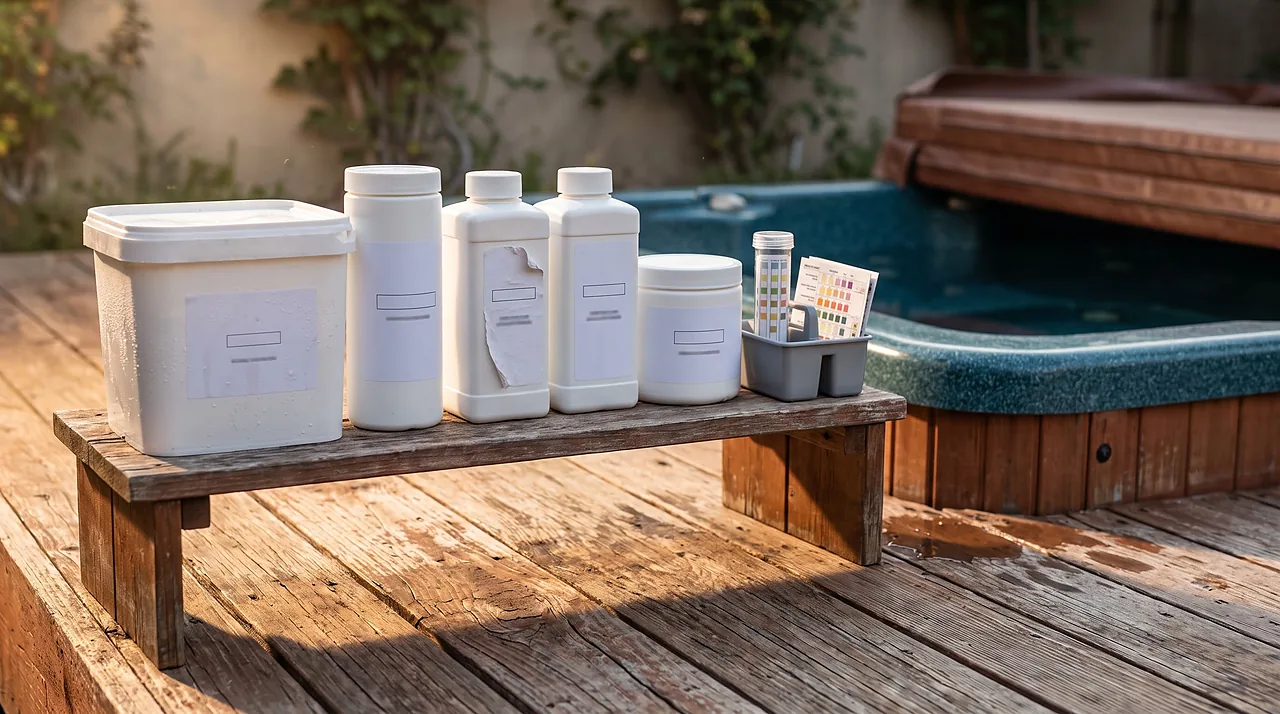
Store each sanitizer in its own sealed, labeled container, in a dry, ventilated spot away from the other. Use a dedicated scoop for each chemical and never let a scoop that touched one type dip into the other without a rinse. Going from bromine to chlorine needs a full drain and refill because bromide stays in the water, while chlorine to bromine is the forgiving direction; in both cases never put the new product into a feeder or container that held the old one. The full comparison of how chlorine and bromine actually behave, and why some owners switch between them, is at bromine vs chlorine for a hot tub; the mechanics of doing a clean changeover live at how to drain and refill a hot tub.
How much to actually put in the water
Every number above is a target range, not a dose. How many ounces of pH decreaser or how many scoops of shock a given number actually takes depends on your spa's gallon count, its current reading, and which brand of chemical you're holding, since concentration varies by manufacturer. Rather than guess or eyeball a pool-sized scoop into a 300-gallon spa, run your own numbers, current test result, target range, and your tub's actual gallons, through the dosing calculator at hot tub water chemistry, explained before you add anything.
Frequently asked questions
What if my fill water already tests in range?
It happens, especially with soft municipal tap water, and it doesn't mean you can skip the adjusters entirely. Test again after the water has circulated for a few hours and the heater has brought it up to temperature; heating drives off dissolved gases and can push pH up half a point or more on its own, and a spa's aggressive jet action aerates the water in a way a still bucket sample never showed. Keep the pH and alkalinity bottles on hand even if day one looks perfect. You'll very likely need at least one small correction once the water has fully mixed and warmed.
Can I use pool chemicals in my hot tub?
Some, like dry acid, soda ash, and baking soda, are identical chemicals regardless of container and work fine at spa-scale doses. Pool-strength trichlor tablets are generally a poor fit for spas: they're highly acidic, add cyanuric acid fast in a small volume of hot water, and most are sized for dosing thousands of gallons, well above a typical few-hundred-gallon spa.
I inherited a tub with a shelf of half-used chemicals. What's actually usable?
Test strips or a liquid kit are fine to keep as long as the bottle or foil pouch is still sealed; reagents that have been open to air for a year or more can drift and give false readings, so treat a fresh set as cheap insurance if you're unsure. Granular sanitizer and shock lose potency once a lid has been left loose or the container has taken on any dampness, so if a dose doesn't move your test result the way it should, that's a sign the product is spent rather than a sign you're doing the math wrong. The one hard rule: never keep or use anything that's unlabeled or missing its lid. You can't verify what it is or whether it's been contaminated, and the risk of an accidental cross-mix with a different sanitizer family makes an unmarked container worth throwing out rather than guessing with.