Someone hands you a bag of granules and says "just shock it" and walks away. No dose, no timing, no explanation of what the powder even does. That gap is the whole problem: shocking a hot tub is not one action, it is two different jobs that use two different products, and doing it on a guess wastes chemical, wastes money, and still leaves the water hazy.
Shock means oxidizing the organic gunk in the water: body oils, sweat, cosmetic residue, sunscreen, and the dead cells and bacteria your sanitizer already killed but hasn't broken apart yet. A sanitizer like chlorine or bromine keeps killing new germs every hour. Shock is the separate step that burns up what's already floating there so the water stays clear and the chlorine you add keeps working instead of getting eaten by junk.
The two kinds of shock, and why they are not interchangeable
There are really only two shock chemicals worth using in a residential spa: dichlor (a chlorine-based granule) and MPS, short for potassium monopersulfate, a non-chlorine oxidizer. They read as similar on a shelf label. They are not the same job.
Dichlor shock is a chlorine compound. Dosed high, it does two things at once: it oxidizes the contaminant load AND it raises your sanitizer residual, since dichlor is still chlorine. That double duty is useful right after a soak session with several people in the water, when you want both a burn-off and a chlorine boost.
MPS works differently. As the International Code Council's technical write-up on the chemical puts it, potassium monopersulfate "is not a sanitizer or algaecide and must be used in conjunction with an EPA-registered sanitizer." It oxidizes through what the same source calls "active oxygen," reacting with contaminants without adding any chlorine at all. That means MPS shock does not touch your sanitizer level up or down. It only clears the organic load, and because it never forms chloramines, it carries none of the "chlorine smell" that dichlor shock can produce if your chlorine was already inadequate going in.
- Free chlorine is low or zero AND water needs oxidizing
- Use dichlor shock: Yes, does both jobs. Use MPS (non-chlorine) shock: No, won't rebuild chlorine.
- Chlorine already reads fine but water looks dull or smells "off"
- Use dichlor shock: Will overshoot chlorine higher. Use MPS (non-chlorine) shock: Yes, cleans without spiking chlorine.
- You want to soak again within 30 to 60 minutes
- Use dichlor shock: Usually need hours for chlorine to drop back to range. Use MPS (non-chlorine) shock: Faster re-entry, commonly under 30 minutes once mixed.
- Using bromine as your regular sanitizer
- Use dichlor shock: Can be used occasionally to oxidize (chlorine and bromine don't have to conflict as sanitizers, but never mix the raw granules together). Use MPS (non-chlorine) shock: Preferred, keeps bromine system untouched.
- Building or protecting cyanuric acid level
- Use dichlor shock: Adds CYA every time. Use MPS (non-chlorine) shock: Adds none.
That last row matters more than most owners realize, and it's the reason the "just use dichlor for everything" advice eventually backfires. More on that below.
Which shock to buy for your tub
For a chlorine tub, keep two products on hand. Use dichlor (sodium dichlor, spa-labeled granules) when free chlorine is low and needs a boost, and use MPS for routine cleanup so you do not drive chlorine levels too high or build up stabilizer prematurely.
For a bromine tub, MPS is the usual choice. It oxidizes organic waste and helps reactivate bromide into active bromine without upsetting your sanitizer bank. You can use chlorine shock occasionally if needed, but never mix chlorine granules and bromine granules together in dry form.
For a salt tub, remember that the salt cell generates chlorine on its own. Use MPS for routine oxidizing, or reach for a spa-labeled chlorine shock after heavy bather use. A salt system automates daily sanitizer production, but salt does not remove the need to oxidize accumulated contaminants.
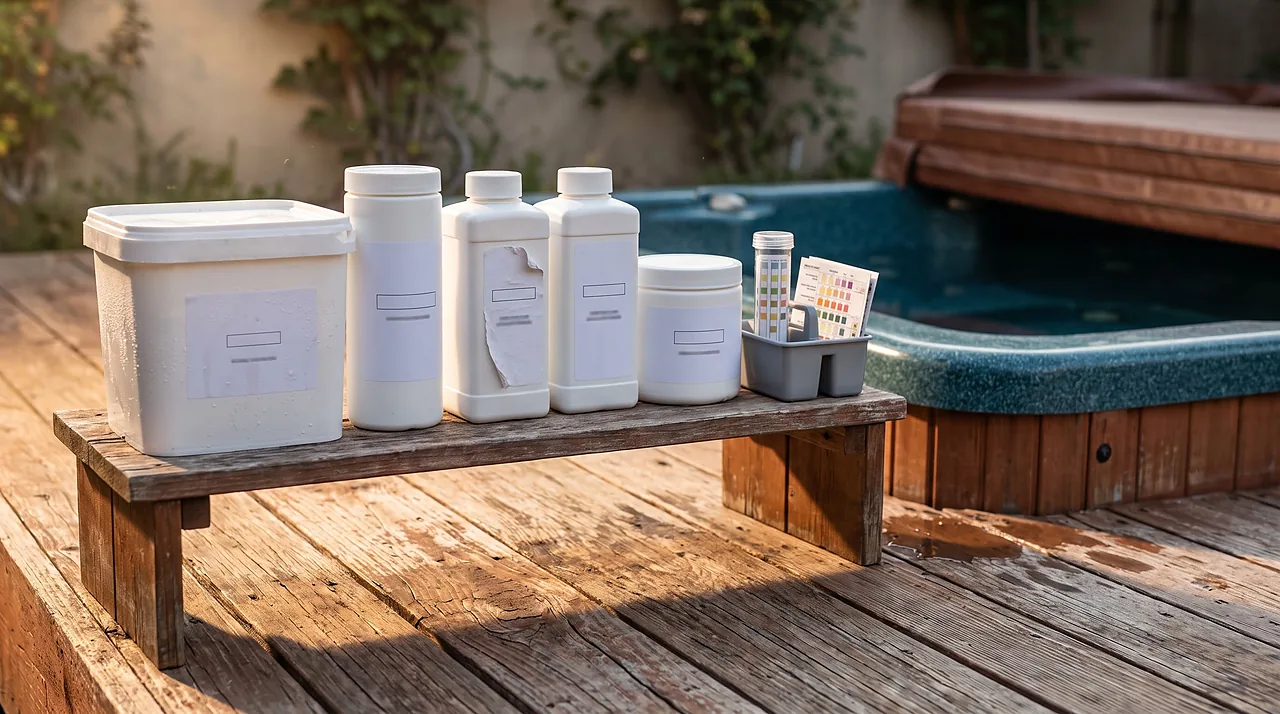
When shopping, read the active ingredient on the label rather than the marketing words on the front. Potassium monopersulfate indicates a non-chlorine oxidizer, often sold as "shock oxidizer." Sodium dichloro-s-triazinetrione or sodium dichlor indicates a chlorine shock. Products labeled as "enhanced" or "dual-purpose" shock use a dichlor or MPS base with added clarifiers or buffers, so the active ingredient still decides what you are adding. Always choose products formulated and labeled specifically for spas or hot tubs rather than large pool shock.
How to tell you actually need to shock

The signal is combined chlorine, sometimes labeled "CC" on a test kit that reads combined chlorine, and it's the number most owners never check. Total chlorine minus free chlorine equals combined chlorine, and combined chlorine is chloramines, the compound formed when chlorine binds to ammonia from sweat and body waste instead of staying free to disinfect. Public-facility rules from the CDC's Model Aquatic Health Code require action once combined chlorine passes 0.4 ppm, and superchlorination (shock) is the first listed remedy. For a residential hot tub, combined chlorine above 0.5 ppm means shock.
Here is the myth worth killing outright: a strong chlorine smell means too much chlorine. It's backward. That smell is chloramines, meaning your free chlorine has been getting consumed faster than you're replacing it, and the fix is more chlorine (via shock), never less. If you want the full breakdown of free versus combined and how to read a test strip correctly, that's covered separately in how free and total chlorine differ.
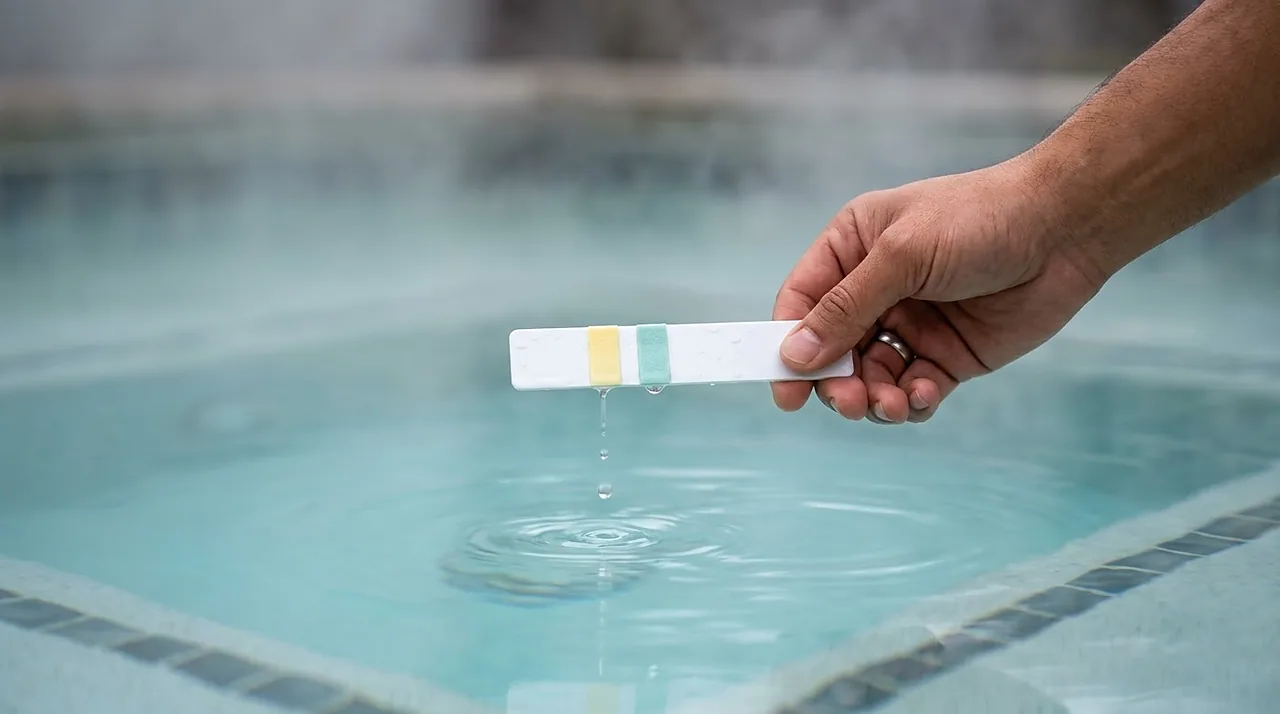
Practical read: test free chlorine and pH before every soak. CDC's guidance for spas sets a minimum of 3 ppm free chlorine with a continuous operating range up to 10 ppm; many owners keep theirs toward the lower-middle of that range, around 3-5 ppm, for day-to-day comfort. Watch the gap instead of chasing a single number: if the water still looks a little dull or hazy, or the strip shows any meaningful gap between total and free chlorine, that gap is what actually tells you to shock, more reliably than the ppm reading on its own.
How much to use and how often
Dosing scales to your spa's actual water volume, and it is on the product label for a reason, since dichlor concentration varies by brand. A common routine for a mid-size 300 to 400 gallon spa runs one to two tablespoons of dichlor granules per shock, dissolved in a bucket of hot tap water first, then poured around the water's edge with the jets running. MPS typically doses similarly by weight per the label, since it isn't fighting a chlorine residual target.
Cadence: shock weekly as a baseline, on the same day you rotate or rinse the filter, since a fresh filter clears out what the shock just oxidized. Add an extra shock any time the tub saw heavy use: a soak with four or five people, anyone who used lotion or hadn't rinsed off first, or two soaks back to back in the same day. Skip the weekly shock and lean only on the sanitizer, and combined chlorine creeps above 0.5 ppm quietly, which is exactly how a tub ends up smelling "like a pool" despite testing "fine" on total chlorine.
Do you really need to shock every week? Weekly shocking is a simple routine that works reliably for most owners. Those who test 2 to 3 times a week can shock only when combined chlorine goes above 0.5 ppm or after heavy use, which is what many forum regulars do. Either way, the test, not the calendar, is the real signal.
The step-by-step: jets, cover, and the wait before you soak

- Test total alkalinity, pH, and free chlorine first, in that order. Total alkalinity is the buffer that keeps pH stable, so bring it toward 80-120 ppm before touching pH; only then adjust pH toward 7.4-7.6. Shock works better and faster once both are in range.
- Remove the cover fully. This is not optional. A shocked tub under a closed cover traps the fumes and off-gasses chlorine or MPS byproducts right back into the foam underside, and it blocks the oxidation reaction, which needs air contact to finish clearing the water.
- Turn the jets on high for a few minutes before adding shock, so the shock disperses instead of pooling in one spot and bleaching a filter or a liner seam.
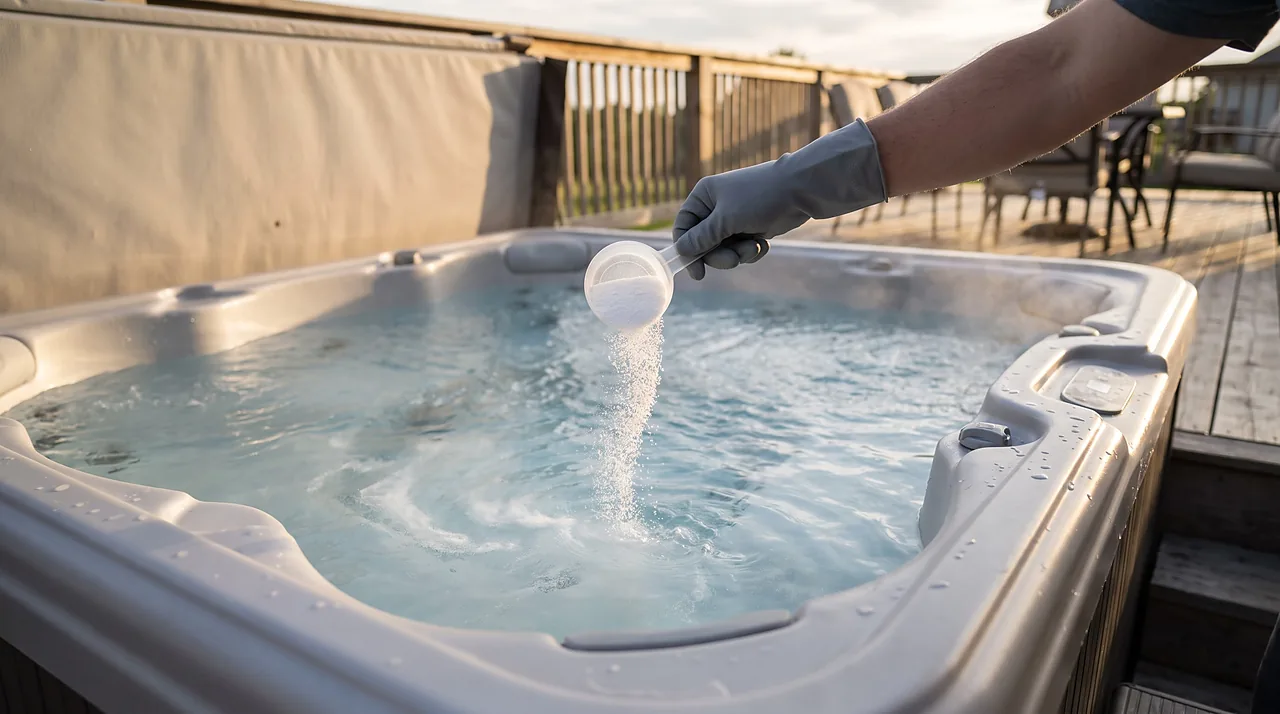
- Pre-dissolve dichlor in a bucket of hot water (this also prevents granules from resting undissolved against acrylic). MPS can typically go in directly per its label, but check yours.
- Pour around the perimeter, away from any single jet intake, with the jets still running.
- Leave the cover off for at least 15 to 30 minutes for MPS, and commonly a few hours for dichlor shock, until free chlorine has drifted back down into the 3-5 ppm range. The label re-entry time is the one number here that genuinely varies by product concentration, so read it.
- Retest free chlorine before anyone gets back in. If it is still climbing or reading far above 10 ppm, wait longer rather than guess.
If the water goes cloudy or milky right after this process instead of clearing, that's a separate and fairly common reaction with its own cause and its own fix, covered on its own rather than solved with a bigger dose. For a general cloudy-water walkthrough beyond the shock step itself, see what actually causes cloudy hot tub water.
The dichlor problem nobody mentions on the bag
Every time dichlor goes into the water, whether as a shock or as daily sanitizer, it leaves behind cyanuric acid (CYA), the stabilizer that shields chlorine from UV breakdown, since dichlor is roughly 50-58% CYA by weight. In a small, hot, frequently re-dosed body of water, that CYA has nowhere to go. It does not evaporate, it does not get consumed, and it does not break down on its own, so it climbs with every dose.
This is not just a slow, seasonal nuisance. CDC guidance goes further and advises against using cyanuric acid, or CYA-containing chlorine like dichlor, in hot tubs and spas at all: even moderate CYA levels can slow chlorine's ability to kill contaminants such as Pseudomonas aeruginosa by roughly a hundredfold compared with CYA-free water. Outdoor pools can tolerate CYA because sunlight otherwise burns off unstabilized chlorine fast; a covered, indoor-adjacent spa doesn't get that tradeoff, so the same stabilizer that helps a pool works against a hot tub. That is a meaningfully stronger caution than "switch eventually". It is a specific reason to be careful about relying on dichlor as your everyday spa chemical from the very first fill, well before a season of buildup even has time to happen.
Trouble Free Pool's community-developed answer to this, often called the dichlor-then-bleach method, treats CYA as a one-time ingredient rather than an ongoing one: use dichlor for the first few weeks to build a modest CYA cushion, then switch every future addition, sanitizer and shock alike, to plain unscented liquid chlorine or bleach, which carries zero CYA. It is a genuinely different long-term habit from "always reach for the dichlor bag," and it is worth understanding before you commit to a shock routine for the whole season. The full walkthrough, including how to test for CYA and when a drain is the faster fix instead, lives in the guide to which hot tub chemicals you actually need.
Safety basics around the bucket
Never combine chlorine granules and bromine granules in the same container, and never mix two different dry chlorine types (dichlor with trichlor, for instance) together dry. Combining concentrated oxidizers can react violently. Add one product at a time, to water, never chemical to chemical. Store dichlor and MPS in their original, separate, labeled containers, away from heat, and keep the lid on tight between uses since both absorb moisture from the air.
Water temperature also affects how shock behaves and how comfortable a wait feels: a spa set anywhere near the 104F ceiling that manufacturers cap at will off-gas shock byproducts faster than a cooler tub, which is one more reason the cover stays open during and right after treatment.
Frequently asked questions
Can I shock and add regular chlorine on the same day?
Yes. Dichlor shock and daily chlorine sanitizing are the same chemical family, just different doses for different jobs. There's no conflict: add the normal chlorine dose once your free chlorine reading has settled back into the 3-5 ppm range, which after a dichlor shock is often later the same day or the next morning.
Do I need to shock a bromine spa?
Yes, bromine spas still accumulate organic waste that needs oxidizing. MPS is the common choice here since it won't disturb your bromine bank, though an occasional chlorine shock is also used by some owners specifically because chlorine oxidizes more aggressively; just never pour bromine and chlorine granules into the same bucket.
Why does the water still smell after I shocked it?
Usually one of two things: the dose was too low to clear the existing chloramine load, so the smell is still combined chlorine, or the cover went back on too soon and trapped the fumes. Retest free chlorine; if it's still low relative to total chlorine, shock again at full dose with the cover off longer.
Is MPS shock safe to use every week instead of chlorine shock?
It's safe, and many owners run MPS most weeks specifically because it doesn't touch cyanuric acid or spike chlorine. It is not a substitute for your regular sanitizer, though; you still need chlorine or bromine actively working in the water between MPS treatments.
Can I use regular pool shock in a hot tub?
Use products labeled specifically for spas. Pool shock is dosed for tens of thousands of gallons and some types are a different chlorine compound, so it is easy to overdose a 300 to 500 gallon spa. Always check the label before adding any shock to your hot tub.