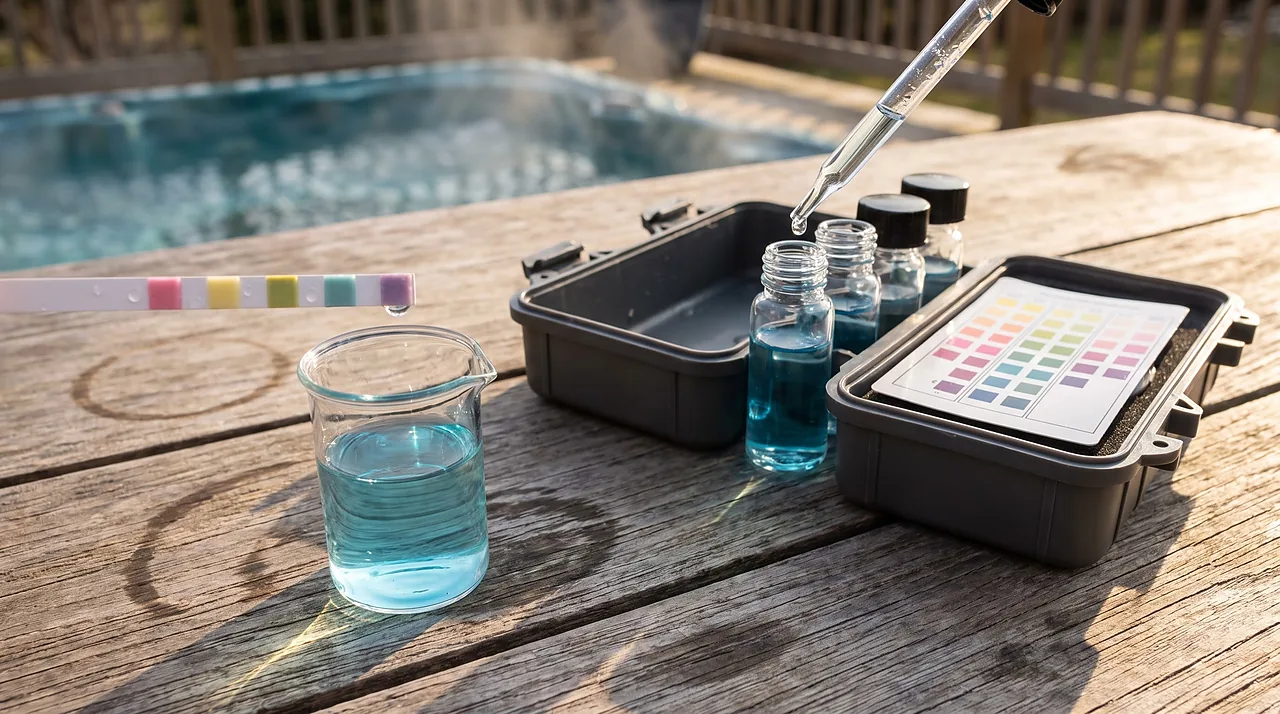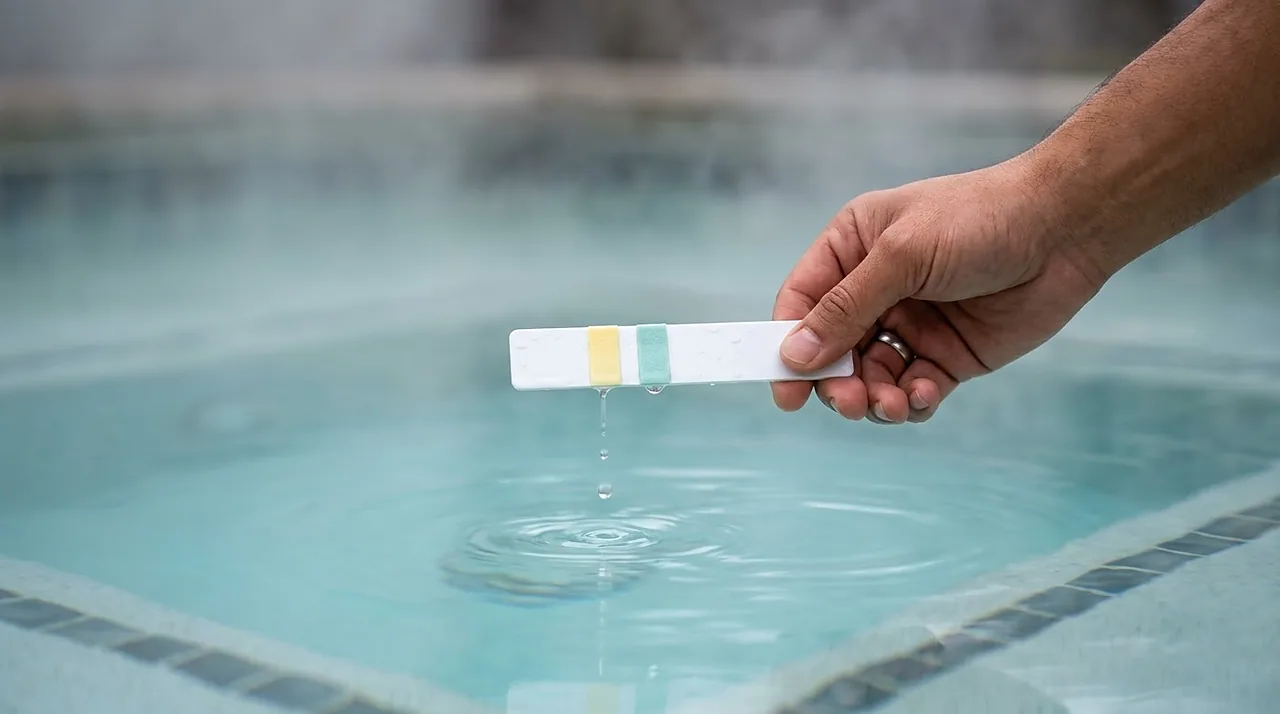
Hold a test strip up to the color chart and read both boxes before deciding anything. Most owners read the bottom box, the total chlorine pad, see a number that looks reasonable, and move on. That's the wrong box to trust on its own. Total chlorine can sit right in range while the water is actually under-sanitized and starting to smell, because total chlorine is made of two very different pieces: the chlorine still working, and the chlorine that already spent itself.
Free chlorine is the part still available to kill bacteria and break down what bathers bring into the water. Combined chlorine is what's left after chlorine has already reacted with sweat, body oils, lotion, and other organic waste; it's a weaker, mostly spent form. Total chlorine is just those two numbers added together. A spa can show 4 ppm total and be in great shape, or show that same 4 ppm total with almost none of it doing any actual sanitizing. The strip won't tell you which situation you're in unless you read free and total separately and do the subtraction yourself.
What each of the three numbers is actually measuring
Free chlorine (sometimes labeled FC) is hypochlorous acid and hypochlorite ion, the active sanitizer molecules. Taylor Technologies, whose reagent test kits are the same chemistry used across the water-treatment industry, describes free chlorine as "the available sanitizer that is ready to combat bacteria and other impurities." The target for a home spa is 3-5 ppm free chlorine; a reading somewhat above that right after a dose is not an emergency, it drifts back down.
Combined chlorine, also called chloramines, is different. It forms after free chlorine has already reacted with nitrogen-containing waste in the water, mostly from bathers. Once free chlorine bonds to that waste, according to Taylor, "it becomes combined chlorine." That combined form is a much weaker disinfectant, mostly along for the ride until it off-gasses or gets broken down. Total chlorine is nothing more than free plus combined, added together with no distinction between them: "total chlorine is the sum of free and combined chlorine."
Here's the arithmetic that turns two strip readings into an actual decision: total minus free equals combined. Test both boxes, subtract, and that leftover number tells you how much of the chlorine in the water has already been used up and turned into the stuff that smells and stings.
The number that decides whether to shock
Combined chlorine is the one with a real trigger point. The Model Aquatic Health Code is a CDC-developed set of codes that most state and local health departments draw from for public pools and spas. It sets 0.4 ppm as the action level for combined chlorine: once combined chlorine passes that mark, the code requires the facility to bring it back down (Council for the Model Aquatic Health Code, citing CDC Model Aquatic Health Code Section 18.3). A home spa isn't running under that code, but the same chemistry applies to a residential tub. Home spa owners commonly use combined chlorine above 0.5 ppm as the signal to shock rather than to just add a small top-up dose.
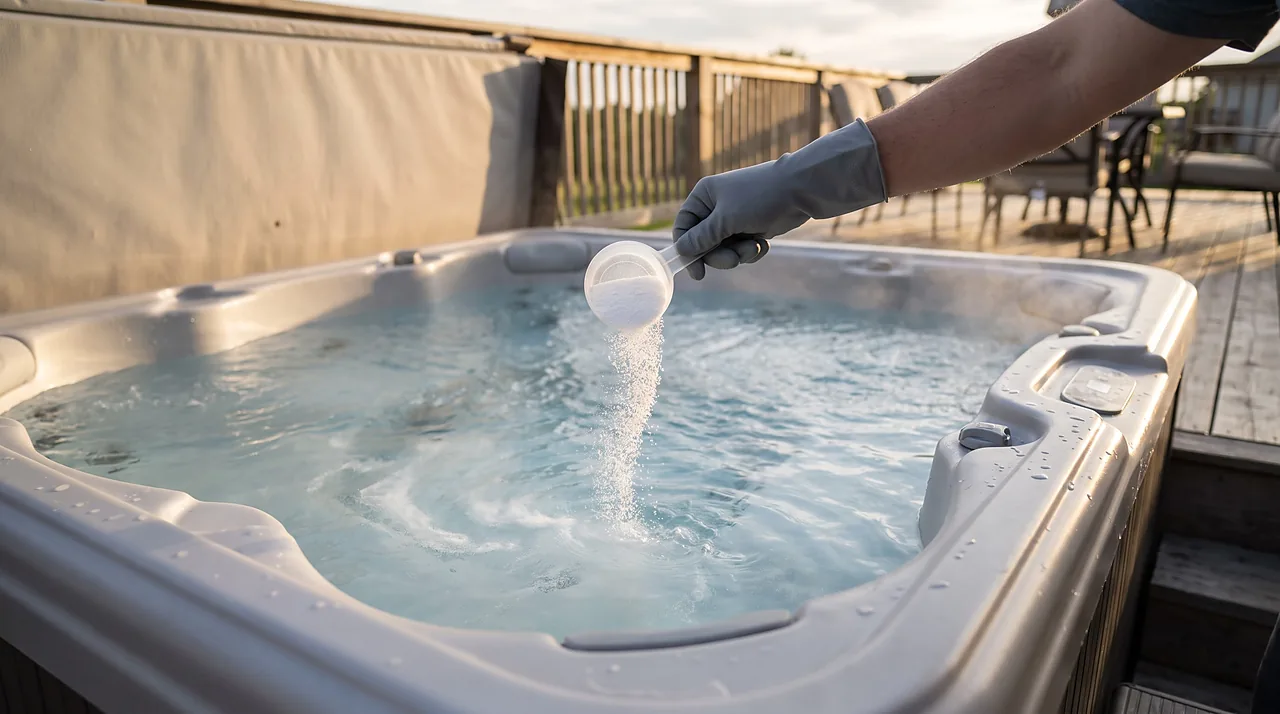
That's a different move from routine maintenance dosing. Shocking means adding enough chlorine, all at once, to push free chlorine well past the combined chlorine level, a reaction called breakpoint chlorination that finishes off the chloramines instead of adding more fuel to them. A small daily dose that barely nudges free chlorine up won't get there; it just adds a little more total chlorine while combined chlorine keeps climbing. The dosing amounts, timing, and how long to wait before getting back in are their own topic, covered start to finish at shocking a hot tub.
Reading the two numbers together
| Free chlorine reading | Total minus free (combined) | What's actually going on | What to do |
|---|---|---|---|
| 3 to 5 ppm | Under 0.5 ppm | Sanitizer is active and chloramines aren't building up | Nothing needed; keep the normal routine |
| 3 to 5 ppm | Above 0.5 ppm | Chlorine is present, but chloramines have passed the home threshold | Shock to breakpoint now, retest the next day |
| Under 2 ppm | 1 ppm or higher | Free chlorine is being outpaced; most of the total is already spent, weak chloramine | Shock to breakpoint, not a small top-up |
| Near zero | High, or total reads deceptively "normal" | The strip's total-chlorine box can look fine while almost none of it is active sanitizer | Shock immediately; treat this as an under-sanitized tub |
Does shock raise free chlorine?
A chlorine shock (dichlor or liquid chlorine) does. A non-chlorine shock (MPS) oxidizes waste but adds no free chlorine. For about a day after an MPS dose many DPD test kits show the MPS as combined chlorine, so retest the next day before deciding to shock again.
Why the "too much chlorine" smell is actually too little
This is the part almost every new owner gets backward. A sharp, eye-stinging chemical smell rolling off the water feels like there's too much chlorine in it. The opposite is closer to the truth. That odor is chloramine off-gassing, and chloramines only build up in quantity because free chlorine wasn't high enough to finish oxidizing the waste bathers introduced. Skipping the next dose "because it already smells like chlorine" actually makes the imbalance worse, since it lets combined chlorine keep accumulating while free chlorine drops even further behind. The strip readings back this up directly: a stinging, smelly tub almost always pairs a low free chlorine number with an elevated combined number. A deeper look at what different odors mean, including the two that have nothing to do with chlorine at all, is at hot tub smells explained.
Where the combined chlorine keeps coming from

Bather load is the biggest daily contributor. Sweat, body oils, lotion, deodorant residue, and even a small amount of urine all react with free chlorine and convert some of it to the combined form, which is why a tub used by four adults for forty minutes needs a bigger response than one that just sat covered all week. Dichlor, a common granular chlorine product, adds a second, slower-moving contributor. Every 1 ppm of free chlorine added as dichlor also adds about 0.9 ppm of cyanuric acid. Unlike chlorine, cyanuric acid doesn't break down or get consumed; it accumulates fill after fill.
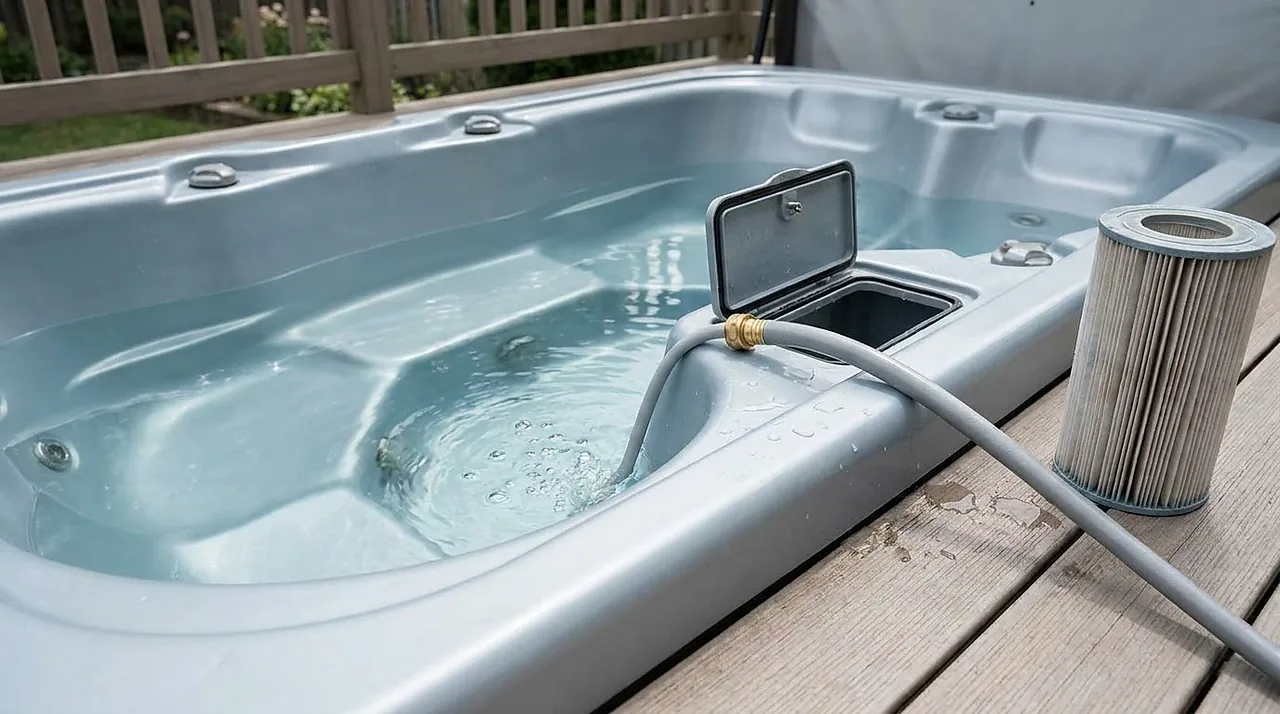
That buildup matters more in a hot tub than in a backyard pool. Montana's Department of Public Health and Human Services, in a fact sheet on cyanuric acid and stabilized chlorine products, notes that even moderate cyanuric acid levels can stretch the time chlorine needs to kill Pseudomonas aeruginosa, the bacteria behind hot tub itch. That slowdown can run to roughly a hundred times longer than in water without cyanuric acid present. It's why that agency specifically advises against using cyanuric acid or stabilized chlorine products in hot tubs or spas. A small volume of water, heated and used often, simply can't absorb that slowdown the way a large pool can. Understanding what cyanuric acid does and how to keep it from creeping up gets its own full treatment at cyanuric acid in a hot tub, and the most reliable reset for both cyanuric acid and combined chlorine buildup is still a scheduled drain, walked through at draining and refilling a hot tub.
A worked example: two spas, the same total reading
Picture two neighbors with nearly identical 315-gallon two-person spas, both testing 4 ppm total chlorine on a Tuesday morning. The first neighbor's strip shows 3.6 ppm free chlorine. Subtract, and combined chlorine comes out to 0.4 ppm, under the 0.5 ppm home threshold. That tub is fine; a normal maintenance dose that evening keeps it there.
The second neighbor's strip shows 1 ppm free chlorine on the same 4 ppm total reading. Subtract, and combined chlorine is 3 ppm, six times the 0.5 ppm home threshold. Both tubs read identically on the total chlorine box. One needs nothing more than routine care. The other needs a full breakpoint shock, a filter check, and probably a look at how many people have been using it and how recently the water was last topped up. Reading total chlorine alone would have missed the second tub's real condition entirely.
Testing it right so the numbers mean something

Strips are only as good as how they're read: dip time, wait time, and reading the pad in real daylight rather than under a phone flashlight all shift the color match enough to misread a 1 ppm difference. A liquid drop-count kit that measures free and total chlorine separately, the same style Taylor Technologies builds its reagents for, gives a more precise split than a strip when the numbers are close to a decision point like the one above. Either tool works for routine checks; what matters is testing free and total as two separate readings every time. The full routine, including how often to test and which method is worth the money for a home spa, is covered at testing hot tub water correctly.