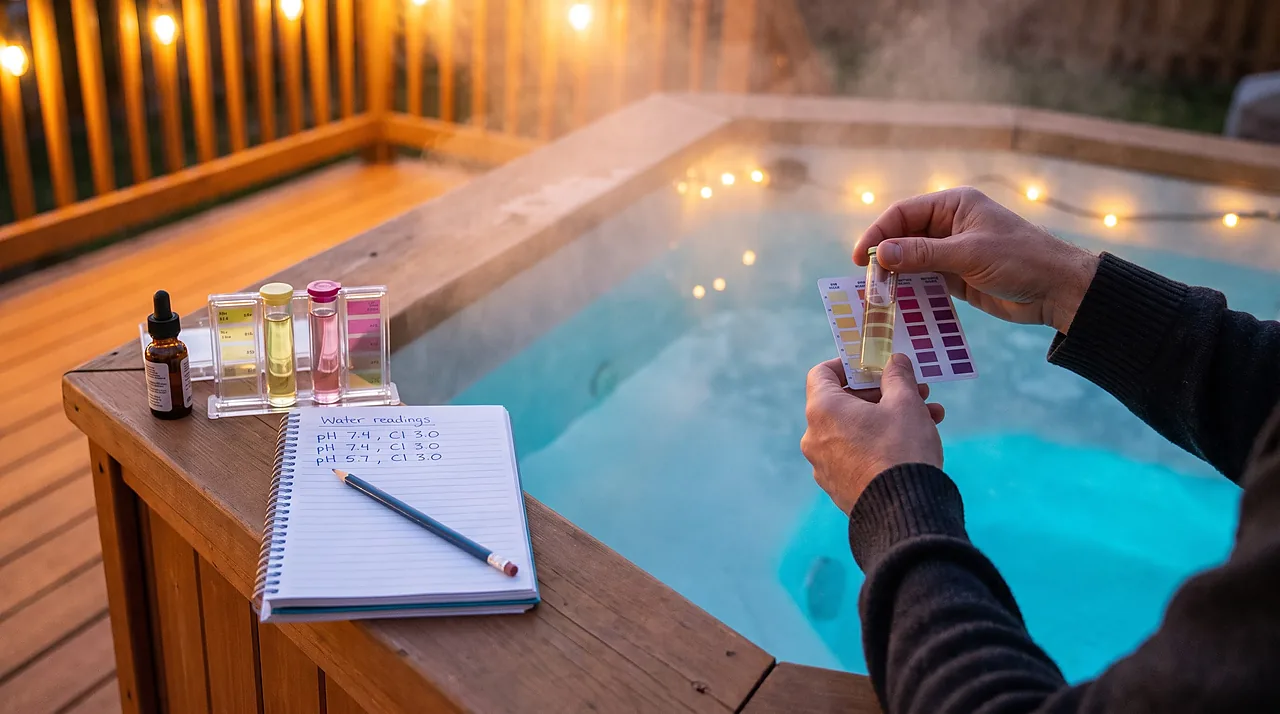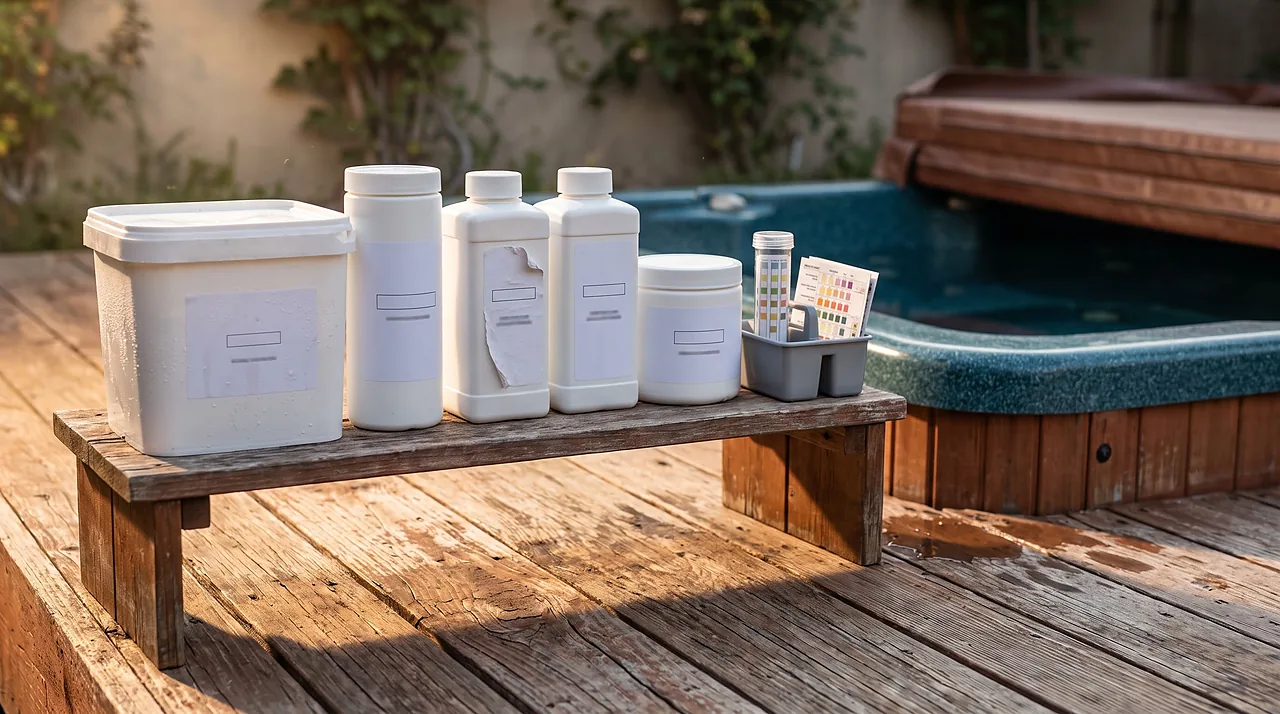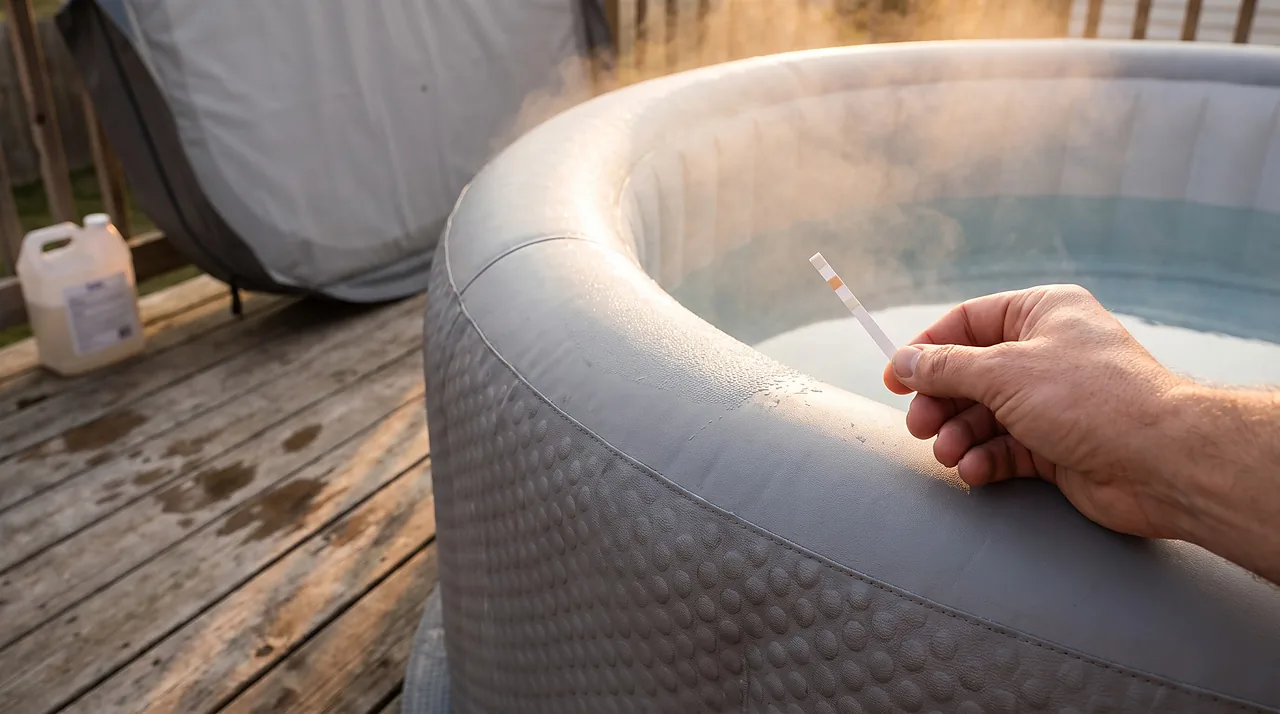
Two hundred and ten gallons. That's the filled capacity Intex lists for one of its most common PureSpa models, and it's a fraction of what most water-balance advice assumes you're working with. Pool stores, generic spa guides, and even a lot of chemical labels are written around a much bigger body of water, so the "one scoop" instructions on the shock jug or the "weekly filter clean" line in a general hot tub article can be off by half or more once you're filling an inflatable, vinyl-sided spa instead of a hard acrylic shell.
The good news: the chemistry itself hasn't changed. Free chlorine still wants to sit in the same window, pH still behaves the same way, and alkalinity still has to get fixed before pH does. What's different is the arithmetic, the filter's workload, and how the pump actually runs, and all three of those change enough that copying instructions written for a bigger tub will leave you chasing cloudy water or a chlorine reading that won't hold. Yes, an inflatable tub needs sanitizer like any spa; warm, still water with people in it grows bacteria fast, and a small volume gets dirty faster.
Why one tub holds half the water of the other
A round, 4-person inflatable spa (the kind sold as an Intex PureSpa or a SaluSpa AirJet model) commonly fills to somewhere between 200 and 300 gallons. Intex's own manual for its SSP-10 model lists a filled capacity of 210 gallons. A similarly sized hard-shell acrylic spa built for the same number of seats generally holds noticeably more, often close to double, since the rigid shell doesn't have to compromise its footprint for portability.
That gap is exactly where trouble starts. A common complaint among inflatable-spa owners looks the same every time: someone followed a "hot tub" dose written for a bigger tub and ended up with chlorine pegged at the top of the test strip, or alkalinity so high the pH won't move no matter how much acid gets added. Manufacturer blogs and most general spa content don't stop to ask how many gallons the reader actually has, which is exactly the question that decides whether a dose is right or badly wrong.
These are the common spa ranges used by the CDC's Model Aquatic Health Code and spa industry guidance, with the 104F ceiling from the CPSC.
- Free chlorine
- Target: 3-5 ppm (code minimum for spas is 3.0 ppm, code ceiling is 10.0 ppm).
- pH
- Target: 7.2-7.8, ideally 7.4-7.6.
- Total alkalinity
- Target: 60-180 ppm code range; most residential guides target a tighter 80-120 ppm band as the practical sweet spot.
- Calcium hardness
- Target: 150-250 ppm for spas (lower than the 200-400 ppm pool range).
- Water temperature
- Target: Never above 104F; typical set point 100-102F.
None of those numbers move for an inflatable tub. What moves is how much product it takes to get there, which is exactly what a half-dose calculation solves. For the full picture of why each of these ranges exists and how they interact, see hot tub water chemistry.
The half-dose method, in one formula

There's no single official gallon count that every chemical label is written for, but a great many granular product labels are scaled around a hard-shell spa somewhere in the 400-gallon range, since that's a common size for that category. Treating 400 as a working baseline gives a useful approximation: your gallons divided by 400, times the labeled amount, gets you close, with testing afterward to fine-tune. A 220-gallon spa gets roughly 55 percent of the label rate. A 280-gallon spa gets roughly 70 percent.
- Find your spa's actual filled capacity first. It's printed on the box, in the manual, or on the manufacturer's product page for your exact model, not guessed from the seating count.
- Do the math once, then write the adjusted amount on a piece of tape stuck to the chemical bottle so you're not recalculating every week.
- When your gallon count falls between two round numbers, round the dose down. Adding a little more sanitizer ten minutes later is easy. Pulling it back out is not.
- Apply the same ratio to shock as well as daily sanitizer: a full-strength shock dose poured into 220 gallons will spike both chlorine and pH at once, since the label assumes a considerably larger volume.
This single adjustment clears up most of the "why won't my chlorine hold" and "why is my alkalinity through the roof" questions that come up around inflatable spas specifically. For a deeper dose-by-dose breakdown of which product does what, the rundown of chemicals a spa actually needs covers the full shopping list, including which ones are genuinely necessary and which are just a marked-up version of something already in the pantry.
Dichlor fills a small tub with cyanuric acid faster than you'd expect
Most inflatable spa starter kits ship with dichlor granules, and for good reason: dichlor dissolves fast and is gentle on vinyl compared to some other sanitizers. The tradeoff is cyanuric acid (CYA), a stabilizer that dichlor carries along with it. For every 10 ppm of available chlorine added as dichlor, roughly 9 ppm of CYA comes along for the ride, and CYA doesn't break down from sunlight or normal chlorine use. The only way to bring it back down is diluting the water.
In a 15,000-gallon backyard pool, that slow buildup can take a full season to matter. In a 220-gallon inflatable spa refilled with dichlor a few times a week, the same math compounds fast enough to push CYA past the point where chlorine stops sanitizing effectively within a couple of months, even while a test strip still shows a chlorine number. This is the single biggest reason a spa that's "being dosed correctly" still ends up cloudy or smelling wrong.
The fix that pool and spa water-chemistry practitioners have used for years, sometimes called the dichlor-then-bleach method, is to lean on dichlor for the initial fill and any top-offs, then switch to plain unscented liquid chlorine (household bleach or pool-grade liquid chlorine, same active ingredient) for ongoing sanitizing once CYA settles around 30-50 ppm. Liquid chlorine adds zero CYA, so day-to-day dosing stops feeding the problem. The mechanics of dosing chlorine correctly at this tub size, including exact ppm targets and how often to test, live in running chlorine in an inflatable spa; the tradeoffs between dichlor and switching to bleach are laid out fully in dichlor versus bleach.
One vinyl-specific habit worth building in here: pre-dissolve every granular dose in a bucket of water before it goes anywhere near the spa. Undissolved granules resting against a vinyl liner can bleach or pit the material in spots, something a hard acrylic shell shrugs off far more easily.
A cartridge filter with less than half the surface area

Inflatable spas run small pleated cartridge filters, typically rated at a fraction of the filtering area built into a hard-shell spa's cartridge. Less media doing the same job means it clogs faster, and Intex's own guidance for these units reflects that: change the cartridge at least every two weeks, with its condition checked weekly in between. A hard-shell spa's larger cartridge, by contrast, often stretches a month or more between full replacements.
- Filter looks fine but water is slightly hazy
- Likely cause: Oil and lotion residue clogging the pleats invisibly. What to do: Rinse now; don't wait for the two-week mark.
- Jet pressure or bubble strength has dropped
- Likely cause: Restricted flow through a loaded cartridge. What to do: Pull and rinse the cartridge before checking anything else.
- Display shows a flow or heating error
- Likely cause: A clogged cartridge is the most common trigger on these units. What to do: Rinse the filter first, then rerun before troubleshooting further.
- Two-week-old cartridge already looks matted
- Likely cause: Heavy bather load or lotion/sunscreen use. What to do: Shorten the replacement interval to match.
Keeping a full spare cartridge on hand and clean is worth doing regardless of what any single manual says: it turns a two-week swap into a thirty-second job, with no delay in running the spa while a replacement dries or gets ordered. If a flow or heating fault ever shows up on the control panel, the filter is worth checking first every time, though the model-specific error codes and what each one actually means deserve their own walkthrough, covered in Intex and SaluSpa troubleshooting and inflatable spa error codes.
The pump isn't running around the clock, so plan the chemistry around that

A hard-shell spa built with a Balboa or Gecko control system typically runs a dedicated low-speed circulation pump close to continuously, keeping sanitizer moving through the water at all hours. Most inflatable spas skip that separate circ pump entirely. The single pump cycles on a built-in timer instead, often a few hours at a stretch, a couple of times a day, and Intex's own support guidance for these units caps active filtering at 8 hours a day while recommending the full volume get turned over once every 24 hours.
That schedule matters for chemistry because sanitizer only gets mixed and circulated while the pump is actually running. Dosing chlorine or shock while the pump sits idle means it can sit on the surface instead of spreading through the water. A simple habit fixes this: set the filter cycle for at least two runs a day, add sanitizer right as a cycle starts so the pump can actually mix it through the water, and stretch runtime longer in hot weather or after a soak with more than a couple of people in the tub.
A frequent question is whether to keep the equipment running all the time. Most owners leave the heater on and the cover on during the season, since a small heater takes many hours to bring cold water back up. If the tub will sit unused for weeks, draining and drying it beats leaving warm water unattended.
A weekly routine sized for a small tub
Picture a two-person household running the spa four evenings a week, with a 235-gallon filled capacity. Here's what a realistic week looks like:
- Test free chlorine, pH, and alkalinity three times a week; test daily on the days the tub gets used. Fix alkalinity first if it's off, then pH, then top off chlorine using the half-dose math above.
- Rinse the filter cartridge every 3 to 5 days, and swap it for a clean spare on roughly Intex's two-week clock.
- Run the filter cycle at least twice a day, adding sanitizer at the start of a cycle, never while the pump is idle.
- Shock at a half-scale dose once a week, or after three or more soaking sessions, whichever comes first, and retest 15 minutes later before deciding on a second dose.
- Wipe the waterline weekly. Vinyl shows an oily scum ring more visibly than acrylic does, and it's easier to remove before it sets.
Cold weather changes several of these numbers at once (run schedule, drain timing, even how fast chemistry drifts), and gets its own full routine in keeping an inflatable spa running through winter. A slow leak throws off every number on this list too, since dilution from added fill water changes the chemistry mid-week without you dosing anything; if the water level keeps dropping between fills, patching an inflatable spa covers finding and sealing the leak before it undoes a week of balanced testing.
How often to change the water
The standard rule of thumb divides spa gallons by 3, then divides by the number of daily bathers to give the days between drains. For the 235-gallon tub with two bathers from the example above, that calculation gives roughly 39 days, so about every 5 to 6 weeks; heavier use means sooner. A small tub hits this sooner than a big acrylic tub.
Water quality can also force an earlier reset. Cloudy water or a chlorine reading that will not hold after a shock is a reason to drain early, and draining and refilling restores clean water when accumulated contaminants keep sanitizer from working.