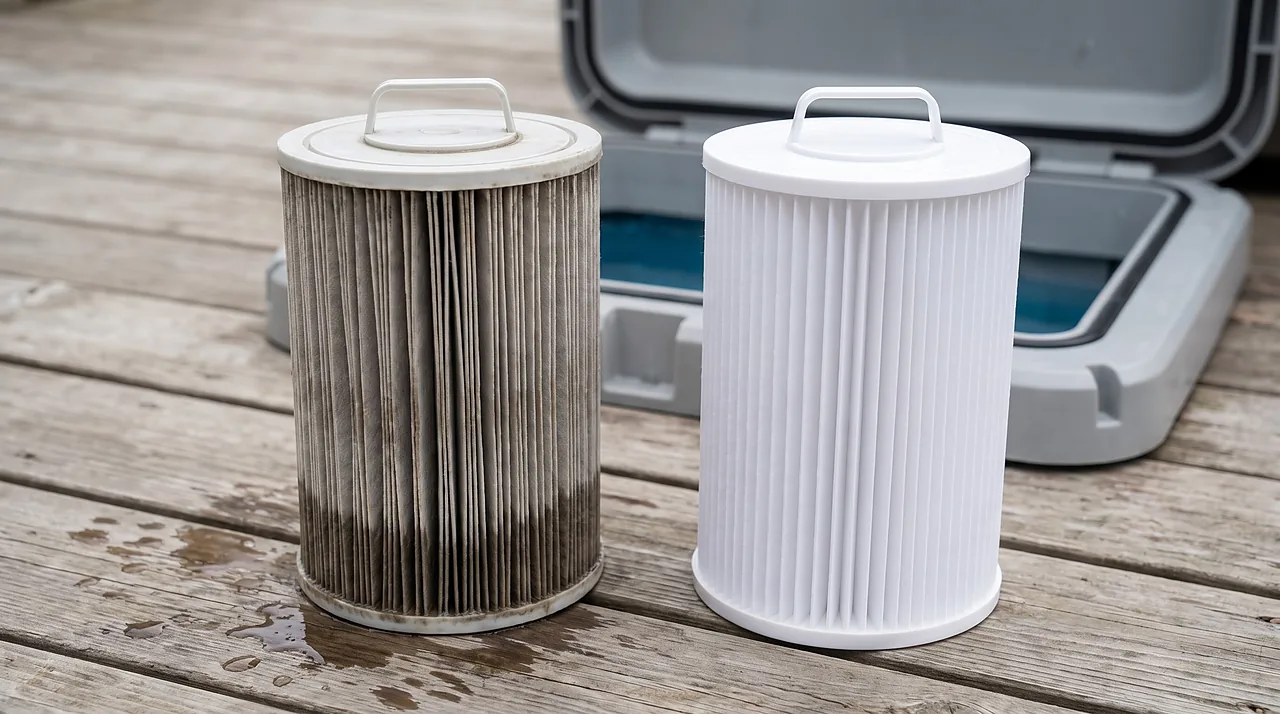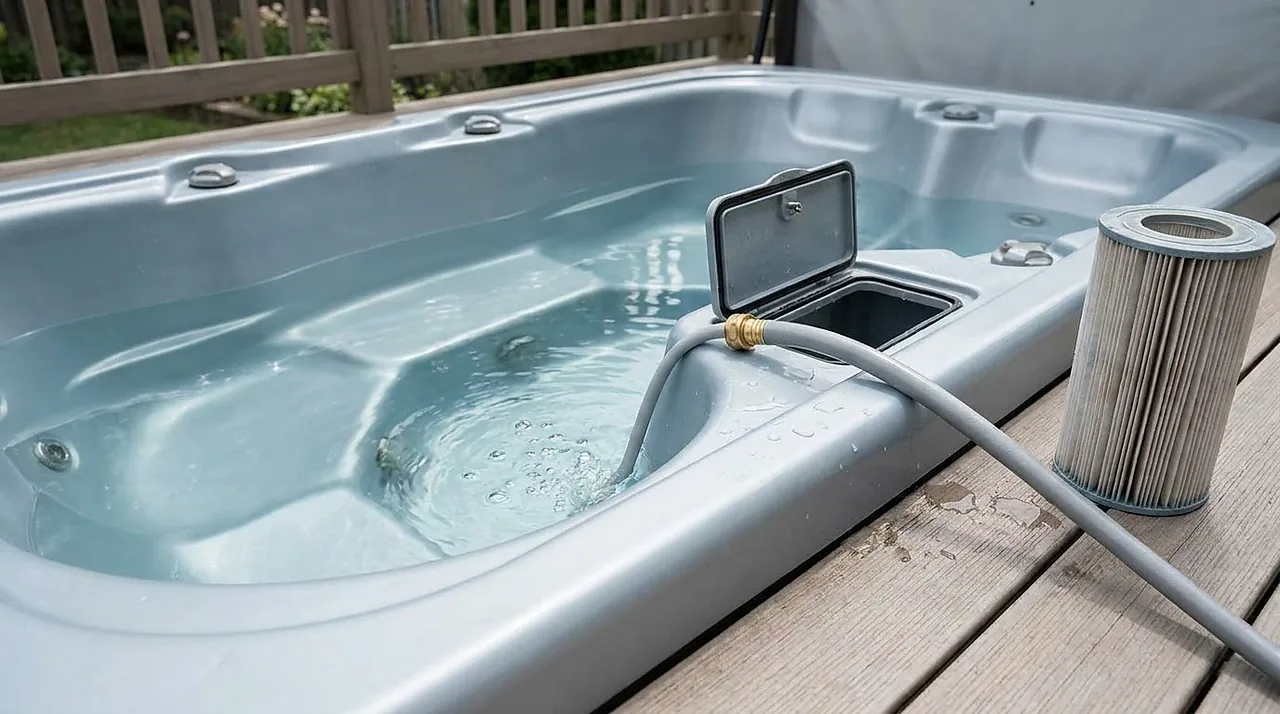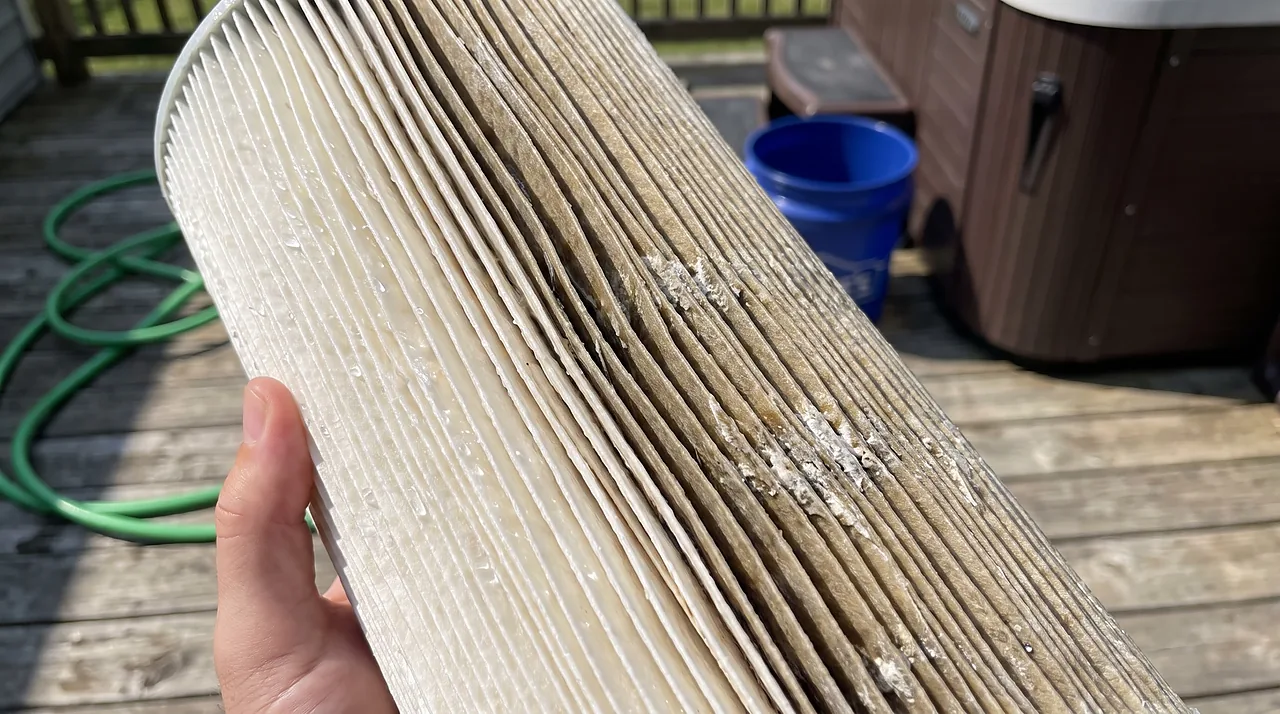
A garden hose gets the leaves, hair, and grit off a hot tub filter. It does almost nothing for the body oils, lotion, and mineral scale soaked into the pleats, and that's the gap that leaves owners hosing a filter every week while the water still turns cloudy by the weekend. The routine that actually works has two separate steps on two separate clocks: rinse the filter every one to two weeks to knock off surface debris, and run it through a real chemical soak about once a month to strip out what a hose can't touch.
Those two steps aren't interchangeable, and skipping the second one is a mistake manufacturer documentation keeps flagging for a reason. A filter that only ever gets rinsed will look clean and still be quietly clogged with oil and scale on the inside of every pleat, restricting flow long before it looks dirty enough to worry about.
Getting the filter out, and back in
Turn the tub off at the panel or breaker first so the pump does not pull debris into the plumbing while the housing is open. Open the filter compartment, usually under a lid or behind the skimmer weir door, and lift out any basket or retaining lid. Most cartridges twist counterclockwise to unscrew, then lift straight up. If it sticks, do not pry on the pleats, and grip the end cap instead. Reinstall by hand-tightening clockwise with no tools, and seat any lid or weir before power goes back on, checking the manual if the layout looks different since models differ.
The two-cadence routine that actually works
Think of it as two different jobs, not one job done twice as often. The weekly rinse is mechanical: pull the filter, hose between the pleats at moderate pressure, and knock loose whatever's sitting on the surface. It takes a few minutes and it's the only step most people ever do.
The monthly soak is chemical, and it's the step that actually restores flow. Body oil, sunscreen, and dissolved minerals bond to the pleated media in a way a hose simply can't reach, and only a soaking cleaner breaks that bond loose. Skip it for a few months and the same filter that "looks fine" is quietly running your pump harder, your heater colder, and your circulation worse than a filter half its age that gets soaked on schedule.
Filter looks clean after a hose rinse, water is still a little hazy
What it means: Oil and scale built up inside the pleats that rinsing can't reach. What to do: Run a full chemical soak now, then keep the monthly schedule.
Filter pleats feel slick or greasy to the touch
What it means: Body-oil and lotion residue coating the media. What to do: Soak overnight; don't wait for the next scheduled cycle.
Water flow from the jets has dropped noticeably
What it means: The filter is restricting flow, possibly enough to trip a flow fault. What to do: Pull and inspect the filter before touching anything else.
Pleats are chalky white or feel gritty
What it means: Mineral scale from hard water clinging to the fibers. What to do: Soak with a scale-rated filter cleaner; check calcium hardness.
Soaking no longer restores flow or color
What it means: The media itself has reached the end of its usable life. What to do: Stop cleaning and replace the filter.
How to run an actual chemical soak

Pull the filter and give it the normal hose-down first, spraying between every pleat from the top down so trapped debris has somewhere to go. Then submerge it fully in a bucket of water mixed with a filter-specific cleaning solution, following the concentration and soak time printed on the product's own label rather than eyeballing it, since dilution ratios vary from one cleaner to the next. Longer soaks generally pull out more embedded oil within the label's recommended range, and there's little downside to leaving it in a covered bucket overnight.
Pull it out, rinse thoroughly from top to bottom until no more suds or discoloration comes off in the water, and let it air-dry before it goes back in. A filter reinstalled while still soapy is how cleaning day accidentally becomes foam day. Any cleaner residue left in the pleats reintroduces the same surfactant problem covered in the cloudy-water guide.
Four things that quietly wreck a filter

Most filters don't fail from age. They fail from someone reaching for the wrong tool on cleaning day.
- Dish soap. It's tempting because it's already under the sink, but dish detergent is built to cut grease on hard surfaces, and its foaming agents cling stubbornly to pleated fiber instead of rinsing cleanly away. A film of it stays behind no matter how long you spray, and the next soak in the spa turns into a foam bomb that has nothing to do with sanitizer levels and everything to do with what's still trapped in the filter.
- The dishwasher. Running a filter through a dishwasher cycle sounds efficient, and it's one of the fastest ways to ruin one. The heated dry cycle runs far hotter than the glued end caps and pleated media are built to handle, and the result is warped, shrunken, or split pleats that never seal against the filter housing correctly again.
- Wire brushing. Scrubbing a stubborn filter with a wire brush or a stiff scrub pad might look like progress, but pleated media is thin and easily crushed. Bristles tear fibers and flatten pleats permanently, cutting the surface area the filter needs to actually catch debris, so a brushed filter often filters worse the day after than it did the day before.
- The washing machine. Agitation and the spin cycle fold and crush the pleats, and laundry detergent leaves the same foaming residue as dish soap.
A spare filter turns soak day into a non-event

Take a household that soaks in the tub most evenings, call it fifteen nights a month, and owns exactly one filter. A monthly overnight soak means one night with no filtration running, or the awkward choice between skipping the soak on schedule and running the tub with a wet filter shoved back in early. Neither is a great option.
Buy a second filter of the same size and rating, and the math changes completely. Clean filter goes in, dirty filter goes into the soak bucket, and there's no night without filtration and no rush to get a filter dry before the next soak. Rotating two filters roughly every other cleaning cycle also means each one spends less total time in the water between deep cleanings, so both last longer. The full rotation schedule, including how to stagger cleaning dates so you're never caught without a spare, is covered in the filter rotation breakdown.
What a clogged filter does to your control panel
On Balboa's TP400 and TP600 topside panels, a restricted filter is a common trigger for the heater's flow-related fault: not enough water is moving through the heater to carry heat away from the element, so the system disables the heater rather than risk damage. A restricted filter is one of the flow restrictions the manufacturer lists as the first thing to check, alongside low water level, closed valves, trapped air, too many closed jets, and pump prime. Pulling a dirty filter and rerunning the system clears the fault in most cases; if it comes back with a clean filter in place, the problem has moved on to the pressure switch, an airlock, or the pump itself, which is its own separate troubleshooting path.
The same firmware is programmed with its own reminders, prompting a filter clean roughly every thirty days and a full filter replacement roughly once a year, which lines up closely with the rinse-and-soak routine above.
When rinsing and soaking stop working
Every filter eventually reaches a point where soaking stops bringing back flow or color, and pushing past that point just means cleaning a filter that's already done its job. Pleated media compresses and its fibers wear down with repeated cleanings the same way any fabric does with repeated washing, and hard-water scale that's baked in over many cycles stops responding to a cleaner no matter how long it soaks.
Replacement roughly every 1-2 years is typical, though a household running heavy bather loads or sitting on hard well water will wear one out faster, and a mineral-rated cleaner can extend that some. When a filter that's been properly rinsed and soaked on schedule still leaves the water hazy, still restricts flow, or still looks gray and matted no matter how it's cleaned, that's the signal to stop cleaning and start shopping, and the filter replacement guide covers picking the right size and micron rating so the new one actually fits.