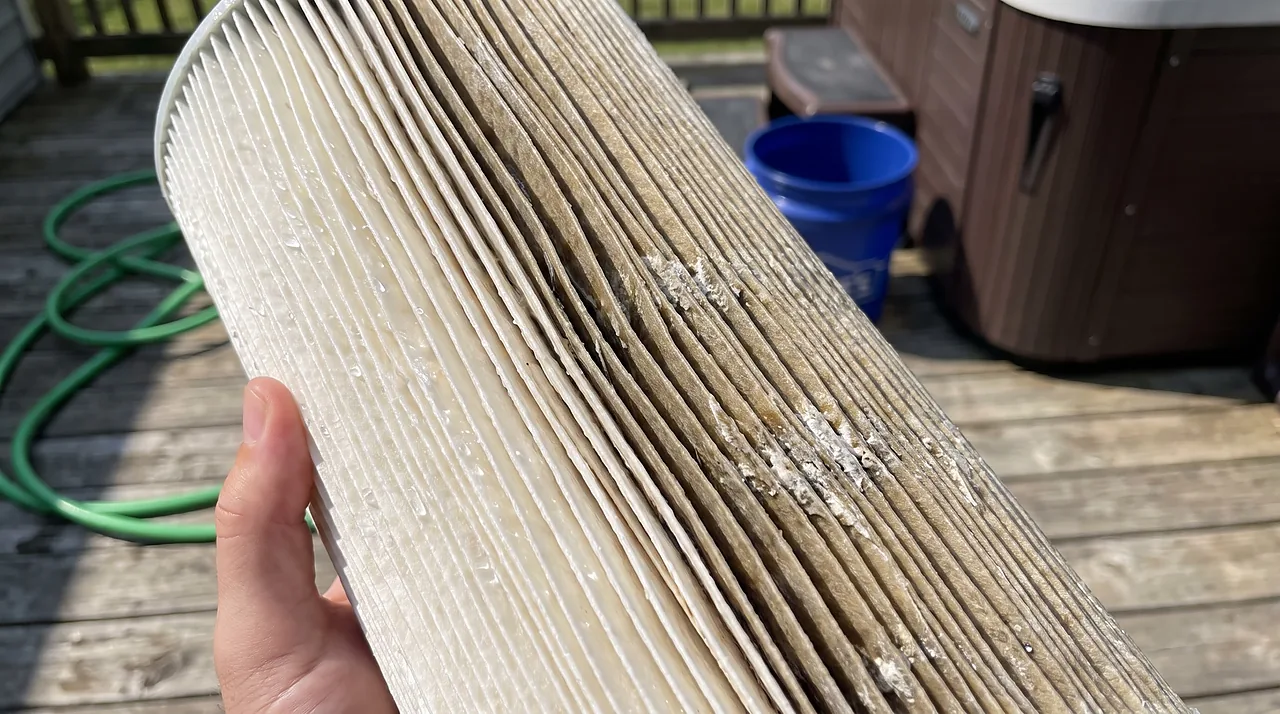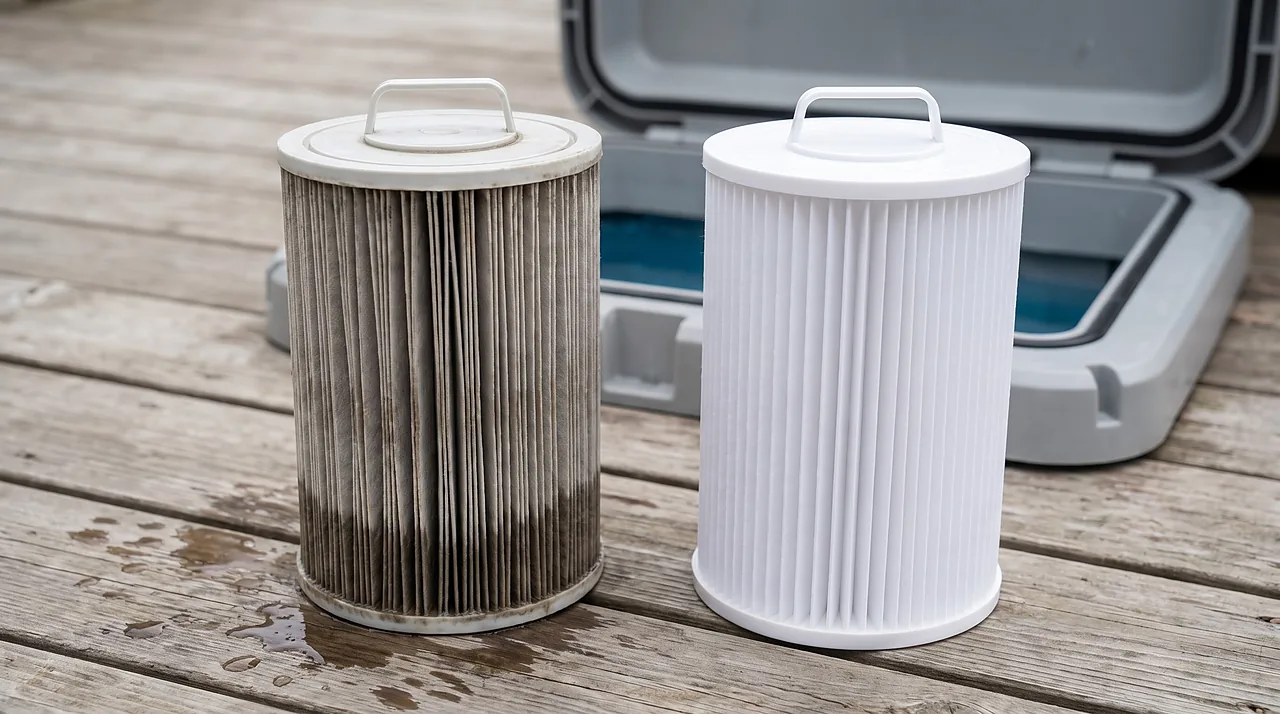
A cartridge that still looks white and unbroken can be filtering worse than one that looks grimy. The synthetic fibers wear out and lose their ability to trap fine particles long before the pleats look ragged. Plenty of owners keep the same filter for three or four years because it never looks dirty, even as the water gets cloudier and the sanitizer demand keeps climbing. The realistic replacement window is roughly every 1 to 2 years of regular use, and how many soaks that filter has caught matters more than the date it went in.
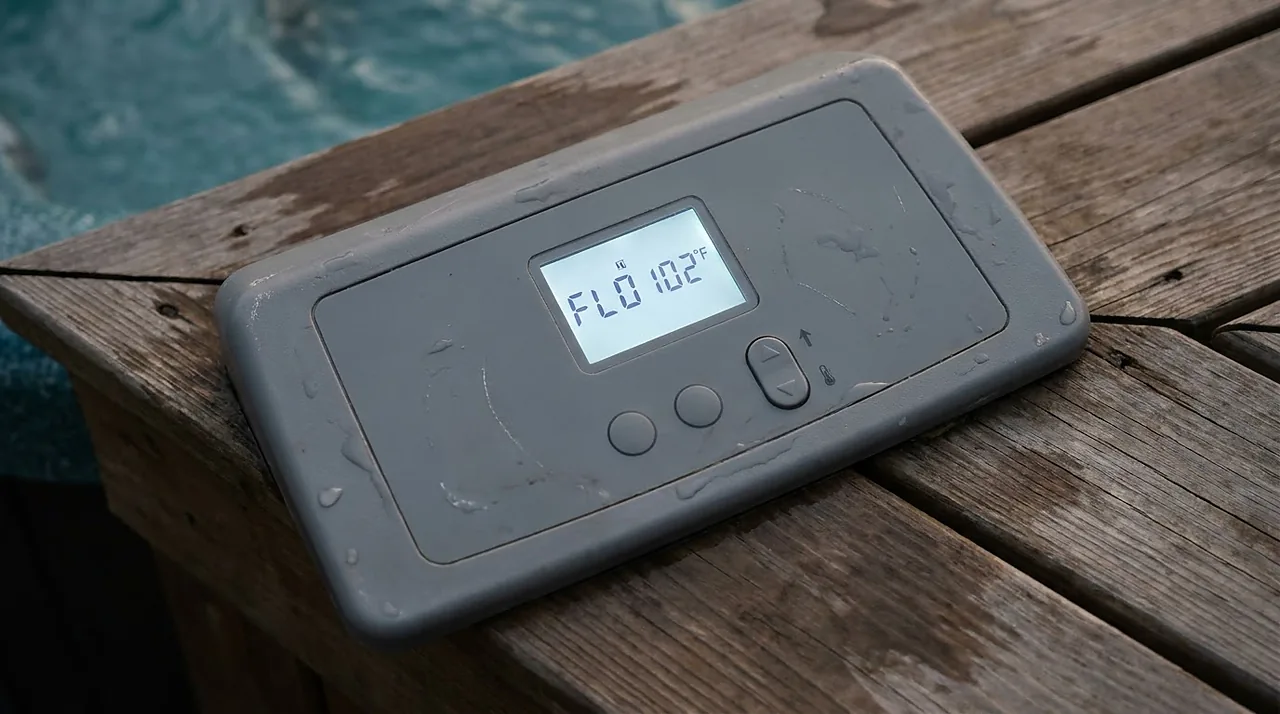
Two different owners land on this page for two different reasons. One has a filter that passes the eyeball test but water that won't hold its clarity no matter how carefully the chemistry gets balanced. The other has a control panel throwing a flow fault on a filter that's a year or two old and has never given trouble before. Both point to the same underlying answer, and neither is solved by scrubbing harder.
Why a filter that looks fine can still be worn out

A pleated spa cartridge is made of bonded polyester media. Every rinse and soak cycle flexes those fibers a little. Over months of chemical exposure, heat, and UV from the cover gap, the fibers stiffen. The pleats stop springing back to their full spread, and the effective filtering surface shrinks. From across the equipment bay, though, the cartridge can still look intact. Common guidance from spa makers and filter makers puts residential hot tub filter replacement at roughly every 1 to 2 years, which lines up with the window most owners should plan around. Torn, flattened, or heavily stained pleats are the physical sign it's time to replace sooner than that, regardless of the calendar.
Biofilm is the other invisible failure. A cartridge that's been rinsed and chemically soaked correctly can still be carrying a slick of biofilm deep inside the folds where a hose can't reach it, and that biofilm sheds into the water every time the pump runs. If cloudiness or a musty smell keeps coming back within days of a fresh soak and clean fill, the filter itself is usually the source, even when the water balance checks out fine. The rinse-and-soak routine that keeps a filter useful as long as possible is covered in the filter cleaning guide; this article is about the point where cleaning stops being the fix.
Two situations, two different reads
Filter looks clean, but water clouds up again within a few days of balancing
What it usually means: Fiber fatigue or embedded biofilm; the media has lost capacity even though it isn't visibly dirty. What to do: Replace the cartridge; a chemical soak won't restore fiber structure that's already worn out.
Sanitizer demand keeps climbing even with steady dosing
What it usually means: Reduced filtration means more organic load stays suspended for the sanitizer to chase. What to do: Replace, then retest dosing over the next week.
Panel throws a flow fault on a filter roughly 1 to 2 years old
What it usually means: Shrunk effective surface area is restricting flow through the heater. What to do: Pull the filter and rerun per the reset steps in the flow-error walkthrough; if the fault clears, replace rather than reinstall.
Panel throws a flow fault on a filter installed in the last week
What it usually means: Usually a fit issue, trapped air, or low water level; fiber wear takes months to develop, so it's rarely the cause this early. What to do: Check water level and burp the pump union first, then confirm the cartridge's dimensions match the housing.
Musty smell from the filter even after a full chemical soak
What it usually means: Biofilm has colonized the media past the point cleaning reaches. What to do: Replace; if the smell returns from the tub itself after refill, that points to a plumbing issue somewhere else in the system.
How long a filter actually lasts
Roughly every 1 to 2 years is the common guidance from spa makers and filter makers, but it's a range for a reason. A household running four soaks a week is pushing far more bather load, body oil, and lotion residue through that cartridge than a vacation-home tub that gets used twice a month, so the heavy-use household should plan on replacing closer to 1 year while the light-use tub can often stretch toward 2. A tub inherited from a previous owner, or one that sat closed up for a season, should get a new filter on day one regardless of its apparent age, since there's no way to know how it was maintained before.
Rinsing every one to two weeks and running a full chemical soak monthly extends the useful life inside that window. Skipping both doesn't shorten the calendar life so much as guarantee the filter is doing less and less work for most of it. Rotating two cartridges, so one is always soaking clean while the other is in service, is a separate habit that helps water quality week to week; how to set that up is in the filter rotation guide, but rotation delays replacement, it doesn't prevent it.
Match the cartridge by size and part number

The tub's brand tells you almost nothing useful about which filter fits. Manufacturers change pump housings, filter compartments, and even cartridge dimensions across model years and trim levels under the same brand name, so two tubs sitting side by side in a showroom can take completely different filters. What actually determines fit is the physical cartridge itself.
Diameter and length
Why it matters: The two numbers stamped or printed on the old cartridge's end cap; get these before shopping, even if you also have the part number.
Filtration area (square feet)
Why it matters: Two cartridges can share a diameter and length but differ in pleat count and total filtering surface, which changes how much flow resistance they add.
Top and bottom end cap style
Why it matters: Threaded, snap, or open-core ends aren't interchangeable even when the cylinder itself matches.
Cross-reference code
Why it matters: Unicel, Pleatco, and Filbur each run their own numbering system; any one of the three codes should point to the exact same physical filter across brands.
Pentair's own Pleatco filter finder lets a buyer search three ways: by part number, by manufacturer, or by raw measurement. That's also the honest order of reliability. A part number is fastest. A measurement is the fallback once the number has worn off the cap. Neither one cares what logo is on the spa cabinet. A replacement cartridge costs far less than a wasted service call, so it's cheap insurance against buying the wrong one twice. A replacement cartridge typically costs about $20-60 depending on size and brand (verify current prices). Spa dealers, pool stores and online filter shops all sell them, and searching by the part number or the measurements finds the same cartridge at any of them.
A fresh filter can still trip a flow error

This trips up a fair number of owners. They replace a worn cartridge, correctly sized and everything, and the panel throws the same flow fault within the first cycle. It isn't always a bad part. Some replacement cartridges pack their pleats tighter than the stock filter did when it was new, especially ones marketed on having more filtration area. A denser, straight-out-of-the-bag cartridge can resist flow more than a broken-in one for the first few days of use. Owners comparing notes on forums describe exactly this pattern. A brand-new, correctly-fitted filter clears the flow fault on its own after a soak or two, once the pleats relax and separate slightly.
Before assuming the new part is defective, run through the same basics that solve most flow faults, regardless of the filter's age. Balboa's low-flow message means the system isn't confident enough water is moving past the heating element to carry heat away. The fix sequence is water level first, then the filter itself, then trapped air. Refilling a tub after any service work almost always leaves an air pocket in the pump housing, and that air reads to the flow sensor exactly like restricted flow does. Pulling the filter, running the system without it for a few minutes, as a test only, and burping the pump union clears both a genuinely bad fit and a simple airlock. Only replace the cartridge a second time if the fault persists after air and water level are both ruled out. The full code-by-code breakdown of what a stuck or flashing message actually means lives in the error code reference.
What to check before you blame the filter
A flow fault and a heater that won't fire are related but not identical problems, and it's worth telling them apart before spending money. If the panel shows a flow message and the heater simply won't turn on at all, the filter is the first thing to rule out. If flow reads fine but the water still isn't warming, or it warms painfully slowly, that's a different chain of causes covered in the not-heating guide, running from the high-limit switch to the element itself.
- Confirm the water level sits above the intake fitting, since it can look fine at the jets while sitting too low at the intake.
- Pull the filter and run the system without it for a few minutes, as a test only, to see if the fault clears.
- Check for a closed valve or a jet left fully shut, since either one can starve flow on its own.
- Burp trapped air from the pump union any time the tub has just been refilled or serviced.
- Only replace the cartridge once the above are ruled out, or once it's roughly 1 to 2 years old and showing flattened pleats.
None of this requires opening the equipment compartment past the filter well. If any step points toward the heater, the pressure switch, or wiring, that's where a licensed electrician takes over rather than a screwdriver at home.