A 400-gallon hot tub and a 320-gallon one look almost identical from the deck. Same footprint, same number of seats, same steam rising off the cover in the morning. But dose that smaller tub like it holds 400 gallons and the sanitizer reading comes back weaker than the bottle promised, every single time, and nobody thinks to blame the gallon number because it's the one figure nobody double-checks.
Most residential hot tubs hold somewhere in the range of 300 to 500 gallons. Compact inflatable and softside models, the Intex and SaluSpa style tubs, generally run smaller, commonly landing between 200 and 300 gallons depending on the exact model. Neither range is exact for any specific tub sitting in a specific backyard, and that gap between "typical" and "yours" is exactly what causes chronic under-dosing or over-dosing that never traces back to the right cause.
Why the number on the box is often optimistic

Manufacturer literature, owner's manuals, and dealer spec sheets usually list a nominal capacity, and it tends to describe the shell at a specific fill line under specific conditions rather than the exact volume sitting in front of you. Water displaced by a full complement of seated bathers, the depth actually reached before water starts lapping at the weir or overflow, and even how full an owner personally likes to run the tub (a few inches under the skimmer line versus right at it) all shift the true number by a meaningful margin. A tub rated at 400 gallons that's filled two inches lower than the rated line, or that has three empty jump seats instead of loungers taking up displacement, can easily sit closer to 350 or 375 in practice.
None of that makes the label wrong exactly. It makes it a starting point, not a measurement. For casual soaking that difference barely registers. For dosing sanitizer, shock, or a pH adjuster to the water actually present, a 10 to 15 percent gap between the assumed number and the real one is enough to leave free chlorine reading low right after a dose that should have worked, or to overshoot pH correction and swing the water the other direction.
Typical gallon ranges by tub type

| Tub type | Typical gallons | What drives the range |
|---|---|---|
| Small acrylic hot tub, 2-3 seats | roughly 150-250 | Compact shell, shallower average depth |
| Standard acrylic hot tub, 4-6 seats | roughly 300-500 | Most common residential size sold |
| Large acrylic hot tub, 7-8+ seats | roughly 450-650 | Longer footprint, deeper corner seats or a lounger |
| Inflatable/softside spa (Intex, SaluSpa style) | roughly 200-300 | Round or square shell, shorter side walls; one manufacturer-listed model runs 290 gallons at its rated fill |
Those bands are general guidance, not a substitute for your own tub's manual or nameplate, and even the nameplate figure is worth verifying against a real measurement if precise dosing matters to you. A drained tub being refilled for the season, or a tub whose paperwork is long gone, is the clearest case for measuring rather than guessing.
Calculate it yourself: the method that beats guessing
The most accurate way: time the fill
On the next refill, time how long the hose takes to fill a 5-gallon bucket, which gives gallons per minute. Then time the full fill from empty to the normal water line. Minutes to fill the tub times gallons per minute gives the tub's real volume. A hose flow meter does the same job directly.
The tape-measure estimate
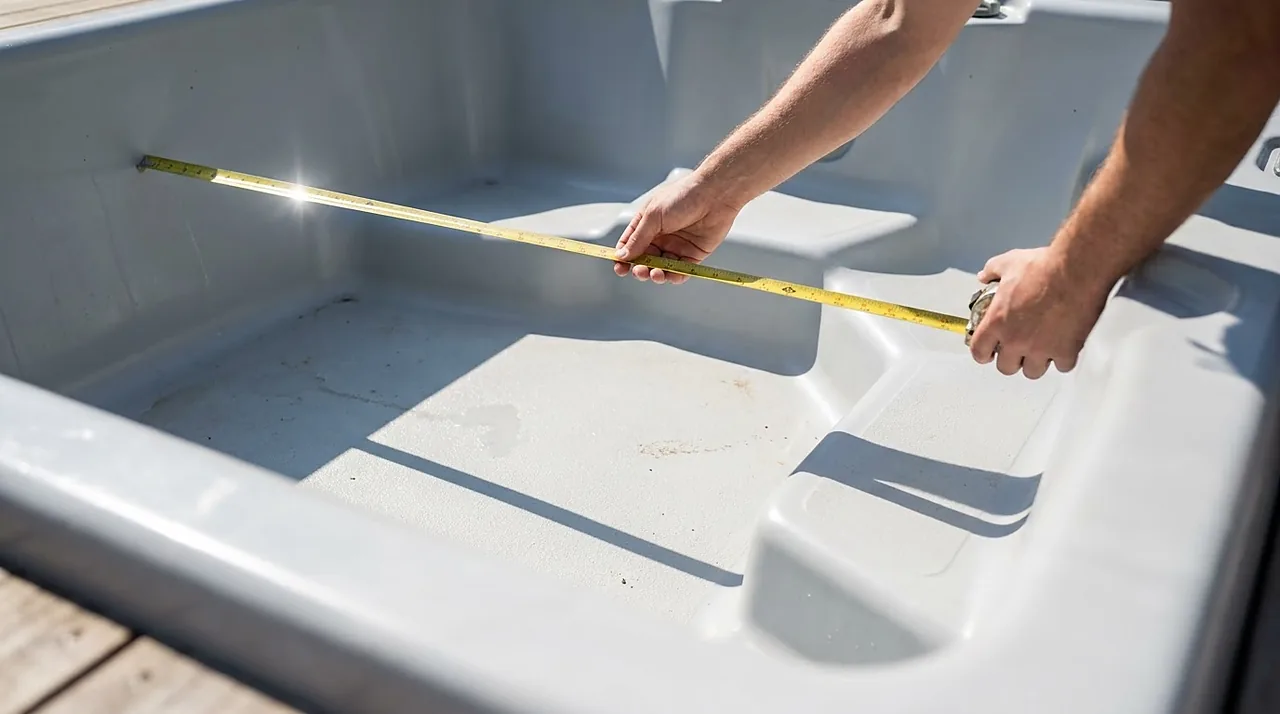
The same length-times-width-times-depth approach municipal water departments use for swimming pools scales down cleanly to a hot tub. Measure the interior length and width of the shell at the waterline in feet, measure the average water depth in feet (account for a stepped seating area by averaging the shallow bench depth with the deeper footwell depth), then multiply length by width by average depth by 7.5, the standard multiplier for a rectangular or square-ish shape. A round or oval shell uses a lower multiplier, closer to 5.9, because a circle holds less volume than a square of the same outer dimensions.
- Measure length and width at the interior waterline, in feet (round to the nearest half foot).
- Measure average depth. If the tub has a seating bench, take the shallow depth and the deep footwell depth, add them, and divide by two.
- Multiply. Length x width x average depth x 7.5 (rectangular/square) or x 5.9 (round/oval) = gallons.
Worked example: a tub measuring 5 feet by 5 feet with an average depth of 2.5 feet comes out to 5 x 5 x 2.5 x 7.5, or about 470 gallons raw. The box formula overstates a molded acrylic tub, often by a lot, because seats, loungers, and the footwell shape take up much of the measured box. The real volume of such a tub is usually well below that, so treat the formula as an upper limit and prefer the manual, the nameplate, or the fill timing.
Dosing to the label, then adjusting from a real reading

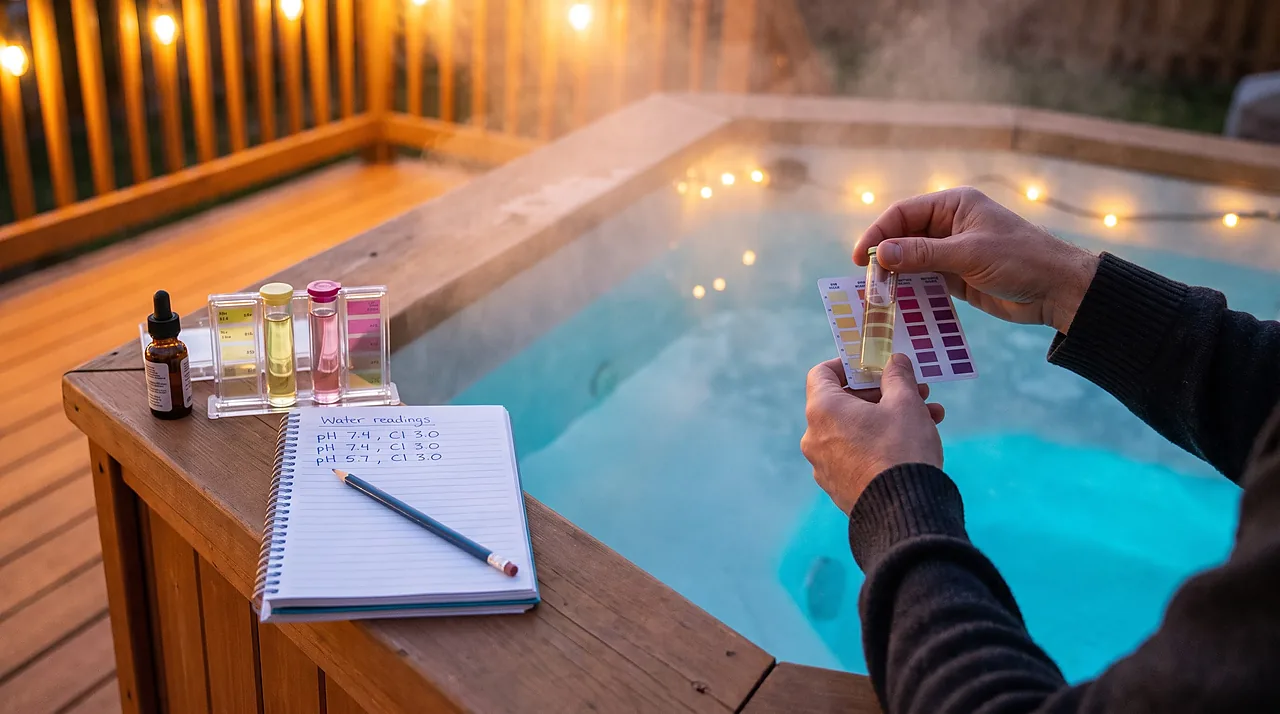
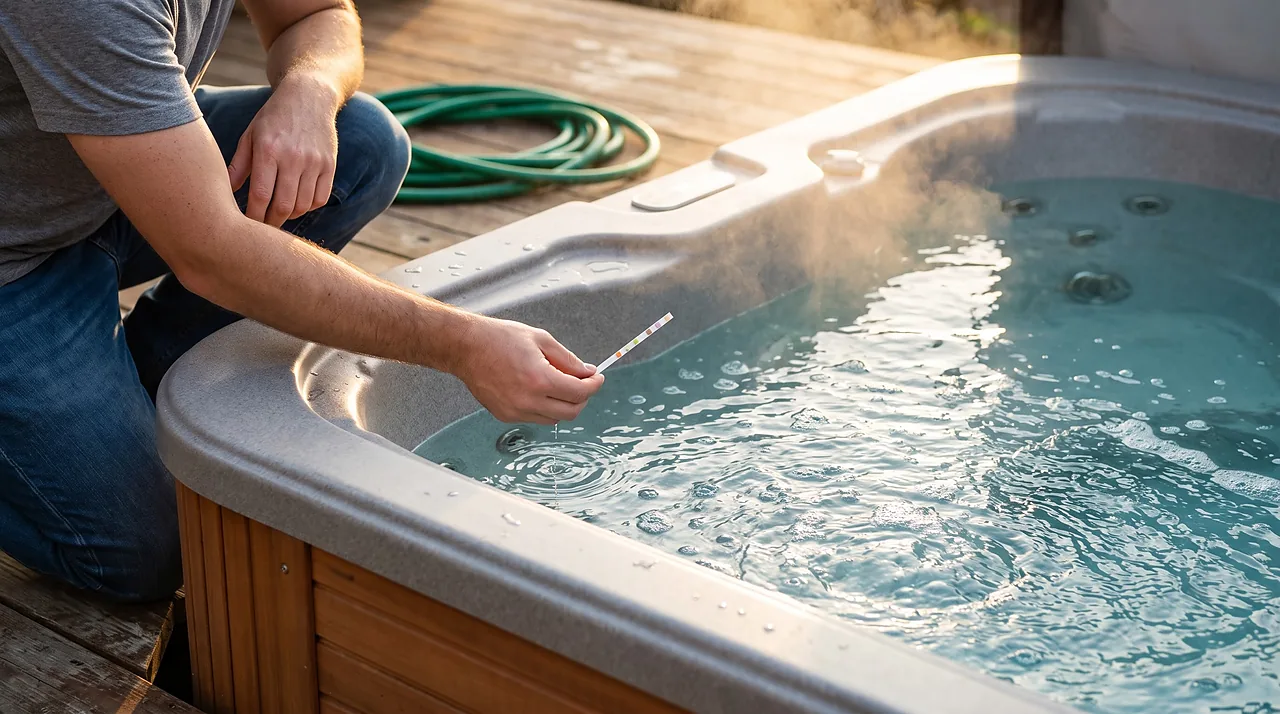
Chemical doses on sanitizer, shock, and balancer labels are always written per gallon, so the gallon figure feeds every single one of them. There are two honest ways to handle the uncertainty. The first is to dose to the manufacturer's stated volume exactly as written and treat the first reading after dosing as the correction step: test free chlorine or bromine 15 to 20 minutes after adding sanitizer, and if it's reading lower than expected for the dose given, the tub likely holds more water than the label says, not less sanitizer than the bottle claims. The second is to run the calculation above once, write the corrected number on a piece of tape inside the equipment bay, and dose to that number from then on.
Either approach beats dosing blind, and the correction only has to happen once. A tub's actual volume doesn't change week to week the way its chemistry does, so a single careful measurement (or a single pattern of "this dose always reads a little light") is a permanent fix, not a recurring chore.
Where the gallon number matters most
Two things downstream of this number are worth getting right on purpose. Every dose on the water chemistry side of ownership, sanitizer, shock, pH adjuster, alkalinity increaser, scales directly off gallons, so a tub logged 15 percent higher than its real volume runs chronically under-treated no matter how faithfully the owner follows label directions. And the drain-interval math many owners use, gallons divided by three, divided by average daily bathers, to estimate days between full drains, only holds up if the gallon figure going in is close to real; that formula and the reasoning behind it live at how often a hot tub actually needs a full drain and refill. Getting the number close, verified once by a real measurement or a pattern of readings, matters more here than getting it exact to the gallon.
Gallons also drive heating cost, since every gallon has to be kept warm, see what a hot tub costs to run each month.
Water temperature, unlike volume, is a fixed spec worth checking against a real limit rather than estimating; the safe range and why 104°F is the ceiling most control panels are locked to are covered separately at setting hot tub temperature safely.