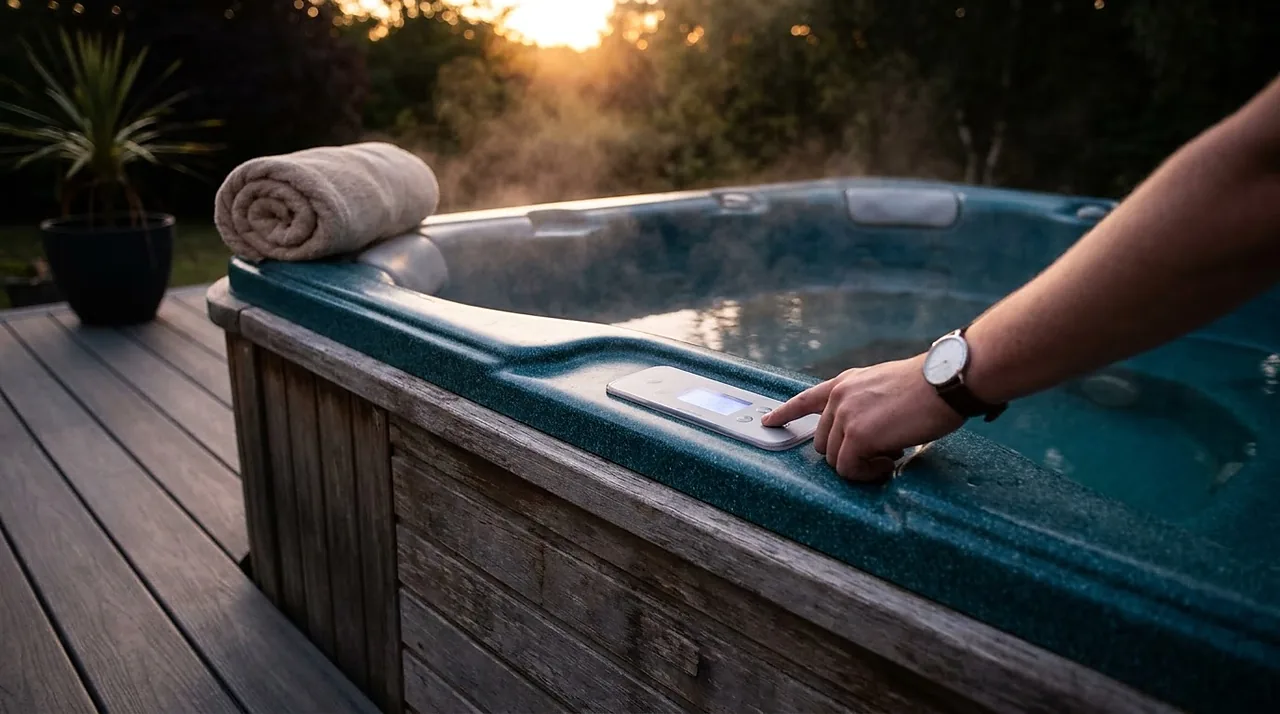
Turn the dial past 104 degrees Fahrenheit and most control panels simply refuse to go any further. It is a hard-coded ceiling, built in because water that hot can push a healthy adult's core temperature into dangerous territory faster than most people expect. Everything else about hot tub temperature, the day-to-day set point, how long it takes to climb from cold to comfortable, whether to turn it down when nobody's using the tub, sits underneath that one fixed number.
So the short version: 104F/40C is the cap, and 100 to 102F is where most owners actually leave the dial. Getting from a cold fill to that number takes real, calculable time that depends on your heater's size and your tub's gallon count.
Why 104 degrees is not a suggestion

The U.S. Consumer Product Safety Commission has said plainly for decades that hot tub water should never exceed 104 degrees Fahrenheit. That is the number every reputable manufacturer builds its control system around, and it is also the exact ceiling written into the Model Aquatic Health Code, the reference standard health departments use for public and semi-public pools and spas, which states flatly that "the maximum temperature for an aquatic venue is 104°F (40°C)." A residential backyard spa is not regulated the same way a hotel spa is, but the physiology behind the number does not change because nobody is checking a permit.
Here is the mechanism in plain terms: hot water raises your core body temperature, and past a certain point your body can't dump heat fast enough to keep up, especially in a fully submerged, humid environment with no breeze. At 104F and above, that margin gets thin quickly, and heat exhaustion or heat stroke becomes a genuine risk. This is equipment-level, universal guidance built into every control system, regardless of brand or model.
Anyone with a medical condition should check with a doctor before regular hot tub use, at any temperature.
The number most people actually run: 100 to 102 degrees

Almost nobody keeps a residential spa parked right at the 104F ceiling for regular use. Most owners settle somewhere between 100 and 102F for a comfortable, sustained soak, warm enough to feel like a proper hot tub, cool enough that a twenty- or thirty-minute session doesn't leave you light-headed climbing out. A few extra degrees near the top of that range feel noticeably more intense than the math suggests; the difference between 100F and 104F is not linear in how it feels on your skin or your pulse.
- 96-98F (about 36-37C)
- What it feels like / who it suits: Family soaking with young kids, or anyone easing into hot water for the first time.
- 100-102F (about 38-39C)
- What it feels like / who it suits: The range most adult owners settle on for regular, longer soaks.
- 103-104F (about 39-40C)
- What it feels like / who it suits: Shorter, more intense sessions; the ceiling and the last couple degrees below it.
- Above 104F (above 40C)
- What it feels like / who it suits: Not available; every reputable control system stops here.
Kids run hotter, relatively speaking, because their bodies regulate heat less efficiently than an adult's. Keep the set point lower, keep sessions short with breaks, and make sure an adult watches the whole time. Follow the warning label on the tub and the CPSC advice, and stop at the first sign of flushed skin or tiredness. If adults and children share the tub, run the whole session at the lower setting.
Is a lower setting too cold?
A lower set point is never a safety problem, only a comfort and readiness choice. Many owners run the tub well below 100F in hot weather as a cool soak. Warm water at any normal setting still needs the sanitizer held in range, since bacteria do not stop at a lower temperature. The only hard rule is the 104F ceiling.
How long heat-up actually takes: the real math
Every gallon of water takes about 8.33 BTUs to raise its temperature by one degree Fahrenheit. That constant, combined with your heater's rated output, tells you almost exactly how long a cold fill takes to reach your set point, and it explains why two tubs that look identical from the deck can behave completely differently depending on what's wired into the equipment bay.
The method: multiply your tub's gallons by 8.33, multiply that by the degrees you need to climb, and divide by your heater's output in BTUs per hour (a heater's kilowatt rating times 3,412 gives you that figure). The result is hours to reach temperature under ideal conditions, with no heat loss factored in anywhere along the way.
- 350 gallons
- Heater: 1.5 kW (standard 110V plug-in). Degree rise: 30F. Approximate heat-up time: about 17 hours.
- 350 gallons
- Heater: 4 kW (240V). Degree rise: 30F. Approximate heat-up time: about 6.4 hours.
- 350 gallons
- Heater: 6 kW (240V). Degree rise: 30F. Approximate heat-up time: about 4.3 hours.
- 480 gallons
- Heater: 1.5 kW (standard 110V plug-in). Degree rise: 30F. Approximate heat-up time: about 23.4 hours.
- 480 gallons
- Heater: 4 kW (240V). Degree rise: 30F. Approximate heat-up time: about 8.8 hours.
- 480 gallons
- Heater: 6 kW (240V). Degree rise: 30F. Approximate heat-up time: about 5.9 hours.
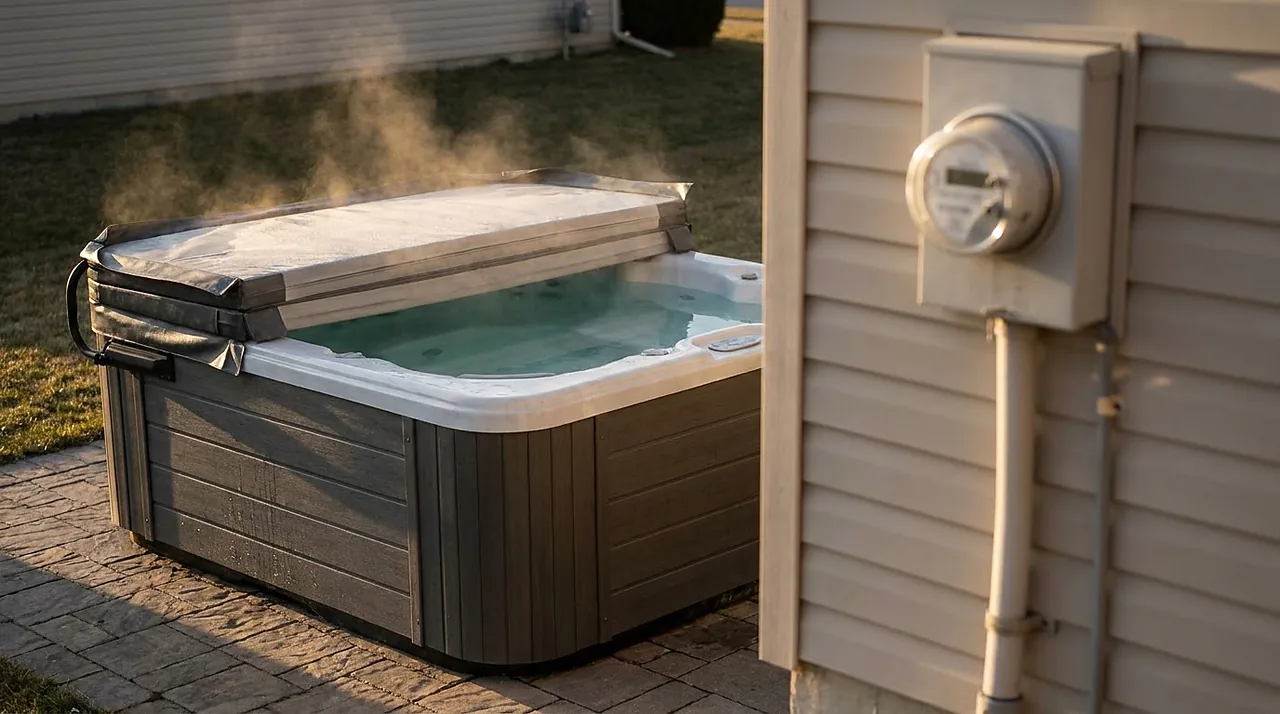
Those numbers are the physics-only ceiling on speed. In practice, a well-fitted cover, a warm garage or patio, and mild weather all shave time off the real-world number. Wind, cold ambient temperatures, and an aging or waterlogged cover stretch it back out again. A workable adjustment for a tub sitting outdoors through cold weather, or wearing a cover that's lost some of its insulating loft, is to add roughly 20 to 30 percent to the calculated hours. The 480-gallon, 4 kW example above goes from 8.8 hours in ideal conditions to something closer to 11 hours in a genuinely cold spell with a tired cover. Treat it as a planning range for setting expectations, then run the exact numbers for your own setup.
If your tub is taking noticeably longer than this table (and its adjusted range) suggests, and that gap keeps widening over time instead of holding steady, something beyond ordinary heat loss is going on. A slow-heat diagnosis runs through the actual causes, which almost always trace back to heat retention.
Your electrical setup drives the single biggest lever in that table: the gap between a 1.5 kW plug-and-play unit and a 6 kW hardwired heater dwarfs anything you can adjust afterward. Choosing between a standard outlet install and a dedicated circuit affects heat-up speed and running cost for as long as you own the tub. That decision is worth understanding before the tub arrives.
Turning it down in summer: what economy mode actually trades away

Most control systems, commonly built on Balboa or Gecko boards, offer more than one way to run the heater, beyond just "on all the time at the set point." A standard mode keeps the water within about a degree of your target around the clock. An economy setting only fires the heater during scheduled filter cycles, letting the water drift down between them, which is exactly the point in summer when you're not soaking daily and don't need the tub standing by at full temperature. A more aggressive sleep-style setting allows a bigger drop still, commonly cited as 15 to 20-plus degrees below your set point on some control boards, for a tub that's genuinely idle for stretches; the exact figure depends heavily on the brand and how the mode is configured.
The trade-off is straightforward: economy and sleep settings cut real energy costs by reducing the two things that actually drive standby consumption, heat lost through the shell and cover, and the electricity the filtration pump draws while it runs. A federal analysis of portable spa energy use identified exactly those two factors as the drivers of standby cost, and pointed to the cover's job as blocking conductive heat loss and slowing evaporation. What you give up is readiness. A tub in economy mode on a Tuesday afternoon might sit ten or fifteen degrees below target. Reaching your set point again, depending on heater size, can take an hour or more. Standard mode skips that wait entirely.
For most households, the practical middle ground is running economy mode through the slower months and switching back to standard a day before you actually plan to use the tub. That single scheduling habit does more for readiness than the mode setting itself. Filter cycles, cover condition, drain timing, and the rest of the seasonal habits that keep a tub running efficiently and reliably live in the full maintenance rhythm. Work through it once and it holds up season after season.
This section deliberately skips a dollar figure. The actual monthly cost of running a tub at any given set point depends on your local electricity rate, your climate, your insulation, and how often the heater actually has to fire. Squeezing that into one number here would do more harm than good. A full monthly cost breakdown walks through the real math properly.
When the season changes more than the thermostat should
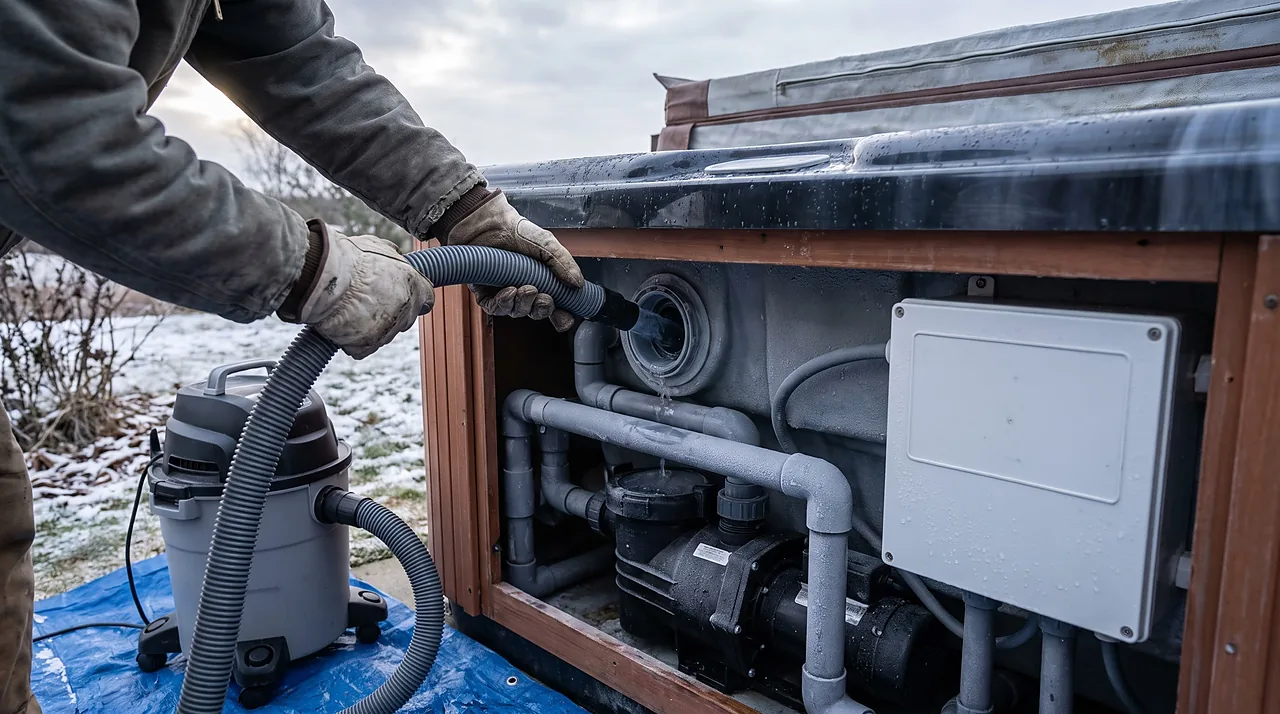
Dropping the set point for a slow summer week and shutting a tub down for winter are different decisions, even though both start with turning a dial down. A genuine seasonal shutdown, or the freeze-protection steps for a tub you're keeping running through a cold climate, involves draining lines, protecting plumbing, and its own separate checklist. The full shutdown and freeze-protection process covers that ground on its own terms.