Somebody opens the utility app, sees the new total, and asks whether the tub is the reason. Most of the time the honest answer is a real but modest one: about $20 to $50 a month for a typical residential spa, heater running on its own schedule to hold a set temperature. That range is wide on purpose, because the actual number for any one household comes out of a simple formula, not a fixed price tag.
Heater output in kilowatts, multiplied by how many hours a day that heater is actually firing, multiplied by the price of a kilowatt-hour where you live. Everything else, climate, the set point, whether the cover is still doing its job, how well the shell is insulated, changes the number by changing one of those three inputs. Nothing else in the equation matters as much as people assume.
The formula, and why it's the whole story

Monthly heating cost = heater kW × average daily run-hours × 30 days × your electricity rate in dollars per kWh.
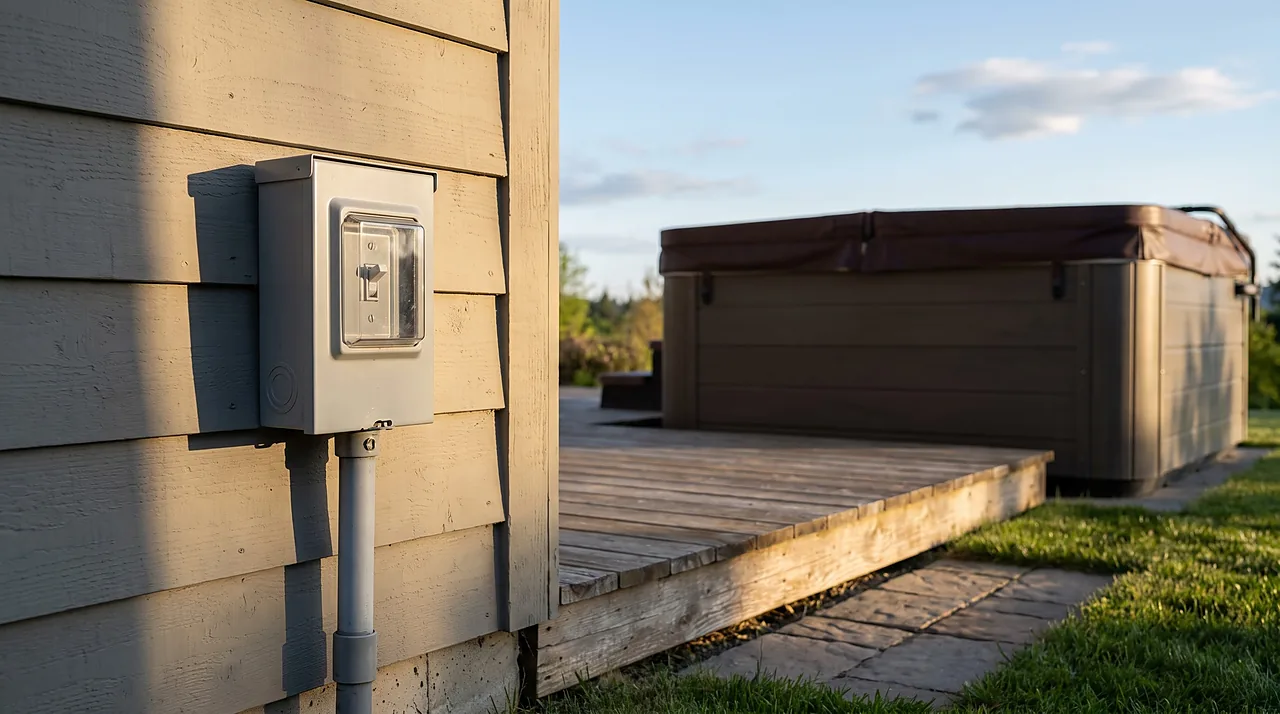
Most 240-volt hardwired spas ship with a 4 kW or 5.5 kW heater element. Smaller 120-volt plug-and-play and inflatable models run a much lighter 1.4 to 1.5 kW heater, which is why they cost less to heat but also struggle harder to climb back to temperature after a big drop; the tradeoffs between the two circuit types are covered in full in the guide to spa electrical requirements. Check your own tub's control panel spec or owner's manual for the exact wattage before you run these numbers, because a 4 kW heater and a 5.5 kW heater on the same schedule are not the same bill.
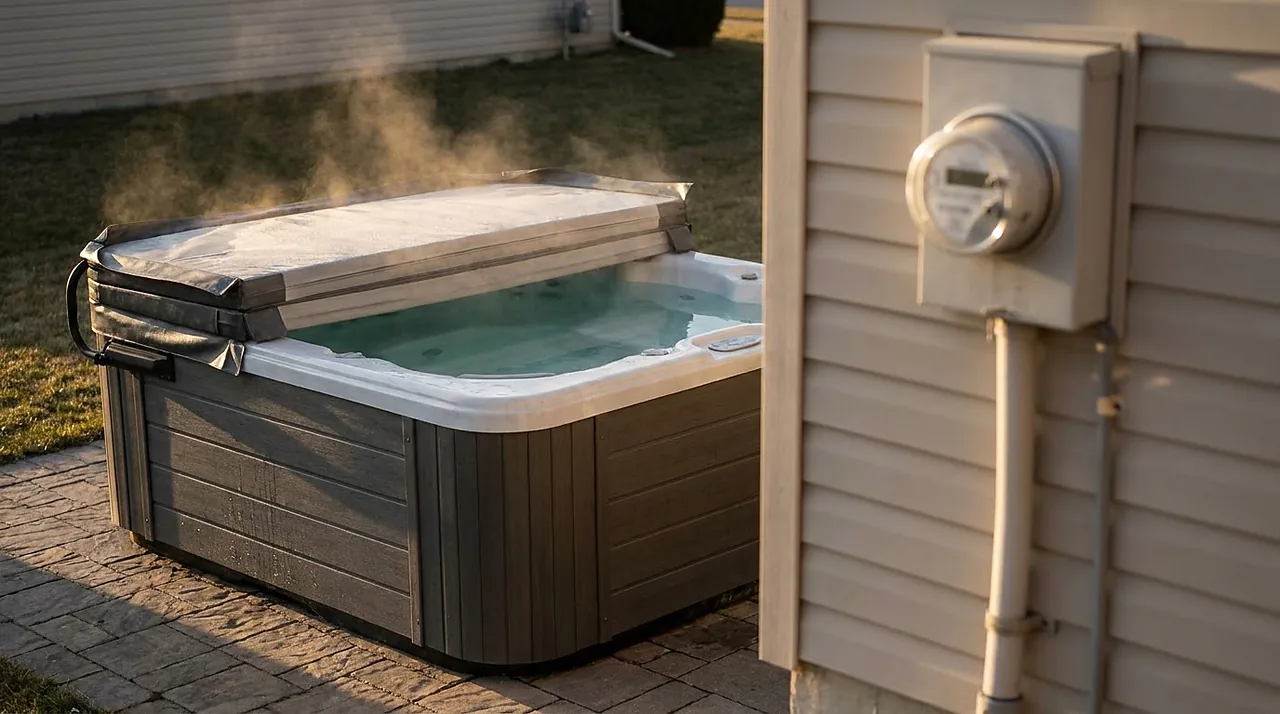
The rate half of the equation moved recently too. The national average residential price sat at 18.83 cents per kWh in April 2026, up from 17.55 cents a year earlier, according to the U.S. Energy Information Administration's monthly reporting. That average hides enormous state-to-state spread, anywhere from the low teens to well over 30 cents depending on where you live. Pull your own rate off a recent bill rather than borrowing the national figure. The heater is the biggest share, but the circulation or filtration pump also runs every day at a much lower draw, so add a little on top of the heater figure if you want the whole electric line.
What actually decides the hours
The kilowatt number on the heater is fixed. The hours are not, and four things move them:
- Climate. A bigger gap between water temperature and the surrounding air or ground means faster heat loss, which means more heater run-time to hold the set point.
- Set temperature. A higher set point widens that same gap. The tradeoffs of running closer to the 104F safety ceiling versus a lower everyday setting are laid out in the temperature guide.
- Cover condition. A tight, dry cover is doing most of the insulating work a spa has. ENERGY STAR, the joint EPA/DOE efficiency program, notes that covering heated water when it's not in use can cut heating cost by as much as 50 to 70 percent, because evaporation off exposed water is the largest source of heat loss there is.
- Insulation class. A full-foam cabinet retains heat far better than an older wood-skirted shell with an air gap underneath, and that difference shows up as more heater hours on a colder night regardless of what the cover is doing.
Four households, four very different bills

Here's the same 4 kW heater run through four real scenarios, at 19 cents per kWh:
| Situation | Approx. heater run-time per day | Monthly kWh | Monthly cost |
|---|---|---|---|
| Warm climate, tight cover, full-foam cabinet | about 1 hour | ~120 kWh | ~$23 |
| Moderate four-season climate | about 1.5 hours | ~180 kWh | ~$34 |
| Cold winter stretch, cover still sound | about 2.2 hours | ~264 kWh | ~$50 |
| Same cold winter, waterlogged or failing cover | about 3.5 hours | ~420 kWh | ~$80 |
That last row is the one worth sitting with. A cover that's stopped doing its job doesn't just get heavier to lift, it hands the heater a much bigger job right in the season when heat loss is already at its worst. The full test for telling a genuinely dead cover from one that just needs cleaning and conditioning lives in a separate breakdown of the waterlog problem, and it's worth running before you assume a jump in the bill is the heater's fault.
Run-time in that table is expressed as full-power equivalent hours. A real heater doesn't sit at one steady draw all day; it cycles on and off to hold the set point, and these figures represent the total time it would take running flat out to use the same energy.
Three savings that actually move the number

Plenty of advice floating around promises to cut a spa's power bill. Most of it is noise. Three things genuinely change the math.
A sound, well-fitted cover. Given the 50 to 70 percent figure above, this is the single biggest lever available, bigger than any thermostat trick or gadget. Check it for water weight and cracked vinyl on the schedule laid out in the cover care breakdown before spending money anywhere else.
The temperature setback myth, checked against the physics. Turning the thermostat down 5 or 10 degrees every single day and back up before each soak sounds like an obvious saver. For a large, poorly insulated pool it can be. For a small, well-insulated spa the math works differently. Heat loss scales with the gap between water and ambient temperature, so a small daily setback only shrinks that gap for a few hours. Then the heater has to spend real energy closing the gap back up before anyone gets in, and the two roughly cancel out. What does save real energy is turning the set point down meaningfully, or into a low vacation setting, for a genuine absence of five or more consecutive days, because then there's no reheat cycle to pay back. Daily fiddling with the dial is mostly wasted effort; a real trip away is where a setback earns its keep.
Off-peak scheduling, if your utility actually offers it. Running the heater during cheaper overnight or off-peak hours doesn't reduce total energy used, it just moves the same kWh to a lower price band, and only pays off if your utility bills on a time-of-use rate plan in the first place. Check a recent statement for a peak/off-peak rate structure before rearranging your tub's schedule around it; on a flat-rate plan, timing changes nothing.
Everything else marketed as an energy fix, aftermarket "efficiency" pucks, mineral additives claimed to cut heating load, thermal blankets sold as a cover replacement rather than a supplement, deserves real skepticism. None of them touch the three inputs in the formula the way a sound cover, a sane temperature policy, and an honest look at your own rate plan do.
The rest of the monthly bill
- Chemicals (sanitizer, shock, balancers) commonly $20-40 a month.
- A filter cartridge at about $20-60, replaced every 1-2 years.
- Water for 3-4 refills a year, usually a small line on the water bill.
- A cover at about $350-600 when it finally wears out, which spreads out to a modest amount per month over its life.
Prices change, so check current ones, and see the chemicals a tub actually needs.
Running your own number
Skip the averages and calculate the real figure for your own tub:
- Find your heater's wattage on the control panel spec sticker or the owner's manual, typically 1.4-1.5 kW for a 120-volt plug-and-play unit or 4-5.5 kW for a 240-volt hardwired spa.
- Pull your actual electricity rate off a recent bill, in cents per kWh, rather than assuming the national average applies.
- Estimate daily heater run-time using the closest row in the table above as a starting point, then adjust up for a colder climate, a higher set point, or a cover you already suspect is waterlogged.
- Multiply: heater kW × estimated daily hours × 30 × your rate in dollars per kWh. That's your month.
If the number that comes out is well above $50 and nothing about your climate explains it, the cover is the first thing worth checking, followed by the set point, before assuming the heater itself is failing.
For a daily figure, divide the month by 30.