Before anyone touches a drain plug, answer one question first: are you actually leaving the tub unused all winter, or are you just trying to cut the power bill while you're still around to enjoy it? Those are two different jobs, and picking the wrong one is how a routine shutdown turns into cracked fittings and a plumbing repair bill come March.
A full winterize (drain, blow the lines dry, protect the low spots, cover it tight) is the right call if the tub sits unheated and unused for weeks or months: a vacant rental property, a tub you're selling, a place with no one checking on it. Running the tub through winter, kept heated and circulating, is often the cheaper and safer choice if you're home and still want to use it occasionally, because a half-finished winterize (some water drained, some water still sitting in a low elbow) is worse than doing nothing at all. Circulating, heated water stays liquid all winter; the danger only shows up once a system sits dead with water still inside it.
Decide first: shut it down, or keep it running
Run through the decision below honestly before you pick up a shop vac. Most owners in a true cold-winter climate who plan to keep using the tub even occasionally come out ahead running it, not winterizing it, once you weigh the cost of a cracked manifold against a few months of electricity.
- You'll use the tub at least monthly, and someone checks on the property regularly
- Better choice: Run it through winter. Why: Circulating, heated water does not freeze; a well-fitted, insulated cover cuts standby heat loss, per PHTA guidance.
- The property sits empty for the whole season (vacation home, rental turnover, tub for sale)
- Better choice: Full winterize. Why: No one is there to catch a power outage, a tripped breaker, or a failed heater, any of which stops circulation and lets standing water freeze.
- You're worried only about the power bill, not freeze risk
- Better choice: Run it, but dial down. Why: Lowering the set point a few degrees and using a good insulated cover saves real money without the all-or-nothing risk of a partial drain.
- You've had freeze damage before, or the tub sits in an unheated, exposed spot with frequent power outages
- Better choice: Full winterize. Why: A history of outages means the freeze protection mode cannot be trusted to save the plumbing every time.
- You're unsure how thorough you can actually be with a full drain-down
- Better choice: Run it through winter. Why: A rushed or partial winterize is the single most common cause of spring freeze damage; do the whole job or don't start it.
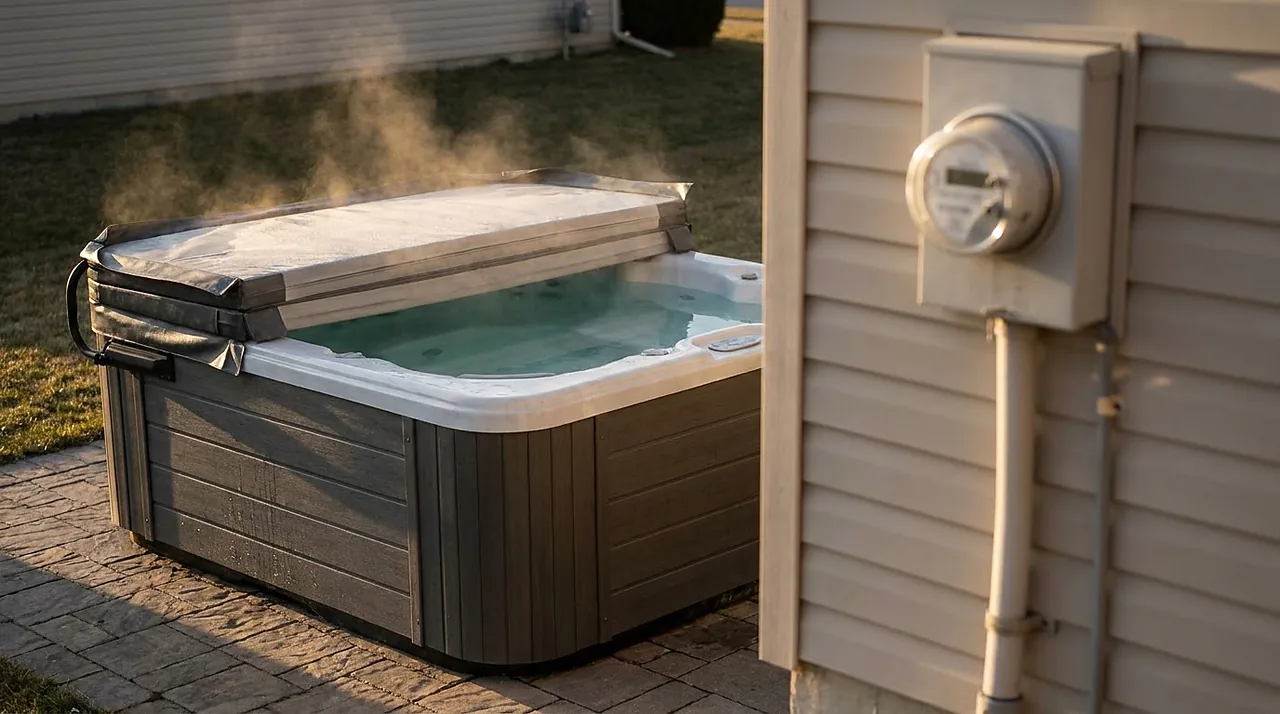
If you land on "keep it running," most control systems built around a Balboa or Gecko pack include a freeze protection mode that senses low temperatures at the equipment and cycles the pump, and sometimes the heater, on its own. Balboa's own documentation describes this plainly as an automatic response, not a malfunction: the system activates water devices when it detects a potential freeze condition, and pumps may turn on and off during that cycle without anything being wrong. That single feature is most of why running through winter is often the lower-risk option for a tub that still has power and is checked on. Worth reading in full before you commit either way: how freeze protection mode actually behaves and what still needs your attention.
What freezing actually does to the plumbing

Ice takes up more room than the water it came from. The USGS puts the number at about 9 percent more volume once water fully freezes, and that expansion happens inside a rigid PVC pipe, a pump housing, or a heater manifold with nowhere to go. The pipe does not always split right where the ice forms. Pressure often builds between an ice plug and a closed fitting somewhere else in the line, so the pipe fails at its weakest point instead, sometimes a foot or more from where the water actually froze. That is the part owners find confusing every spring: a crack shows up in a fitting nowhere near where the "obvious" puddle of standing water was sitting.
This is also why a partial job is dangerous. Draining the main shell but leaving even a coffee-cup's worth of water trapped in a jet body, a check valve, or a low loop of pipe gives that same expansion a place to do damage. One missed low spot is enough. It doesn't matter how well you did everything else.
Power outage: how long before it freezes?
There is no fixed number, because the cooling rate depends on air temperature, wind, the cover, and how warm the water was when the outage began. A full, covered tub of warm water holds heat for a while, but the small pipes and pump in the equipment bay freeze long before the shell does. Keep the cover closed and strapped tight to preserve that warmth. If a long outage is expected during a hard freeze, drain and blow out the lines using the steps below rather than waiting.
The full shutdown sequence

If you've decided the tub is genuinely going unused and unheated, do the job in this order and do not skip a step because it seems redundant.
- Turn off power at the breaker or GFCI disconnect. Confirm the pumps and heater are dead before you open anything.
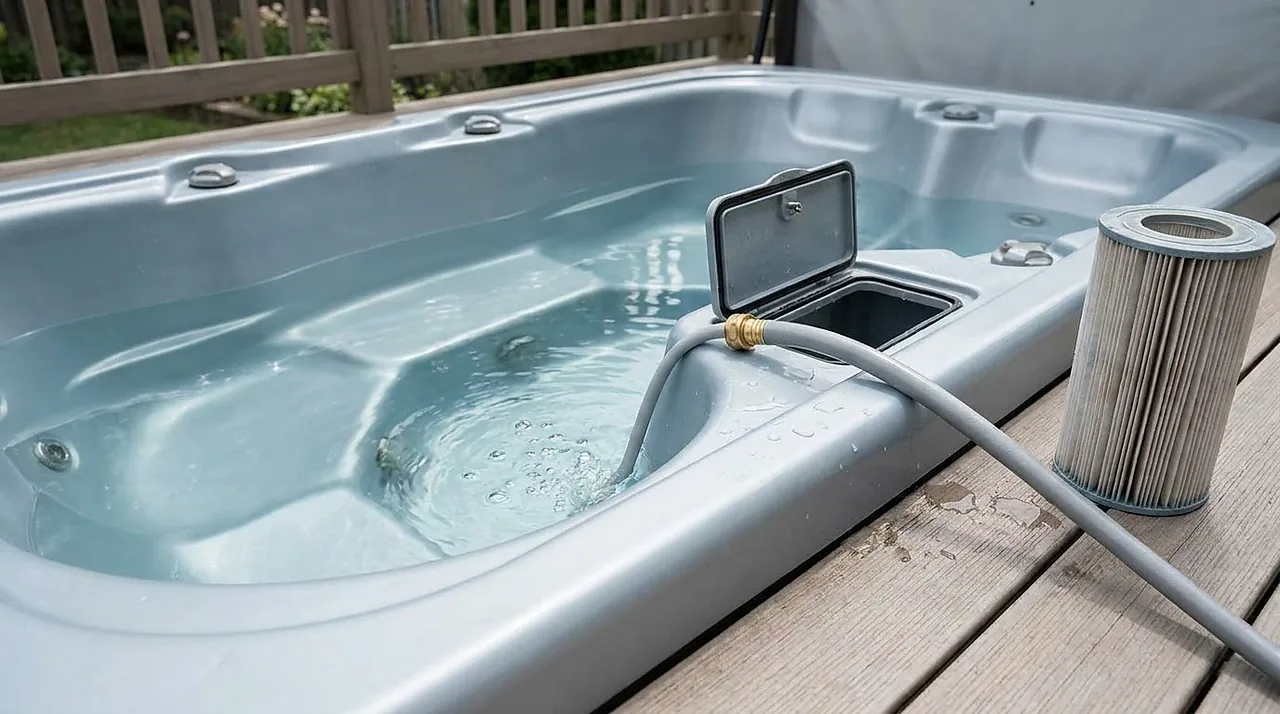
- Drain the shell. Use the built-in drain valve with a garden hose, or a submersible pump for a faster job. Full coverage of this half of the process, including what to do with no drain plug, lives in the drain-and-refill guide; the winterizing job is really that same drain, followed by everything below.
- Pull the filter(s). Rinse and store them somewhere dry and above freezing; a wet filter left in a cold garage can crack its own housing.
- Open every union and loosen fittings at the pump and heater. This lets trapped water drain out of the plumbing runs instead of just the shell.
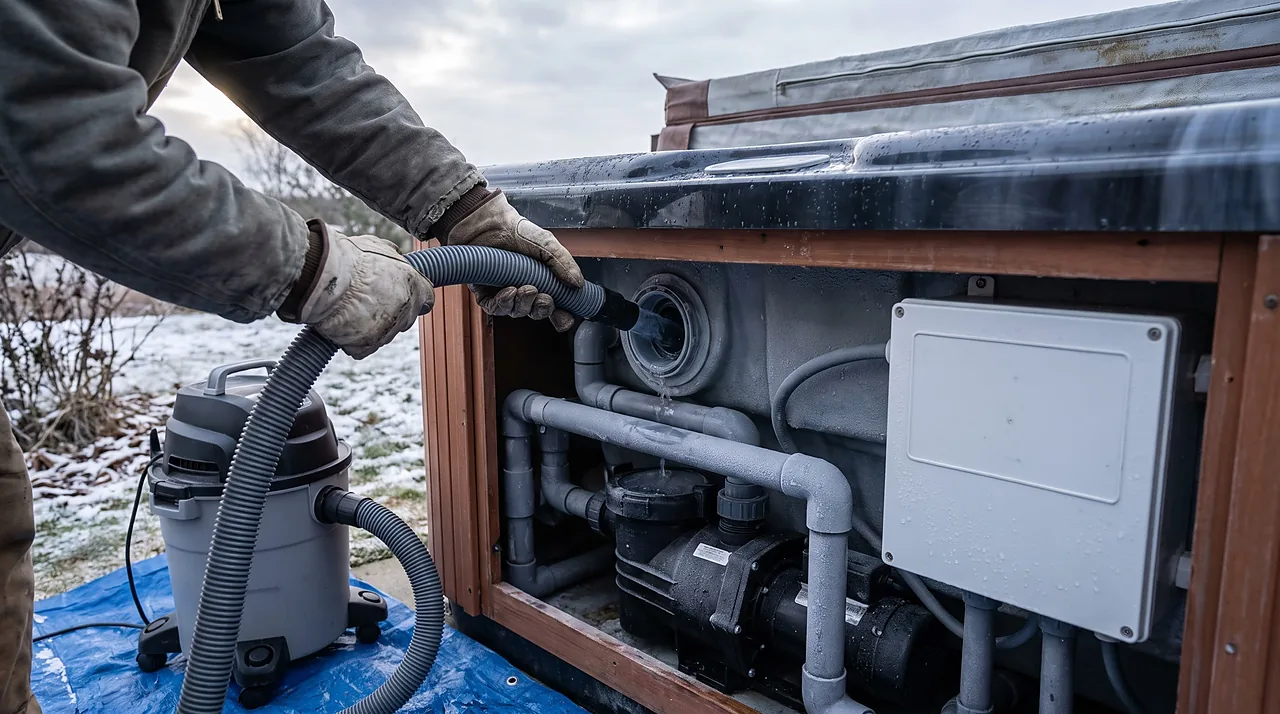
- Blow out every line with a wet/dry shop vac on the blow setting. Work through each jet, each drain, the filter cavity, and every union: hold the vac hose over each opening for roughly 15 to 20 seconds, and toggle any diverter valves open and closed while you do it so water trapped behind a valve seat gets pushed out too. Switch to suction at the same spots afterward and pull for another 10 to 15 seconds; blowing pushes water one direction, suction catches what's left going the other way, and using both catches more than either alone.
- Add propylene glycol antifreeze (the RV/marine kind rated non-toxic, never automotive antifreeze) only in the footwell and any other point where a small amount of water simply cannot be blown or sucked out. This is not a bath, it's an insurance pour into the last low spots the vac can't fully reach; check your owner's manual for the amount your specific plumbing layout calls for, since footwell depth and pipe routing vary by model.
- Leave unions and drain valves open, and leave the cover slightly cracked or ventilated so any residual moisture can evaporate rather than sit and refreeze, unless your owner's manual specifically says to reseal.
- Strap the cover down. A shut-down tub with no heat is more exposed to wind lift and snow load than a running one, since there's no rising steam to help shed snow. Full technique for tie-downs and winter cover care is in the cover-care guide.
The one missed spot that cracks pipes in spring

Ask any spa technician what they see most in March and April, and it's rarely a total drain failure. It's one line: a single jet on a secondary pump that never got its own union loosened, a low loop under the equipment pack that the shop vac hose never reached, an ozone injector line nobody thought was "plumbing." Walk the equipment bay with a flashlight before you close it up and physically confirm every fitting you can see is open and dry. If your tub has a second pump, a blower, or an ozonator, treat each one as its own separate line to blow out, not an afterthought hanging off the main pump.
Winterizing when it is already freezing
The shutdown can still be done when temperatures are already freezing, but complete the drain and the line blow-out on the same day without pauses. Water left sitting in the plumbing lines freezes fast once circulation stops. If ice is already present in the equipment bay or the pump will not turn, do not run the pumps. Let the equipment thaw first and inspect for cracked fittings before refilling or running anything.
If you're leaving it running instead
Choosing to run through winter is not a "do nothing" choice; it has its own short checklist.
- Confirm the cover is in good shape, not waterlogged, since a heavy, wet cover is a silent multiplier on your heating cost and a collapse risk under snow. See cover care and when a cover needs replacing.
- Check that the freeze protection feature is actually functioning; if your panel has thrown a flow-related error recently, get it resolved before cold weather, since a tub that can't circulate can't protect itself from freezing either.
- Keep the water level topped up above the skimmer or intake at all times; a pump drawing air instead of water can run dry and overheat even while the ambient temperature is well below freezing.
- If you'll be away for more than a few days but still running the system, look into vacation mode rather than shutting the heater off completely.
- Budget realistically: running through winter costs more than running through summer because the heater works harder against a bigger gap between water and air temperature. The running-cost breakdown and a few energy-saving habits both help more in winter than in any other season.
If the tub is a permanent fixture you use most weekends, running it is usually the better economics once you account for what a botched or partial winterize actually costs to fix: a cracked heater manifold, a split union, or a pump housing replaced in April easily outruns a whole season of the extra electricity a running tub costs.
Waking a winterized tub back up
Coming out of a full winterize is not just flipping the breaker back on. Refill slowly through the filter compartment so air works its way out of the plumbing instead of getting trapped as a lock, prime each pump before you trust the display, and reinstall the filters you stored over winter. If a pump won't push water on the first try, trapped air is almost always the reason; the fix is in how to prime a hot tub pump. Balance the fresh fill water before you sit in it. If you're doing this on an inflatable or softside tub rather than a hardshell spa, the shutdown and startup steps differ enough that it's worth reading separately in the guide on inflatable winter care rather than assuming the same sequence applies.
Frequently asked questions
How long does a full winterize actually take?
Plan on an hour to ninety minutes for a straightforward hardshell spa with one pump, longer if you have a second pump, a blower, or an ozonator, since each of those is its own line to blow out separately. Rushing the blow-and-suction step to save fifteen minutes is the most common reason owners end up with spring freeze damage, so treat the time estimate as a floor, not a target.
I winterized correctly, but the property still lost power for an extended stretch. Is the tub still at risk?
No, and this is one advantage a genuinely complete winterize has over running the tub through winter: an empty, dry shell and plumbing have nothing left inside them to freeze, so a power outage at an unoccupied, winterized property is a non-event for the tub itself. The risk that outages create is specific to a tub that's still full of water and relying on power to keep circulating.
Can I winterize the tub myself without voiding the cover's warranty?
Yes. Winterizing works on the plumbing, shell, and equipment bay; it doesn't involve cutting, gluing, or modifying the cover itself. The only cover-related step is strapping it down more securely for a shut-down tub, which counts as normal use under most cover warranties. If you're unsure, check your specific warranty's terms on damage from improper installation versus normal wear, since that's usually the only clause that applies.
Is it worth paying a technician to winterize instead of doing it myself?
A winterizing visit is billed as a service call, and the price varies by area and by how many pumps and accessories the tub has, so ask local spa services for a flat winterizing quote. The service buys you a second set of eyes checking the low spots a first-timer might miss. If you're comfortable with basic tools and following the shutdown sequence step by step, DIY is straightforward on most hardshell spas. If you've had freeze damage before, or your equipment bay has multiple pumps and accessories you're not confident identifying, paying for the first professional winterize and watching how it's done is a reasonable way to learn the layout before doing it yourself in future years.