Two numbers decide almost everything about a hot tub hookup: 15 and 50. A small plug-in spa runs happily on a dedicated 15 or 20 amp household circuit. A full-size hardwired tub needs a 50 amp (occasionally 60 amp) GFCI-protected disconnect mounted in sight of the water. Which one your tub needs is printed on the owner's manual and the rating plate near the equipment bay, so there is no need to guess, and it is the single biggest thing to nail down before an electrician ever quotes the job.
This page walks through both setups so a new owner can budget the hookup honestly and ask an electrician informed questions. It does not teach anyone how to wire a spa panel. Any work on a 240V spa circuit is licensed-electrician territory, full stop, and even the 120V side is safest left to a qualified installer even though the hardware is simpler.
The two hookup types, and how to tell which one you have
Most inflatable and small acrylic spas (roughly 2 to 4 person, lower heater wattage) are built as "plug-and-play": they arrive with a standard household plug and run on ordinary 120V house current. Most full-size acrylic hot tubs, especially anything with dual pumps or a bigger heater, are hardwired 240V units with no plug at all; a licensed electrician connects them directly to a dedicated circuit.
The tub's manual states the voltage, amperage, and breaker size in its specifications page. If that paperwork is missing, the data plate near the equipment access panel lists it. Guessing based on tub size alone is unreliable, because two similarly sized tubs can ship in either configuration depending on the heater and pump package.
What a 120V plug-and-play hookup actually needs

A 120V spa needs its own dedicated circuit, meaning nothing else shares that breaker. It plugs into a GFCI-protected 15 or 20 amp outlet rated for outdoor, wet-location use, and it runs straight from that outlet to the tub with no extension cord and no power strip in between. An extension cord voids the point of the dedicated circuit and adds a resistance and heat risk that a fixed, correctly sized cord and outlet do not have.
Because a 120V heater draws far less power than a 240V one, these tubs heat noticeably slower, often a degree or so per hour compared to several degrees an hour on a hardwired unit. That lag is simply how the plug-and-play format works: less power in means less heat out per hour, and an owner leaving the cover off or drawing the water down after each use will notice it most. On many 120V tubs the heater pauses while the jets run on high, because the circuit cannot feed both at once, so long soaks with the jets on can let the water cool.
The GFCI outlet itself should be tested on its own schedule the way any wet-location outlet is, and a spa left unused over a cold snap or a trip still needs that circuit live and protected; see the guidance on running a tub safely while it sits idle for what to leave on and what to dial back.
What a 240V hardwired hookup actually needs

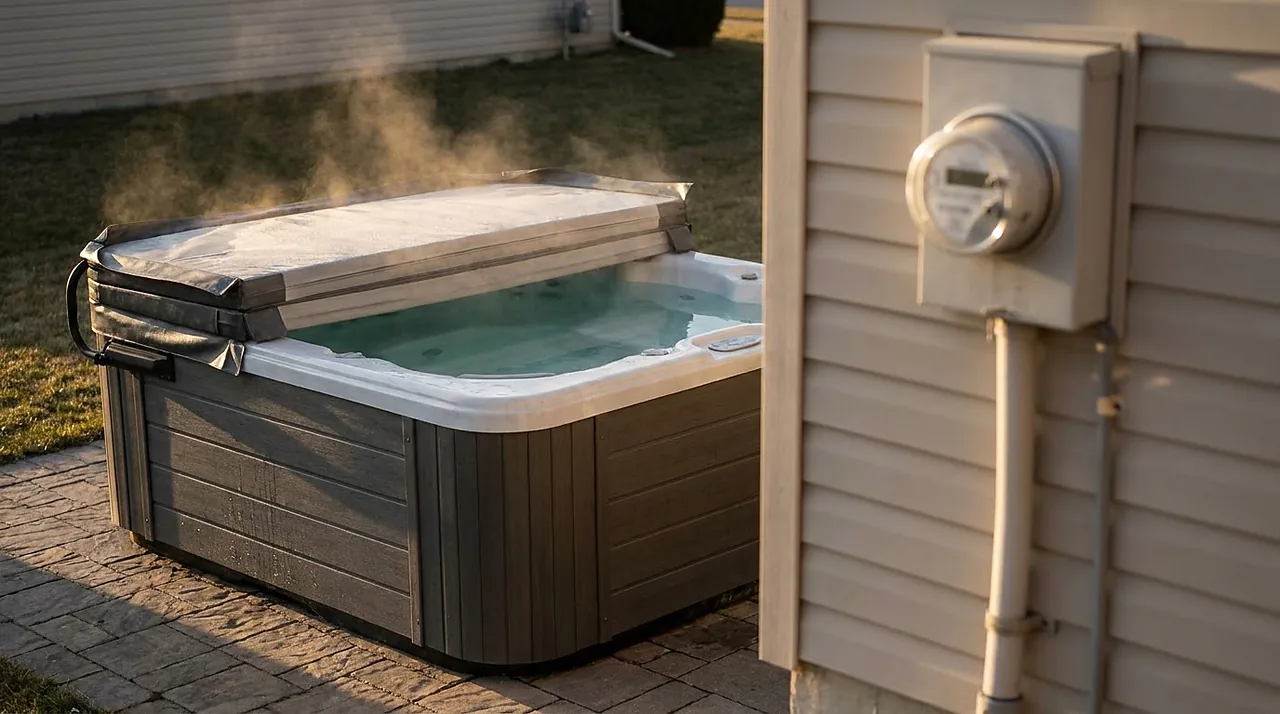
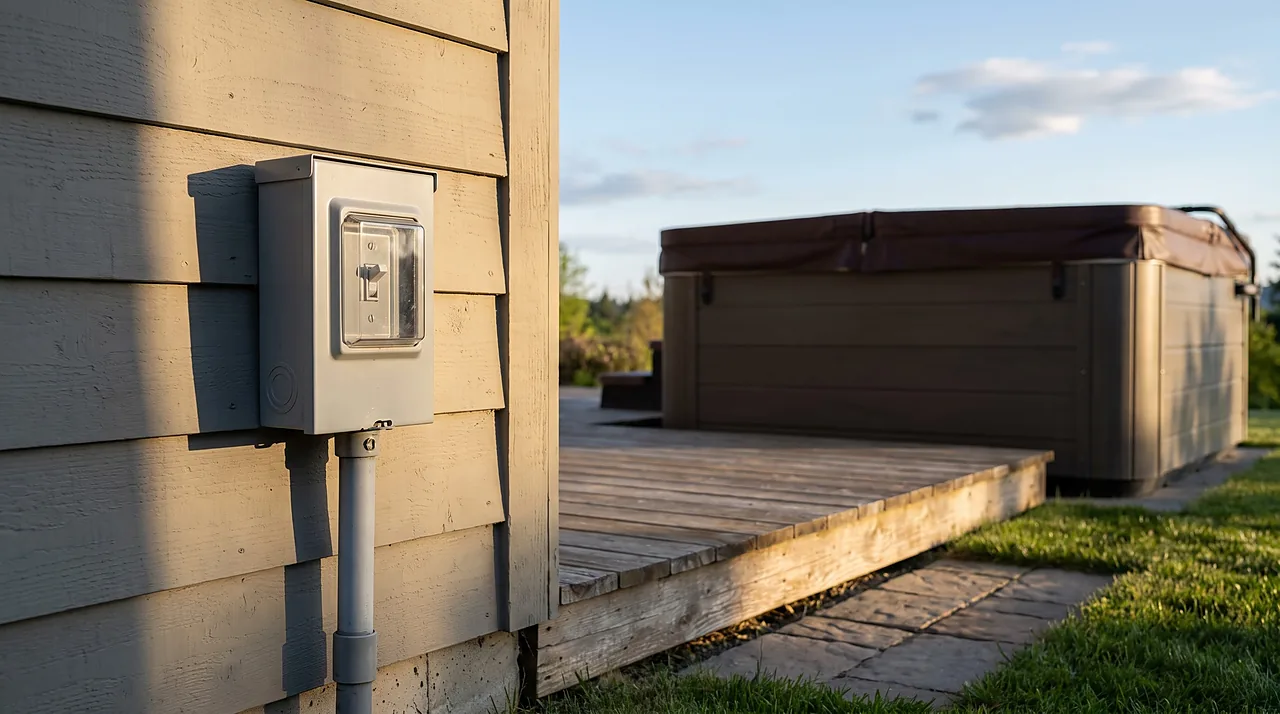
A full-size hardwired spa is fed from the main panel by its own dedicated 240V circuit, almost always rated 50 amps (some larger dual-pump tubs call for 60). That circuit terminates in a GFCI spa disconnect, a weatherproof box with its own breaker and test/reset buttons, mounted outdoors near the tub. The National Electrical Code sets the placement rule for that disconnect in Article 680.13 (Maintenance Disconnecting Means): readily accessible, in direct line of sight of the spa, and no closer than 5 feet from the inside wall of the tub, with roughly 50 feet as the practical outer limit of "within sight." (A separate emergency-shutoff switch, covered under 680.41, does not apply to a one-family dwelling, so most residential installs only need to satisfy 680.13.) The logic is simple. Someone standing outside the water needs to be able to see and reach a shutoff without stepping into the wet zone during an emergency.
A 240V spa circuit is usually a four-wire run (two hots, a neutral, and a ground) because the spa pack uses both 240V and 120V. The wire gauge is chosen by the electrician from the breaker size, the run length, and the tub's installation manual, which lists it. This is why a "wiring kit" from a store is not a substitute for the manual and the permit.
A hardwired spa also needs bonding, meaning the metal parts of the equipment (pump housings, heater, any metal frame components) are tied together and to the grounding system so a fault cannot create a stray-voltage gradient in and around the water. This is inspected work that belongs to the electrician, and a homeowner should leave it alone.
120V versus 240V, side by side
| Feature | 120V plug-and-play | 240V hardwired |
|---|---|---|
| Typical breaker | Dedicated 15 or 20 amp | Dedicated 50 amp (some 60 amp) |
| Connection | Plugs into a GFCI outdoor outlet | Hardwired through a GFCI spa disconnect |
| Extension cords | Never allowed | Not applicable, there is no cord |
| Disconnect placement | The outlet itself, in sight, no cord run needed | In sight of the tub, 5 ft or more away (NEC 680.13) |
| Heat speed | Slower, roughly 1 degree per hour | Faster, several degrees per hour |
| Who does the work | Licensed electrician recommended | Licensed electrician required, no exceptions |
| Best fit | Small inflatable or entry acrylic spas | Full-size acrylic tubs, multi-pump models |
Is a 120V tub cheaper to run?
A 120V tub is usually not cheaper to run by much, and sometimes not at all. Heating the same water to the same temperature takes about the same energy either way. A 120V heater just runs longer to deliver it. What actually moves the bill is climate, cover and insulation, set temperature, and the local kWh rate, with running costs commonly about $20-50 a month.
What the electrician actually does, step by step

A straightforward hookup visit generally covers these stages, whether it is a same-day job or split across a rough-in and a final inspection:
- Pull the local electrical permit and confirm the tub's actual load against the panel's spare capacity.
- Run the wire from the main panel to the spa location, in conduit where code or the local inspector requires it.
- Install and mount the GFCI disconnect (240V jobs) or the dedicated GFCI outlet (120V jobs) at the correct distance and orientation.
- Bond the equipment's metal components and the disconnect enclosure to the grounding system.
- Make the final connection at the tub's equipment bay and test the GFCI trip function.
- Call for the inspection that closes out the permit.
Rough install cost ranges vary a lot by region, trench length, and how far the spa sits from the main panel, so treat any number as a planning ballpark rather than a quote. A short 120V dedicated-circuit run tends to land in the low hundreds of dollars. A 240V hardwired install with a new GFCI disconnect, especially one needing a longer trench or conduit run, commonly lands well into four figures. Ask for a written estimate that itemizes permit, trenching, wire, the disconnect hardware, and labor separately, since that breakdown is what actually varies job to job.
A quick way to size up what the electrician will quote
Before the estimate call, an owner can do one useful bit of homework: find the tub's rated amperage on the spec sheet or data plate and compare it against what is already running on the panel near the intended spa location. A common example is a 6-person, roughly 400-gallon acrylic spa rated for a 50 amp 240V circuit; if the nearest panel already has two 240V loads (say a range and a dryer) close to its total capacity, the electrician may need to upgrade panel capacity before the spa circuit goes in at all, which changes the quote considerably. Knowing the tub's actual gallon count also helps the electrician and the owner sanity-check the heater size against the water volume, since a badly undersized circuit on a large tub is a common source of slow heating complaints that get blamed on the heater itself.
Where this page stops
Nothing here is a wiring instruction. Any work on a 240V spa circuit, including the disconnect, the bonding, and the final termination, belongs to a licensed electrician, and most local codes require the permit and inspection regardless of who technically could do the labor. Even the simpler 120V side is best installed by a qualified electrician, since a wrong outlet type or a shared circuit is a real fire and shock risk that a manual alone will not catch.
If the tub is already installed and something is tripping the breaker or the GFCI won't reset, that is a different problem than sizing a new hookup, and the diagnosis path is covered separately: see what makes a hot tub trip its breaker for the FLO-error, ground-fault, and heater-element checks that come before calling anyone out. And once the tub is wired and running, the ongoing electrical cost question (not the install cost) is answered in the monthly running-cost breakdown, along with what actually drives that number up or down.
A licensed electrician is who confirms the exact permit rules in a given city, so pairing this explainer with the practical side of pulling that permit and locating the disconnect on the property is worth doing before the quote call; that ground is covered in the piece on permits and disconnect placement. Routine care after the hookup is done, including the seasonal checks that keep the electrical side trouble-free, lives in the full maintenance schedule and in the spring startup routine, where testing the GFCI button is one of the first items on the list.