Someone told you 3 to 4 months. Someone else swears their tub goes 6 months with no trouble. Both can be right. The real answer isn't a season on the calendar. It's a small equation: how many gallons you're heating, divided by how many people are actually getting in, divided by three. That number tells you when the water is due, and it beats any rule of thumb passed around in a forum thread.
The formula comes straight from the pool and spa service industry's own standard for figuring a water replacement interval, and it's simpler than it sounds. Once you run it for your own tub, you'll also understand why two households with an identical hot tub can need completely different drain schedules.
The formula: gallons divided by three, divided by daily bathers
The Pool & Hot Tub Alliance calls this the water replacement interval, or WRI, and the math is: take your spa's volume in gallons, multiply by 0.33 (that's the same as dividing by three), then divide by the highest number of people using it on a typical day. The result is roughly how many days the water can go before it needs to come out. A spa gets drained once days since the last fill catch up to that number, or sooner if total dissolved solids climb 1,500 ppm above what your fill water started at, whichever comes first.
Here's what that looks like for common tub sizes and bather loads. Pick the row closest to your spa and the column closest to how many people actually use it most days.
- 300 gallons
- 1 bather most days: about 100 days (3.3 months). 2 bathers most days: about 50 days (7 weeks). 4 bathers most days: about 25 days (3.5 weeks).
- 400 gallons
- 1 bather most days: about 133 days (4.4 months). 2 bathers most days: about 67 days (2.2 months). 4 bathers most days: about 33 days (4.7 weeks).
- 500 gallons
- 1 bather most days: about 167 days (5.5 months). 2 bathers most days: about 83 days (2.8 months). 4 bathers most days: about 42 days (6 weeks).
- 600 gallons
- 1 bather most days: about 200 days (6.6 months). 2 bathers most days: about 100 days (3.3 months). 4 bathers most days: about 50 days (7 weeks).
Notice something: a heavily used tub can need a drain in under five weeks, and a lightly used one might genuinely stretch past six months on the math alone. The "6 months" answer people repeat online isn't wrong, it's just only true for a specific, lighter-than-average bather load. That's the whole reason a single fixed number never satisfies everyone asking.
Two households, two very different drain schedules

Say a couple uses a 400-gallon two-seater every evening, both of them getting in. That's 2 bathers a day, every day, so from the table above, the water is due around day 67, call it a little over two months. Skip ahead and let it run to six months and you're roughly triple the calculated interval, which is exactly the kind of gap where the water chemistry quietly stops keeping up no matter how carefully it's tested.
Now take a different couple with a 350-gallon spa who only soak on Saturday and Sunday. Spread across a full week, that's 2 people times 2 days divided by 7, or about 0.57 bathers per day on average. Running the same formula, 350 divided by (3 times 0.57), gives roughly 205 days, close to seven months. Light, infrequent use really can outlast six months by this math, and that's a fair answer to "is 6 months fine?" for a household that fits this pattern.
But watch what one gathering does to that same 350-gallon tub. Invite nine friends over for a single long soak, and spread across the week that's 9 divided by 7, or about 1.29 bathers a day, stacked on top of the couple's usual 0.57. The new average is 1.86 bathers a day, and 350 divided by (3 times 1.86) works out to about 63 days, nine weeks. One party pulled a seven-month interval down to about two months. This is the part of the math people miss: bather load isn't the two names on the deed, it's every person who gets in, averaged honestly over the whole stretch since the last fill.
Why the water wears out even when it still looks clear
Two separate things are piling up between fills, and neither one announces itself until it's already a problem.
Total dissolved solids build with every soak

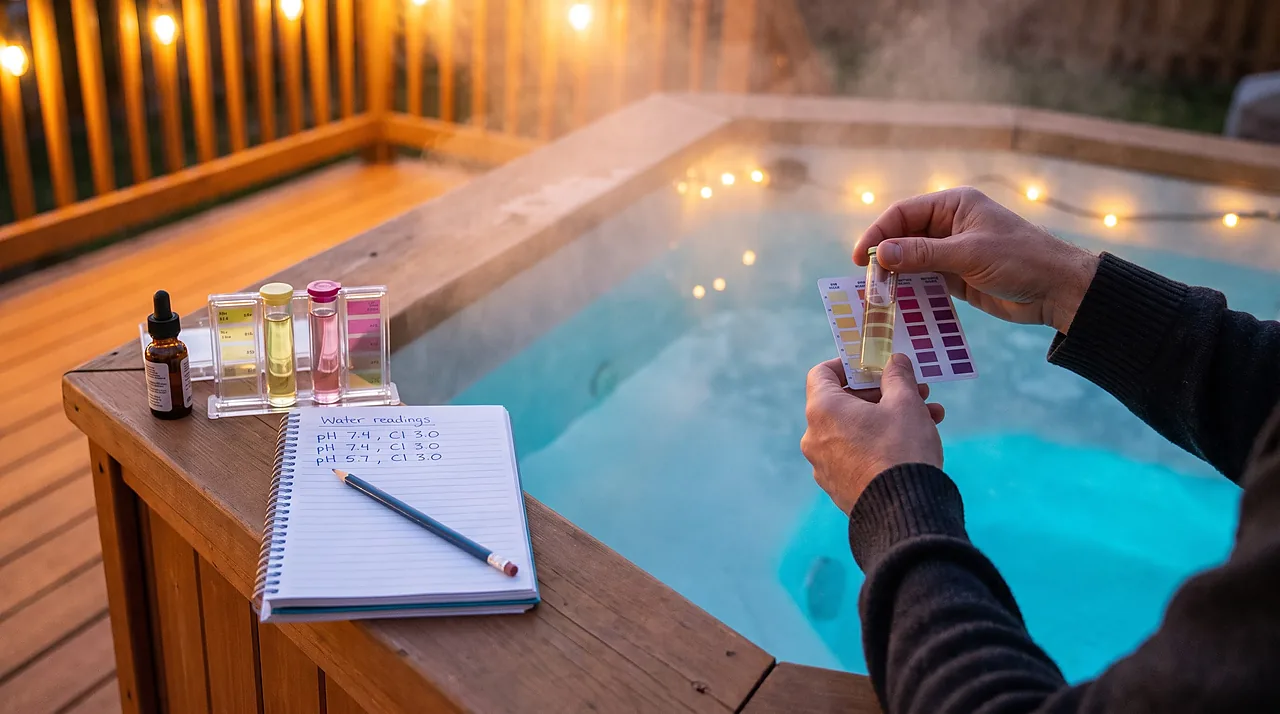
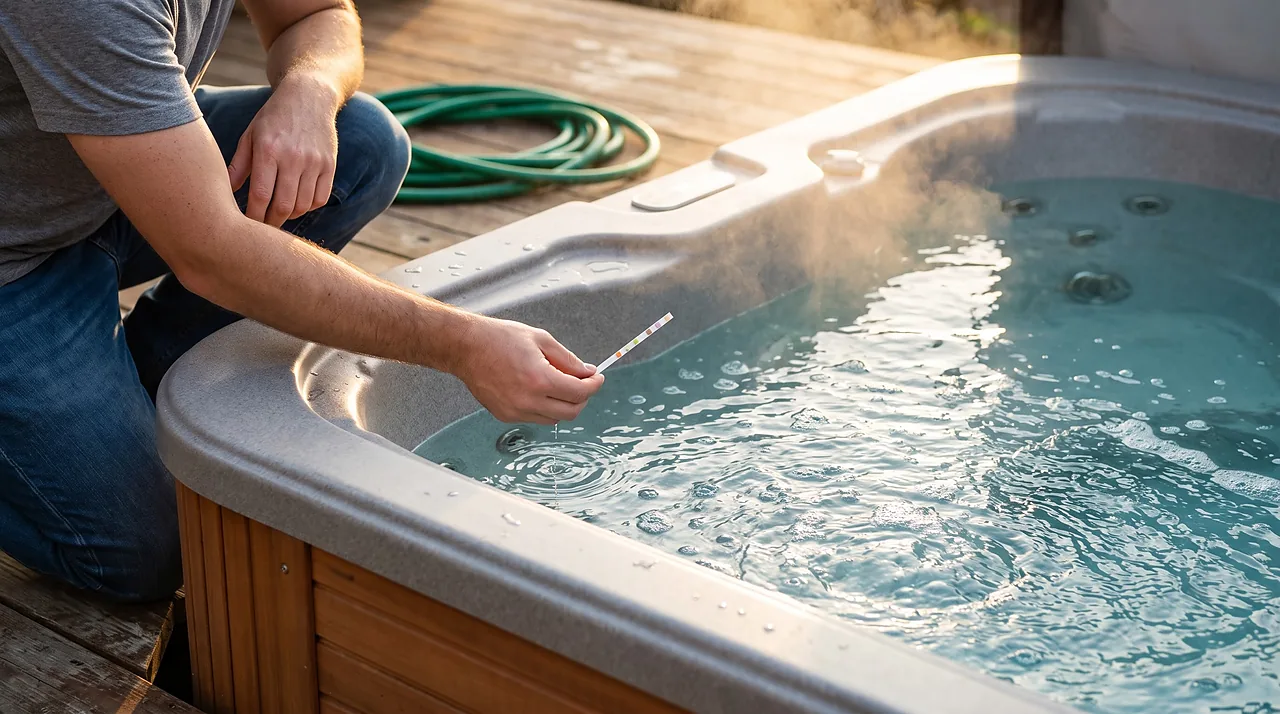
Every bather, every scoop of chemical, and every bit of evaporation adds dissolved material that a filter cannot strip back out. The Pool & Hot Tub Alliance's own guidance treats a 1,500 ppm rise over your fill water's starting TDS as the trigger to drain outright. Past that point, sanitizer works less efficiently and the water starts reading as flat or "tired," even when the test strip colors still look acceptable. Testing TDS with a simple meter now and then is the only way to see this one coming before it shows up as sluggish chlorine.
Dichlor adds cyanuric acid every time you shock
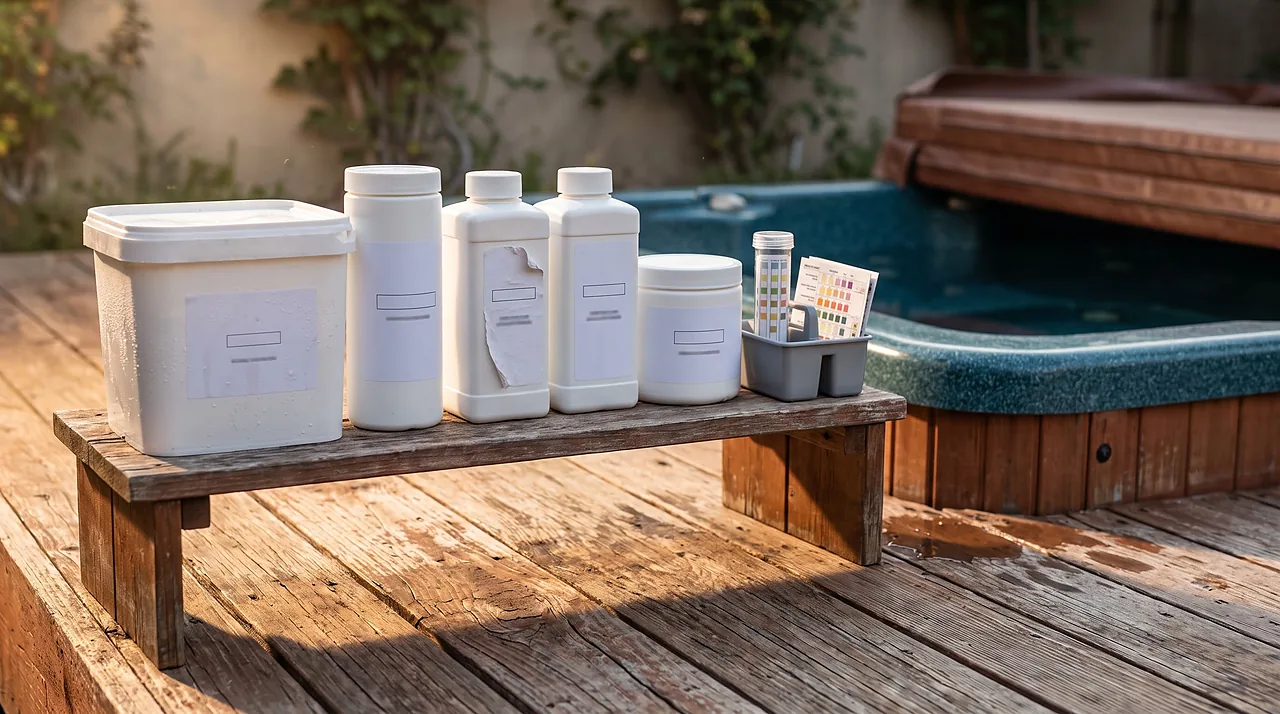
If the sanitizer routine leans on dichlor granules, which is the case for most residential tubs, each dose that pushes chlorine up also adds cyanuric acid, about 0.9 ppm of CYA for every 1 ppm of free chlorine it adds. CYA has a real job in an outdoor pool, shielding chlorine from sunlight, but a hot tub has a lid and rarely sees direct sun for long stretches, so the CYA just accumulates with nothing useful to do. Past a certain point it slows chlorine down badly enough that the same 3 ppm reading on a test strip is doing far less disinfecting work than it looks like. This is the actual argument for the dichlor-then-bleach approach some owners switch to partway through a fill cycle, using plain unscented bleach once CYA starts climbing instead of adding more dichlor on top of it. Whichever sanitizer path a tub runs, understanding what's actually dissolved in the water is covered in more depth over on the chemicals a spa actually needs.
Signs you're overdue no matter what the math says

The formula gives a planning number, and real tubs don't always cooperate with math. A tub can still hit trouble before its calculated interval if any of these show up:
- Chlorine won't hold a reading anymore, or you're adding more and more to get the same number on the strip.
- The water looks hazy or dull even right after you've balanced it, a change from how clear it looked on day one.
- A strong, sharp chlorine smell shows up. That smell is combined chlorine (chloramines), a sign that free chlorine has dropped too low to keep up with what's in the water.
- The water feels slightly slick or the shell has a thin film at the waterline.
- A TDS test comes back 1,500 ppm or more above what the fill water read on day one.
- Skin or eyes sting even though free chlorine and pH both test in range, which usually points to CYA quietly dragging chlorine's kill power down.
Any one of these is a reason to drain early, regardless of what day the formula landed on.
Topping up is not the same as changing
Evaporation and splash-out lower the level every week or so, so add fresh water whenever it drops toward the bottom of the skimmer opening (low water lets the pump suck air). A top-up dilutes a little but leaves almost all the dissolved solids in place, so it never resets the drain clock. Retest pH and alkalinity after a big top-up.
How long can the water just sit before it's a problem?
There's no fixed shelf life on hot tub water sitting untouched, and that's a different question from how often to schedule a drain. A properly covered spa with the pump cycling and sanitizer held at free chlorine or bromine at 3-5 ppm and pH 7.2-7.8 can sit unused between soaks without anything changing for the worse until its drain interval comes due. What actually decides whether stagnant water is a problem is whether that sanitizer level is being maintained. Water that's been shut down, uncovered, or left to lose sanitizer entirely is a separate situation, one with its own risks that fall outside the routine change schedule this formula is built for.
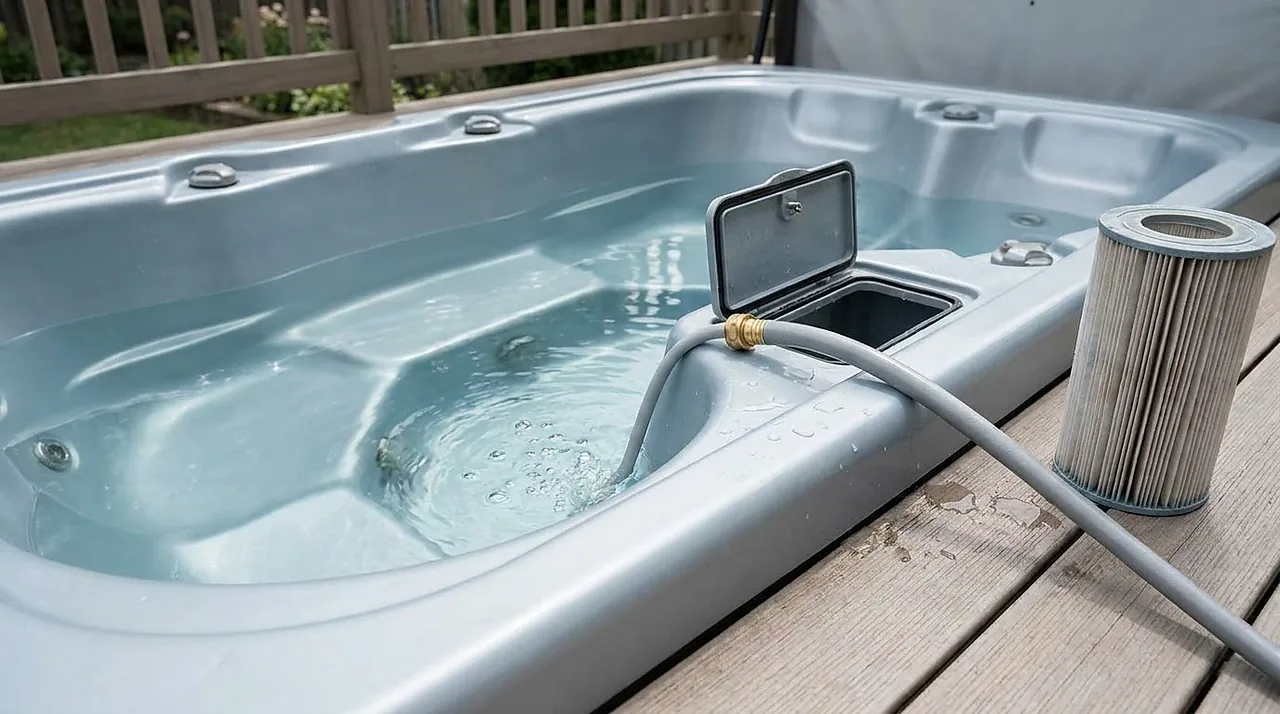
Once the math, the TDS number, or the signs above say it's time, the process itself, siphoning it out, cleaning the shell, and refilling correctly, is its own job with its own steps at the full drain and refill routine.