You bought a spa with an ozonator as one of the listed features, or you're staring at a small box wired into the equipment bay and wondering what it's actually doing. The question that usually follows is the one that matters: does this thing mean you can run less chlorine, or skip it entirely? The honest answer is the first half, not the second. A working ozonator genuinely reduces how hard your sanitizer has to work. It does not, and structurally cannot, replace the sanitizer itself.
That distinction isn't a marketing nuance. It's how the pool and spa industry actually classifies the equipment. The Pool & Hot Tub Alliance, the trade body that helps write the codes public health departments adopt, puts ozone and UV in the same bucket: secondary or supplemental disinfection systems that are required to run alongside a primary halogen, never instead of one. Understanding why makes the rest of this page (how to tell if yours is even working, and when it's worn out) much easier to act on.
What ozone is actually doing in the water
Ozone (O3) is an unstable, highly reactive form of oxygen. A small generator, either a corona-discharge chip or a UV lamp, converts a stream of air into ozone gas, which gets pulled into your circulating water through a venturi injector or a dedicated port. Once that ozone dissolves, it goes to work immediately: it oxidizes body oils, lotions, and other organic waste, and it destroys the chloramines that cause the "chlorine smell" everyone blames on too much chemical rather than too little. The Pool & Hot Tub Alliance describes the mechanism plainly: the oxidation reaction destroys organic contaminants and even renders some dissolved metals insoluble, and ozone is capable of killing every known microorganism it contacts, including chlorine-resistant ones like Cryptosporidium and Giardia.
That's real, useful work. Every bit of organic gunk ozone burns off is one less thing your chlorine or bromine has to oxidize. That's the actual mechanism behind "less sanitizer demand." A spa running ozone alongside a halogen simply has less background junk competing for that halogen's attention. Less of the sanitizer gets consumed doing cleanup, so more of it stays available for sanitizing.
Why it can't be the whole plan

Here's the part that trips owners up: ozone does almost none of its work in the bulk water where you and your sanitizer test strip live. It reacts at the injection point and in the plumbing on the way back to the tub, and by the time that water reaches you, only a trace survives. The Pool & Hot Tub Alliance's own figure for a properly operating commercial system is a residual of roughly 0.1 ppm of dissolved ozone reaching the pool, a fraction of the 3 to 5 ppm working range you'd maintain for chlorine or bromine. Ozone also breaks down within minutes once it's off-gassed at the surface. There's nothing left standing guard between the moment you get out and the next bather getting in.
That's the entire reason a residual sanitizer exists in the first place: something has to keep working in the water between test strips, after a heavy soak, and overnight. Ozone's job is oxidation and knocking down chloramines; the halogen's job is the lasting kill-and-hold. Every code body and every manufacturer's install manual agrees on this split, which is why an ozonator ships as an add-on to a spa's chlorine or bromine system, never in place of one. If you're still deciding which halogen to run alongside your ozonator, that's a separate call covered on its own page at bromine versus chlorine, and where an ozonator fits next to mineral cartridges and salt systems in the broader lineup of supplemental equipment is covered at hot tub mineral systems.
A spa ozonator makes a small amount of ozone and most of it reacts in the plumbing, but what reaches the surface off-gasses under the cover. Ozone is a lung irritant, so an indoor tub needs real ventilation. Opening the cover for a minute before leaning over the water is a good habit.
How to tell if yours is actually running

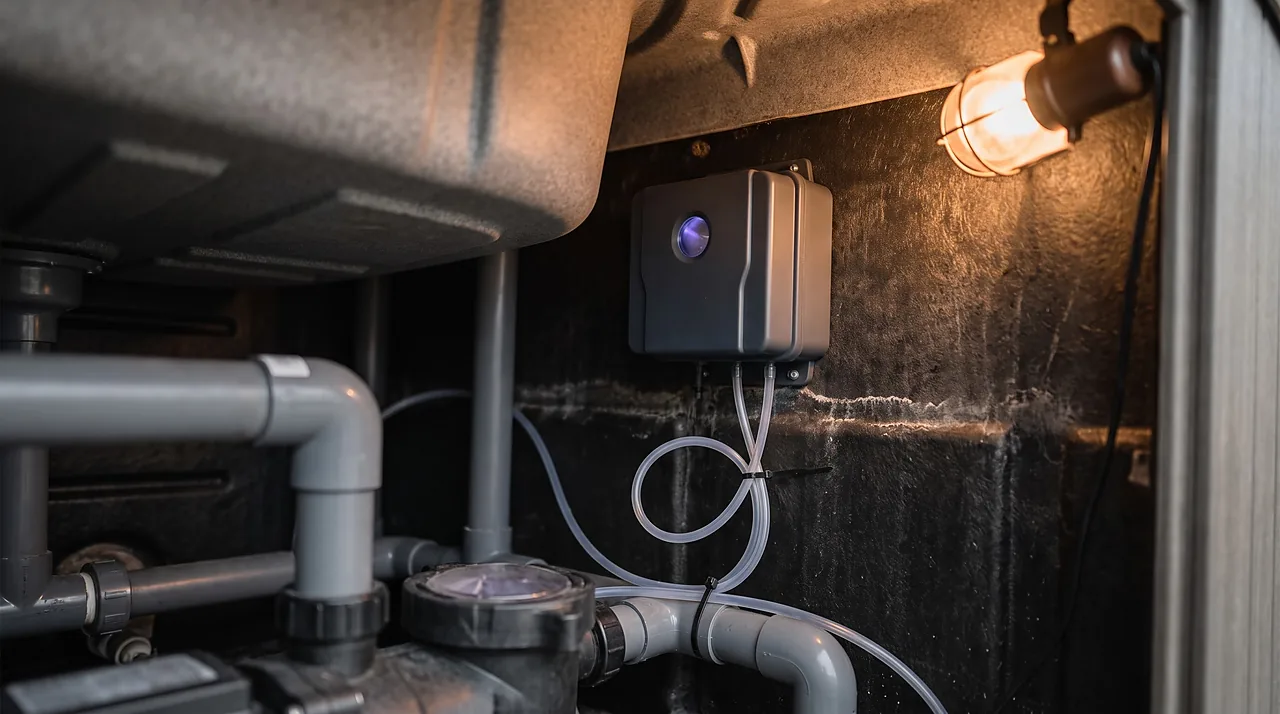
Most ozonators sit inside the equipment compartment where nobody looks at them for years, so the honest first step is confirming the thing is alive at all. DEL Ozone, whose corona-discharge and UV units have been factory-installed in more portable spas than any other brand, builds the check directly into the hardware: when the pump cycles on, the ozone chip or lamp cartridge should show a visible blue glow through its viewing window. No glow with the pump running means no ozone, full stop, and the fix is almost always a blown chip, a dead power connector, or a tripped breaker.
A glow doesn't automatically mean ozone is reaching the water, though. The table below separates what you can actually observe from what it means, because the two get confused constantly.
- Blue or violet glow visible at the chip/lamp window when the pump runs
- What it actually tells you: The generator itself is producing ozone. What to check next: Nothing yet, this part is working; move to the suction/injector path.
- No glow at all, pump running
- What it actually tells you: The generator has failed or has no power. What to check next: Check the cord, breaker, and the chip or lamp cartridge itself.
- Steady stream of small bubbles at a jet
- What it actually tells you: Air is moving through a venturi line, which is necessary but not proof it's ozone-carrying air. What to check next: Confirm the bubbling jet is actually tied to the ozone injector, not an unrelated air blower "supercharging" the jets.
- Faint clean or "electrical" smell right after the spa runs
- What it actually tells you: A reasonable sign ozone reached the surface. What to check next: No action needed.
- No smell at all, glow present
- What it actually tells you: Could mean weak suction, a leaking air control valve O-ring, or the smell simply being masked by fresh chemicals. What to check next: Run a suction test on the tubing and inspect the air control valve before assuming failure.
That third row is the one worth sitting with. A hot tub jet full of bubbles proves a blower or venturi line is pushing air into the water. It does not prove that air passed through the ozone chip on the way there. Some spas run a separate air blower purely to "supercharge" jets for a stronger massage, completely independent of the ozone plumbing, and on those tubs the visible bubbling has nothing to do with sanitation at all. The only reliable confirmation that ozone specifically is being generated is the glow at the unit itself, backed up by a suction check on the actual ozone supply line (pull the tubing off the generator, run the pump, and feel for suction with a fingertip over the open end).
Is an ozonator worth it, and can you add one?
If the tub came with an ozonator, it is worth keeping alive, since a working unit lowers sanitizer demand and helps with smell and foam. Adding one to a tub that never had it depends on the spa pack. Many control boards have an ozone output and the plumbing has an injector port or a spot for one, and then a universal kit is a moderate job. If the pack has no ozone output and no injector, the retrofit gets bigger and the benefit is modest, so balanced water and a good sanitizer routine matter more. Wiring into the spa pack is electrician or technician work.
How long an ozonator actually lasts, and when to replace it

Ozonator hardware wears out on its own schedule. It has nothing to do with how the rest of the spa is holding up. Per DEL Ozone's own service documentation, the corona-discharge chip or UV lamp cartridge inside a typical residential unit carries a life expectancy of about 9,000 hours of operation. Under normal daily filtration cycles, that works out to roughly two to three years before it needs swapping. That number is a manufacturer engineering spec, not a guess. It's the same rating used across that company's SpaECLIPSE, CDS-16, and ZO-series lines, and other brands in the category run comparable ranges depending on the chip or lamp technology used. Balboa's own product line makes the same point a different way. Its CD Cartridge, CD Chip, and UV models each carry different maximum spa-size ratings, power draws, and warranty lengths: one year on both CD models, two years on the UV model in that lineup. That's a reminder that "the ozonator" isn't one standardized part with one fixed lifespan. It's whatever chip, cartridge, or lamp your specific spa manufacturer chose.
None of that means you need to track hours on a spreadsheet. A simpler replace-or-skip call works for almost every situation:
- Unit is under 2 years old, glows when the pump runs, suction test passes
- Call: Skip. Nothing to replace; recheck the glow every few months.
- Unit is 2 to 3+ years old, no glow, spa is used several times a week
- Call: Replace. You're past the rated service life and the part has likely reached end-of-life on schedule.
- Unit glows, no ozone smell, jets show plenty of bubbles
- Call: Don't replace yet. Run the suction test and check the air control valve O-ring first; a weak-suction fix is often free.
- Spa foams, clouds, or needs more sanitizer than it used to, and the unit is old with no glow
- Call: Replace. This is the pattern of a dead ozonator quietly handing its whole workload back to your chlorine or bromine.
- Unit is well past 3 years and still glows fine
- Call: Optional. It's outlasting its rating; keep an eye on it but there's no rule that forces replacement on a calendar date alone.
If the diagnosis points to a wiring, suction, or airflow problem rather than a genuinely dead chip, the deeper repair steps (checking the air control valve, testing the injector line, sorting out a blower-versus-ozone mixup) are covered in more depth at ozonator not working. And if you're trying to figure out where an ozonator fits into the sequence you already balance week to week, alkalinity, pH, and sanitizer, that order lives at hot tub water chemistry.
The bottom practical line: treat a healthy ozonator as a discount on your sanitizer bill, not a replacement for it. Keep testing free chlorine or bromine at the same range you'd hold in a spa without one. If ozone is doing its job, you'll likely find yourself dosing a little less to hold that range, especially after heavy bather loads, and that's the entire benefit working as intended.