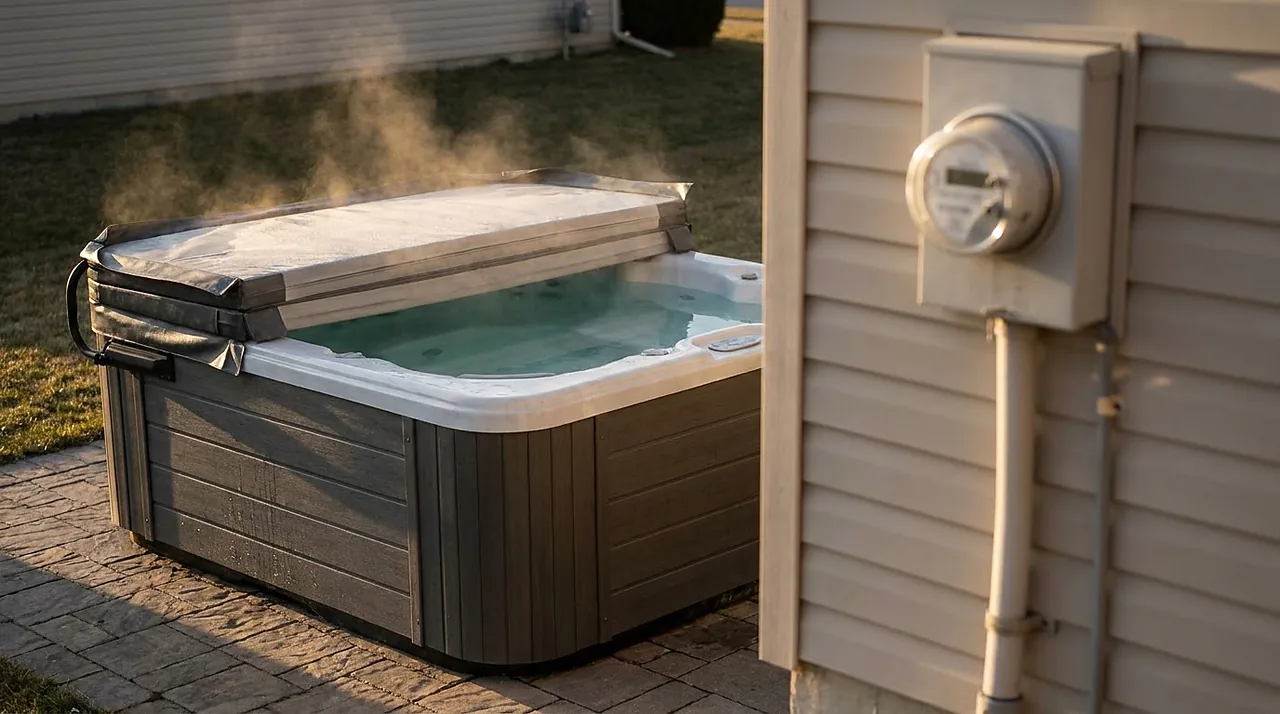
Picture the scene most owners know too well: one hand braced on the cabinet, the other hauling up a slab of waterlogged foam and vinyl that outweighs a bag of concrete, twisting sideways to lean it against a fence before it slides off and lands in the yard. That is the moment a cover lifter earns its keep, and it is also the moment most people go shopping for one for the wrong reason. The mechanism that will actually work at your tub has nothing to do with which brand is rated highest online. It comes down to three measurements you can take with a tape measure in about five minutes: the clear space behind the cabinet, the clear space to each side, and the surface you would be anchoring hardware into. Get those three numbers first, and the mechanism picks itself.
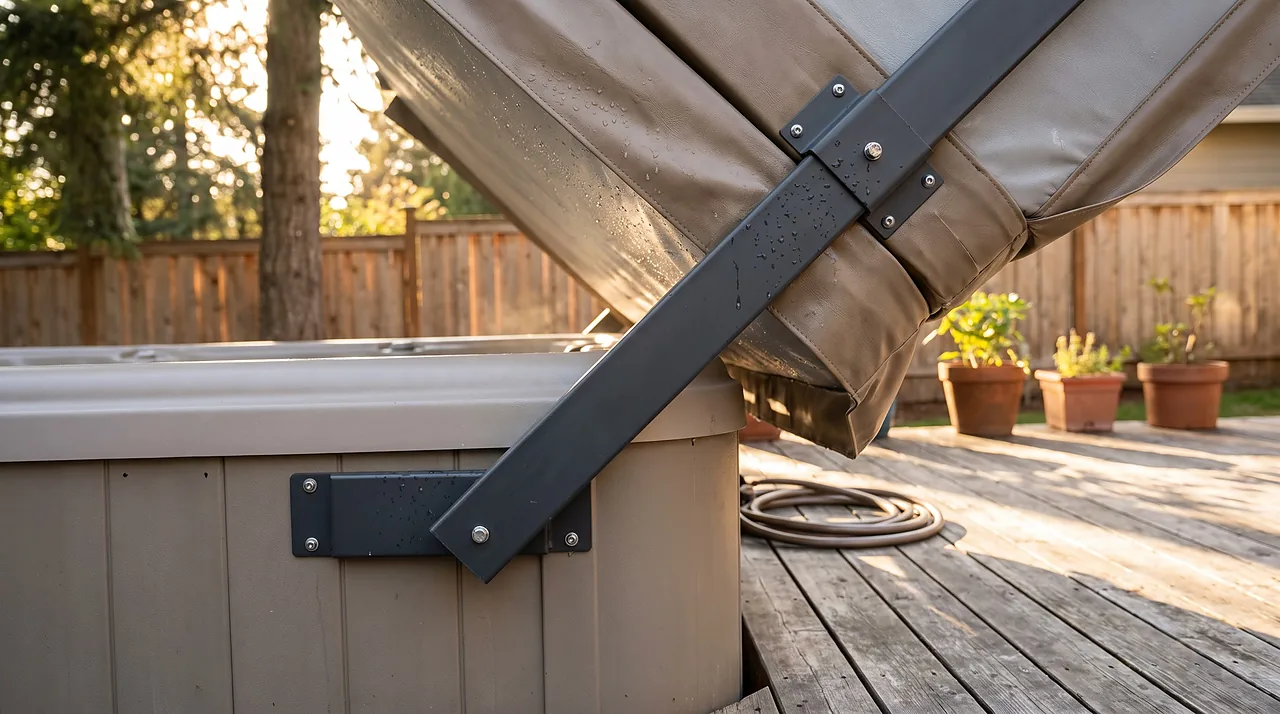
Choosing a lifter involves two separate decisions: lifting style and mounting style. Lifting styles dictate how the cover moves and how much clearance is required. A manual bar or pivot lifter folds the cover in half and swings it behind the spa, demanding the most rear clearance. A hydraulic or gas-assisted lifter uses pressurized gas shocks to lift the folded cover with far less effort while requiring less space behind the cabinet. Low-profile lifters are designed specifically for tight quarters where rear clearance is minimal. Meanwhile, mounting styles determine how the hardware attaches: cabinet-mount brackets screw directly into the side panels, under-mount plates slide beneath the tub base and stay anchored by the spa's weight without any drilling, and deck or free-standing mounts anchor into surrounding decking or concrete for sunken installations.
The three mechanisms, and the clearance each one actually needs

None of these designs is a universal upgrade over the others; each solves a specific clearance challenge and creates its own installation requirement.
| Type | How it works | Room needed behind the tub | Mounting | Typical price |
|---|---|---|---|---|
| Bar or pivot lifter | Folds the cover in half and swings it up and back over a bar behind the spa | The most rear room; check the lifter's spec sheet | Cabinet-mount or under-mount bracket plates | Lower end of the $80-250 range, verify current |
| Hydraulic or gas-assisted lifter | Uses gas shocks so the folded cover lifts up and back with minimal effort | Less room behind the tub; check the lifter's spec sheet | Cabinet-mount, under-mount, or deck / free-standing mount | Upper end of the $80-250 range, verify current |
| Low-profile lifter | Pivots the folded cover to sit lower or tighter behind the spa | Least, made for tight spots; check the lifter's spec sheet | Cabinet-mount, under-mount, or deck mount | Within the $80-250 range, verify current |
A manual bar or pivot lifter is the design most people picture, and it is typically the most budget-friendly, but it also gets returned frequently because it demands the most clear space behind the tub. If the spa backs up against a privacy fence, a wall, or a raised garden bed, a standard bar cannot complete its swing arc and the cover cannot fully open. A hydraulic or gas-assisted lifter solves this by using gas shocks to take on the physical weight of the cover, lifting it up and back smoothly while requiring less rear clearance than a purely manual arm. For especially confined locations, low-profile lifters tuck the folded cover into the tightest possible space behind the cabinet. Pairing any of these lifting mechanisms with the right mounting style is equally critical: cabinet-mount brackets work well on sturdy wood framing, under-mount plates slide beneath the spa to eliminate cabinet drilling entirely, and deck or free-standing mounts provide a stable anchor when a tub is sunken into surrounding decking.
Measure before you shop, in this order

A tape measure and five minutes will save a return shipment. Work through these in sequence; guessing from a photo online skips the details that actually decide the outcome.
- Stand at the back of the tub and measure straight out from the cabinet to the first solid obstruction, whether it is a fence, a wall, a raised bed, or a step. That distance rules basic pivot-arm designs in or out immediately.
- Measure overhead too, from the top of the cabinet to any pergola beam, roof eave, or gutter. A pivot-arm cover swings up before it swings back, and a low overhang stops it partway.
- Measure clear width to each side of the tub at cabinet height. Lifter pivot arms and mounting brackets need room to operate along the cabinet flanks without hitting a rail or a neighboring hedge.
- Look at the mounting surface itself. Deck or free-standing brackets need a footing that will not shift, so soft lawn or loose gravel usually means a concrete pad or reinforced deck framing before installation, not after.
- If the cabinet is weak, synthetic or has panels you do not want to drill, look at under-mount plates that slide under the base (they need a flat base and enough tub weight on them).
- Weigh the cover, or estimate it, before choosing a weight rating. A dry foam-core cover already runs 50 to 100 pounds on a typical residential spa, and a cover that has taken on water can push close to double that, which is the real reason lifter weight ratings matter more than the cover's listed size.
That waterlogged-weight problem is worth separating out, because a lifter cannot fix it and no amount of extra hardware compensates for it. If a cover already feels heavier than it should, or the foam core has started sagging in the middle, that is a cover-condition question, not a lifter question. It belongs with the maintenance routine that keeps a cover from waterlogging in the first place; a lifter has no bearing on it either way.
Where the mounting surface decides the outcome

Clearance gets most of the attention, but the surface underneath a lifter's hardware fails almost as often. A pivot-arm unit typically bolts straight to the tub's own cabinet frame or to a ledger board fastened to the deck behind it, so a cabinet with thin, brittle side panels, common on an older or budget spa, may need a reinforcing bracket before it can take the load of a full cover swinging on it repeatedly. A hydraulic lift's posts carry real leverage every time the cover opens, which is exactly why they need a footing that will not heave or sink: a poured pad, a deck with blocking underneath the boards, or a manufacturer-supplied ground sleeve set in concrete. Skip that step and the posts will lean a little more with each season until the cover no longer seats evenly, which is its own slow path back to the waterlogging problem above.
An under-mount system asks nothing of the cabinet panels because it requires no screws into the cabinet exterior. Instead, sturdy plates slide directly under the spa base and stay anchored purely by the tub's own filled weight, making them ideal for weak or synthetic skirts. However, the tub must rest on a completely flat, solid base, such as a concrete pad or reinforced deck framing. An under-mount lifter cannot be added under a tub that is already set into a deck surround without draining and physically lifting the spa off the foundation. Checking these surface constraints before setup, alongside following the broader schedule for keeping a spa running well, prevents costly installation surprises.
When none of the three mechanisms quite fits
A handful of tubs sit in spots where every clearance comes up short: a rear wall close behind, side rails on both flanks, and a low pergola overhead. In that layout, a folding cover caddy that simply rolls the cover to one flat side, without lifting it clear of the water, sometimes fits where a powered mechanism cannot, though it trades away the one-motion convenience for a bit more manual effort. It is worth mentioning honestly: none of the three main mechanisms always has an answer. A caddy costs less than a powered lifter, well under any of the assisted options, and it mounts to whichever single flank actually has clear space, usually the side facing the house since that is the edge more likely to be open. It only needs room to swing the cover flat against that one edge, not a full arc or a matched pair of side clearances. Round covers fold on a center hinge too, so most lifters work, but check that the model lists round covers.
While the cover is off: cleaning and the foam inside
Wipe the vinyl regularly with mild soap and water followed by a vinyl protectant, avoiding harsh solvents or household cleaners that strip the material. Many covers have zippered foam inserts that can be replaced when waterlogged, and a heavy cover makes any lifter struggle. Consistent cleaning and routine inspections, outlined in the hot tub cover care guide, keep the cover light and protect the lifting mechanism from unnecessary strain.
Frequently asked questions
Can a cover lifter interfere with the cover's child-safety lock?
It should not, if installed correctly. The relevant safety standard requires a spa's fastening system to stay inaccessible to a young child regardless of how the cover is otherwise supported or moved, so any lifter bracket or post has to be positioned so the existing straps, clips, or locks still engage fully and are not blocked by the new hardware.
Does a heavier, thicker cover need a different lifter class?
Usually the mechanism stays the same and the model tier changes. Manufacturers commonly sell each mechanism in two or three weight tiers, and the split tracks foam density and thickness more than overall size: a 4-inch tapered foam core in a common density is a light-duty lifter's territory, a denser or 5-to-6-inch core pushes into a mid-tier lifter, and a high-density commercial-grade core is usually where the manufacturer specifies its heaviest-duty bracket or strut set regardless of the cover's footprint. Checking the foam spec sheet, not just the cover's outer dimensions, is what narrows down the right tier.
Can I install a lifter myself, or does it need a professional?
Most pivot-arm and hydraulic lifters are designed for a homeowner with basic tools, and they publish a bracket and post-spacing template for exactly that reason. An undermount system that requires cutting into a cabinet or deck is the one class where hiring the work out is usually the more sensible call.
What if my rear clearance is close but not quite enough for a pivot-arm design?
A few extra inches from trimming a hedge, moving a planter, or shifting the tub itself, if it is portable, is often cheaper than switching mechanisms entirely. Measure the actual arc height needed, since some pivot-arm designs need less swing room than others of the same style.