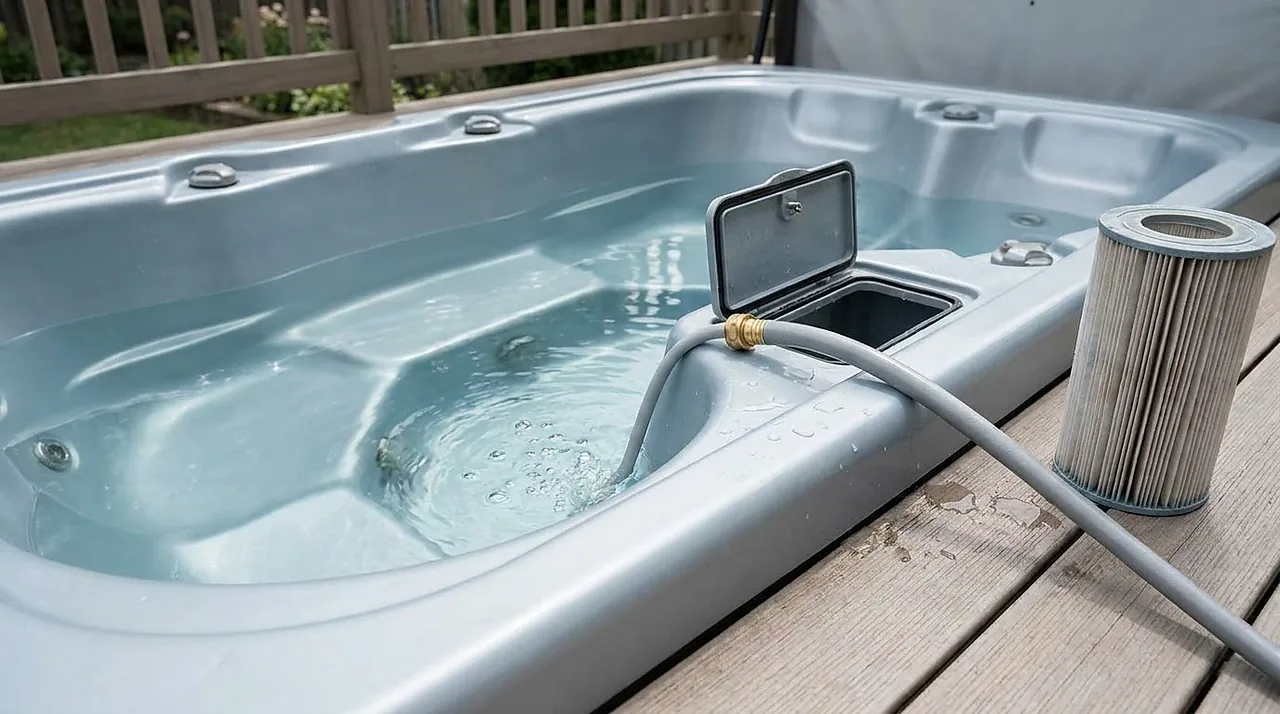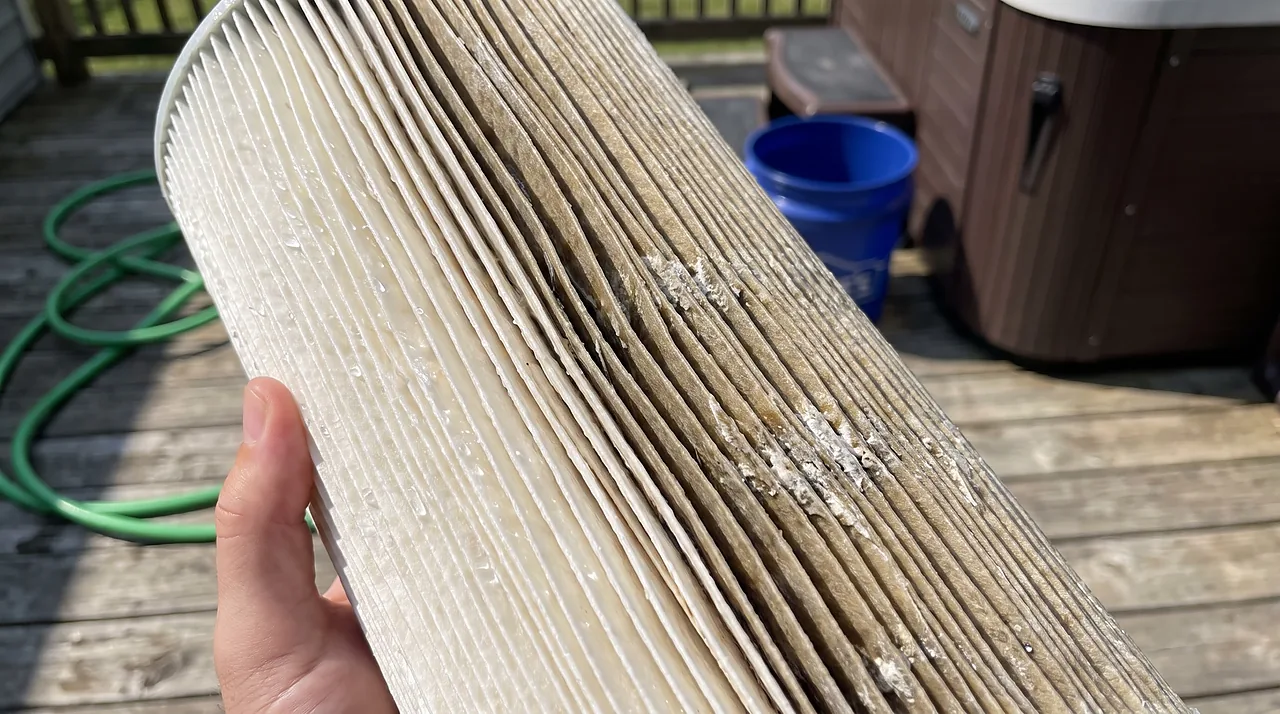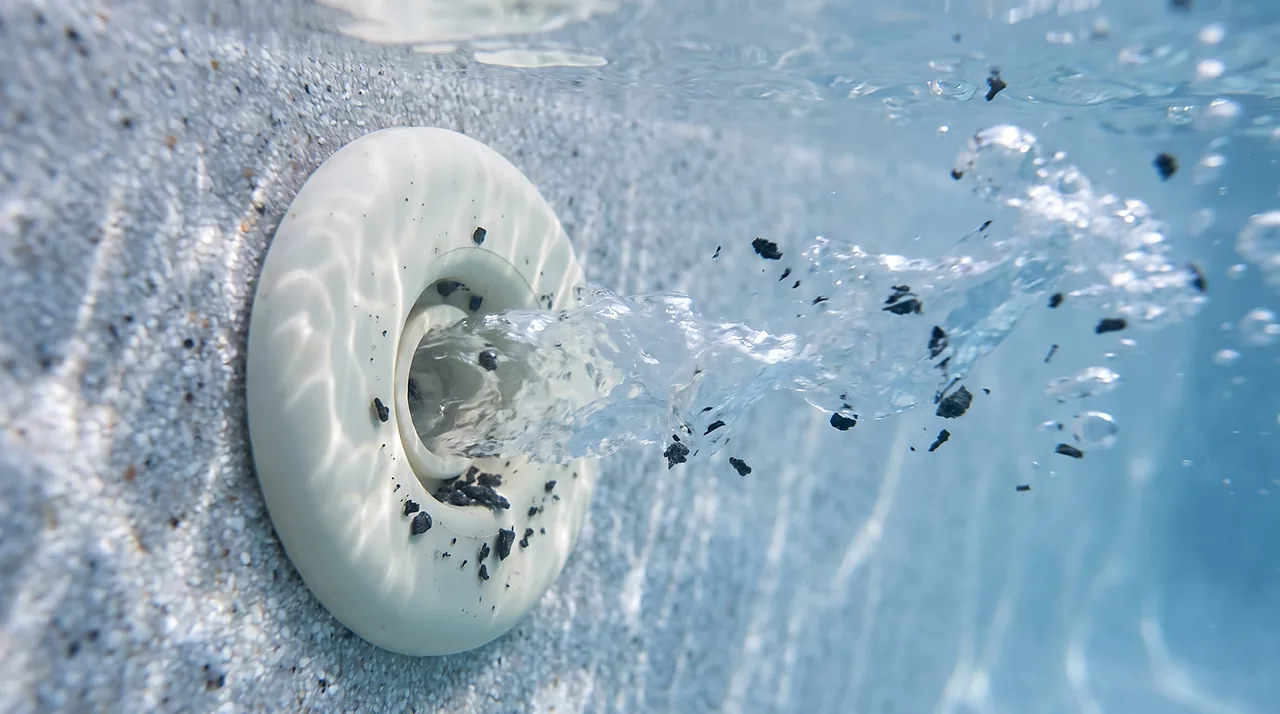
A tub with 60 jets across four seats only needs a handful of them acting up to ruin a soak: one nozzle spitting black flecks, another coughing out pale grit, a third spinning with a faint grind instead of a smooth swirl. None of that means the jet itself is broken. It almost always means one of two things is loose inside the plumbing behind it, biofilm sloughing off the pipe walls or calcium scale flaking off the jet body, and the fix depends on telling which one you're looking at before you reach for a screwdriver.
Black flakes, white flecks, and rough spin: what they're actually telling you
Dark or grayish flakes shooting out with the water are almost always biofilm, the slimy bacterial and organic buildup that coats the inside of spa plumbing and periodically sheds in chunks, especially right after the jets have been running hard or the tub sat idle for a stretch. CDC's own Legionella-control guidance for hot tubs names sediment and biofilm as one of the core factors that lets these organisms establish themselves inside the mechanical system, and its standard control measure is blunt: scrub every surface the tub touches each time it's drained, because the buildup lives in the plumbing loop, not just the open water.
White or off-white flecks point somewhere else: calcium carbonate, the same scale that leaves a chalky ring at the waterline, breaking loose from inside a jet body or a fitting where hard water has been depositing it for months. A jet face that spins rough or catches instead of turning smoothly is usually scale or mineral grit fouling the rotating insert itself, less often a worn bearing on an older jet. Both problems can show up in the same tub at once, which is why a single visual check rarely settles it on its own.
Dark gray or black flecks in the stream
Likely cause: Biofilm shedding from plumbing walls. What to do first: Run a line purge before the next drain.
White or off-white grit or flecks
Likely cause: Calcium scale breaking off a jet or fitting. What to do first: Pull the jet insert and soak it in dilute vinegar.
Jet face spins rough, catches, or feels gritty
Likely cause: Scale fouling the rotating insert. What to do first: Remove and soak the insert; check for wear once clean.
Jet spins freely but pressure feels weak
Likely cause: Usually a filter or pump issue, not the jet itself. What to do first: Check filter and flow before touching the jets.
Musty smell alongside dark flecks
Likely cause: Biofilm load high enough to affect sanitizer demand. What to do first: Purge, then retest and rebalance chemistry.
If pressure is weak everywhere rather than flakes coming out of one or two nozzles, that's usually a circulation or filter problem rather than something inside the jet itself; the troubleshooting order for that lives separately at weak jet pressure, and it's worth ruling out before you start pulling jet faces apart.
One jet with no flow at all
First twist the jet face, since many jets open and close by rotating and get turned off by accident. Check the diverter or valve knob for that seat. After a refill, an airlock can starve a group of jets until the pump is burped. If the face is open and flow is still dead, debris (hair, a filter fragment, a broken insert piece) may be lodged behind the face, and pulling the insert as described below usually finds it.
Why the purge has to come before the drain, not after
The order matters more than most owners expect. A line purge, run with the jets circulating and the old water still in the tub, is what pushes loosened biofilm out of the plumbing and into water that's about to be dumped anyway. Drain first and refill, and any biofilm still clinging to the inside of the pipes stays right where it is, ready to shed into the fresh fill within days. CDC's guidance for a hot tub with a confirmed biofilm or bacterial problem follows this same logic in reverse: it treats the plumbing loop, including the jets, the surge tank, and the filter housing, as the thing that actually needs cleaning, not just the visible shell.
So the sequence for a tub throwing dark flakes is: purge first, with the current water still in the system, then drain. Skimming the loosened gunk off the surface right after the purge and moving straight into the drain, rather than letting it sit and resettle, is the difference between actually clearing the plumbing and just stirring it up. The full purge chemistry, dosing, and contact time live at how a biofilm purge actually works, and the drain-day steps that should follow it immediately are covered start to finish at the drain-and-refill routine.
Pulling the jet inserts and soaking out the scale

Most residential spa jets are built in two pieces: a fixed housing threaded permanently into the shell's plumbing, and a removable insert (the face, the rotating eyeball, or the whole cartridge on some directional jets) that twists or pulls out by hand for cleaning. Not every jet is designed to come apart this way; some are sealed units meant to stay in the housing, so check for a visible seam or a face that turns independently of the ring around it before forcing anything.
For jets that do remove, the process is simple:
- Turn off the pump and, if the tub has isolation valves near the equipment bay, close them so water doesn't drain out through the open jet port once the insert comes out.
- Twist the jet face or insert counterclockwise by hand. Most turn a quarter to a half turn before releasing; a few pull straight out once turned. Resist any urge to use pliers on the first attempt.
- Soak the insert in a solution of roughly one part household white vinegar to one part water for 30 minutes to an hour, longer if the scale is heavy. Vinegar's mild acidity dissolves calcium carbonate without the harsher risk that a stronger descaler or muriatic acid carries around plastic and rubber jet parts.
- Scrub gently with a soft brush or an old toothbrush to knock loose any remaining grit from the internal air-adjustment slots and the rotating collar, then rinse thoroughly in plain water before reinstalling.
Calcium hardness that's been running high is usually the reason scale keeps forming in the first place; the target range for a spa, why it drifts, and how to correct it without overshooting live at hot tub calcium hardness, and it's worth checking that number so the jets don't scale right back up within a season.
Reseating jets without cracking the housing

The housing threaded into the shell is plastic, and plastic threads strip or crack far more easily than the metal ones people are used to on plumbing fittings. Start every jet insert back in by hand, turning it clockwise slowly until it catches its own threads naturally. If it doesn't turn smoothly within the first quarter turn, back it out and realign it; forcing a cross-threaded insert is the single most common way an otherwise fine jet housing ends up cracked and leaking behind the shell, a repair that's far more involved than the cleaning that was supposed to fix things. Snug the insert until it seats flush and stops turning easily under light hand pressure. It does not need to be wrenched tight, and most jet faces were never designed to be.
If a jet feels loose and rattles even after reseating, or if a housing already shows a hairline crack, that's a different repair than a cleaning job, and pushing water through it under pump pressure risks a worse leak later.
When the flakes keep coming back

A single purge and jet cleaning fixes most cases, but flakes returning within a few weeks usually mean one of two things: the purge didn't get full contact time through every jet (some directional jets restrict flow more than others and need longer circulation to clear), or the underlying cause, high calcium hardness or a persistently low sanitizer residual that lets biofilm regrow fast, hasn't actually been corrected. Keep free chlorine or bromine at 3-5 ppm and pH at 7.2-7.8 between tests; a tub that drifts below that gives biofilm and scale an easy path back in.
Water age matters too. CDC's own formula for how long a hot tub's fill should reasonably last is the spa's volume in gallons divided by three, then divided by the average number of daily users, and a tub that's overdue for a drain by that math is fighting an uphill battle no matter how clean the jets were last time.
How often to clean the jets
Wipe the jet faces when you clean the shell at each drain (typically every 3-4 months). Pull and soak inserts whenever they show scale or spin rough. Run a line purge before a drain when flakes, foam or a musty smell show up, and always before the first fill on a used tub.