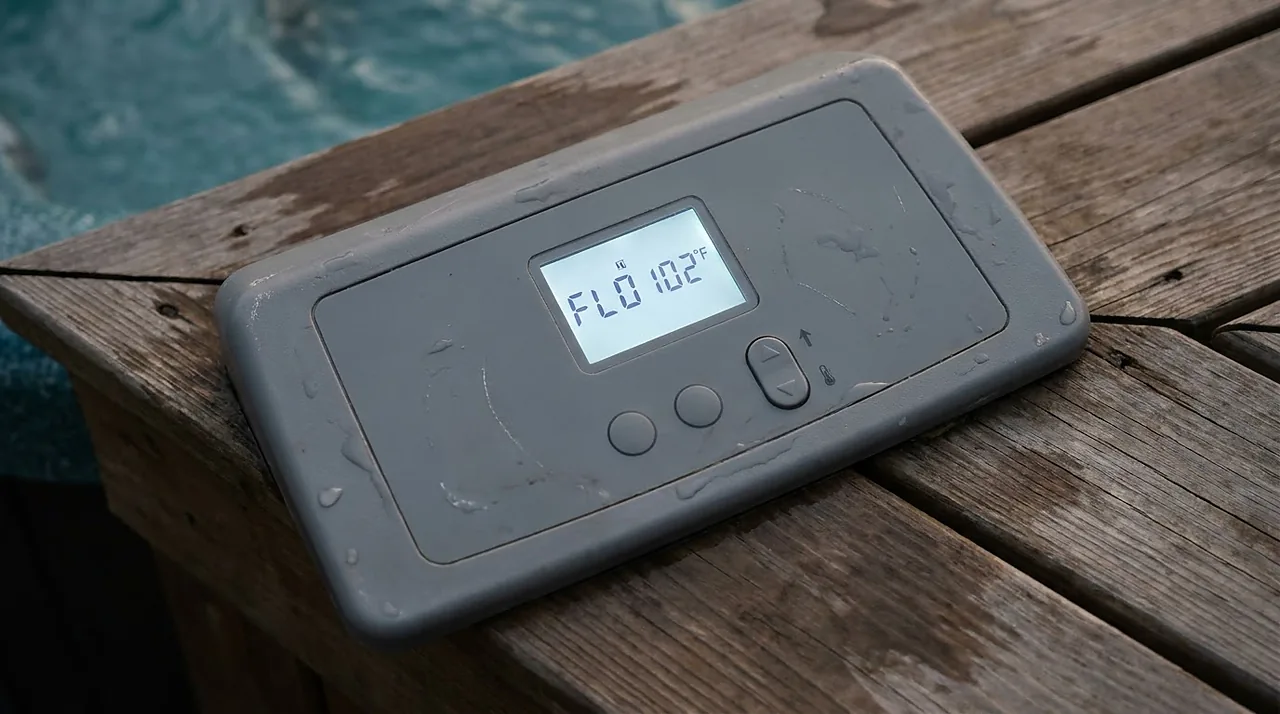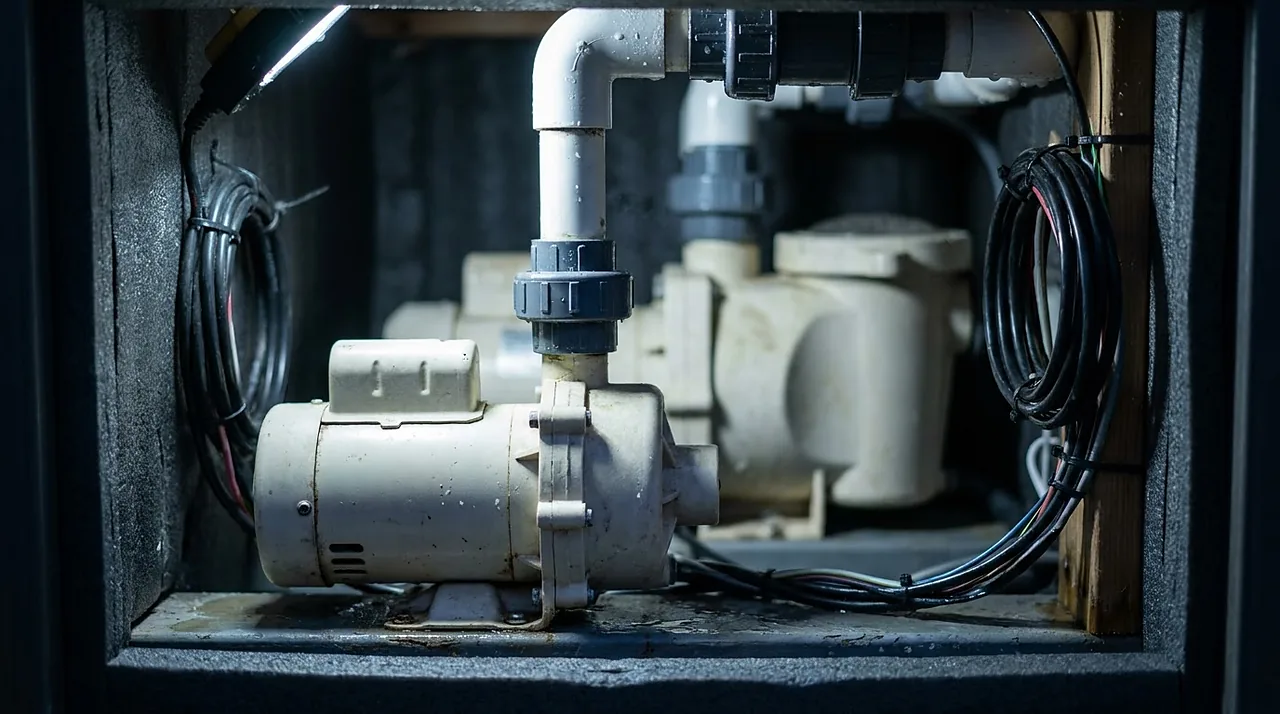
A spa can have two pumps doing completely different jobs, and most owners find that out only after something goes wrong. If the water feels lukewarm even though the jets still blast on high, or an error code keeps popping up despite a spotless filter, the part actually causing the trouble is often the one owners never think about: a small, quiet pump that never gets a switch of its own because it is never supposed to turn off.
That pump is the circulation pump, and it runs nonstop, moving water through the filter and past the heater around the clock. The jet pump, the one everyone knows about because it powers the massage, only spins up when someone presses the jets button. Confuse the two when troubleshooting and it is easy to chase a jet-pump fix for a circulation-pump problem, or the reverse, and get nowhere.
Two pumps, two jobs
Not every spa has a dedicated circulation pump. Many older or lower-cost tubs run everything, filtration included, off the main jet pump's low speed. But on most mid-range and higher-end spas built around a Balboa or Gecko control system, there is a small dedicated pump wired to its own relay on the control board, separate from the jet pump relays entirely (Balboa's BP2000/2100 board documentation, for example, lists "a dedicated circulation pump" as distinct equipment from the jet pumps and blower it also controls).
| Circulation pump | Jet pump | |
|---|---|---|
| Job | Moves water through the filter and heater, continuously | Powers the massage jets when switched on |
| Run pattern | 24 hours a day, or nearly so, on many systems | Only while jets are selected, typically 15-30 minutes at a time |
| Size | Small, commonly around 1/15 HP to 1/4 HP | Larger, commonly 1 HP to over 4 HP, sometimes two-speed |
| Typical draw | Well under 2 amps | Several amps to well over 10, depending on horsepower |
| Noise | A soft, steady hum, easy to ignore | A louder whoosh that starts and stops with the jets |
| If it fails | Water stops filtering and heating properly; jets can still work fine | Jets go weak, silent, or intermittent; heating is usually unaffected |
That last row is the one worth remembering, because it is also the fastest way to sort out which pump is at fault before touching anything.
Should it run all the time?
Yes, on tubs built with one, it is designed for continuous duty at a low power draw, and that steady flow is what keeps the water filtered and the heater sensor fed. Some control systems pause it briefly on their own, for example in hot weather once the water is above the set point. Do not put it on a separate timer unless the manual allows it.
What circulation pump failure actually looks like

A failing or dead circulation pump rarely announces itself the way a jet pump does. There is no jet-pressure drop to notice, because jets run on the other pump. Instead, three quieter signs tend to show up, sometimes together and sometimes one at a time.
- No flow ripple at the return jets. With the jets off, a working circulation pump still pushes a faint, steady stream out of the small return fittings, visible as a gentle ripple or a soft trickle sound if you put a hand near the return. If that ripple is gone and the jets themselves work fine when switched on, the circulation pump is the suspect, not the jet pump.
- A flow-related error code even with a clean filter. On a Gecko-controlled spa, a flow fault means the system is not detecting enough water moving past the heater, and a dirty filter is only one of several causes the manufacturer's own troubleshooting guide points to, alongside closed circulation valves, a low water level, and trapped air in the plumbing. Rinse or replace the filter, confirm the water level and open valves, burp out any trapped air, and the fault still returns: a dead or dying circulation pump is a strong candidate, since on systems built around one, it is the pump that keeps water moving past the heater sensor. (On spas that instead rely on a flow switch as the sensing component, a stuck or failed switch is its own separate suspect, but that is a different part from the circulation pump itself.)
- A tub that runs cold while the jets still work. This is the pattern that throws people off the most. The heater only warms water that is actively flowing across it, and on most systems keeping that flow going between soaks is the circulation pump's job alone. Jets can push water beautifully during a session and the tub can still be losing heat overnight, because the pump responsible for the slow, constant flow past the heating element has quit.
None of these three signs is proof by itself. A dirty filter, a closed valve, or a stuck air pocket in the plumbing can mimic every one of them, so rule those out first. If the symptoms line up after that, the next step is confirming with a flashlight and a listen: a circulation pump that has failed outright usually goes silent, while one that is dying often hums, buzzes, or runs hot without moving water, sometimes because its impeller has worn or its bearings have seized.
Priming, air locks, and the failure that only looks like a dead pump

Before assuming the worst, rule out an air lock, especially after a drain and refill or any time a union fitting was loosened for filter or plumbing work. A pump with air trapped in its wet end can spin without actually moving water, which produces the exact same symptoms as a failed pump: no flow ripple, a flow-related fault code, or a heater that never catches up. Manufacturer fill guidance is specific about this: a pump should not be left running unprimed for more than about two minutes, and priming is only confirmed once water flows from the jets or returns without air bubbles in it. If a fresh refill or plumbing job happened recently, burping the trapped air out at a union fitting, slowly, with the pump running, is worth trying before ordering a replacement part.
Genuine circulation pump failure usually comes down to one of three mechanical causes: a worn or cracked impeller that can no longer push water efficiently, seized bearings from age or mineral buildup, or a burned-out motor winding, often from years of continuous duty in a warm, humid cabinet. Poor water chemistry accelerates all three, since scale from high calcium hardness and pitting from long stretches of low pH both wear on pump seals and impellers faster than clean, balanced water does.
Lifespan and what replacement runs
Circulation pumps earn their wear differently than jet pumps because they never rest. A pump that runs continuously for years, even a small, low-draw one, tends to reach the end of its service life somewhere in the 5- to 10-year range, with well-maintained water chemistry and a clean filter pushing that toward the longer end and neglected chemistry or a chronically clogged filter cutting it shorter. That is a general range rather than a fixed number, since duty cycle, water quality, and the specific pump model all move it.
Replacement cost also spans a range, and it is worth knowing before a quote comes in. A circulation pump itself, as a part, commonly runs somewhere in the low hundreds of dollars, with the motor alone sometimes replaceable separately at a lower cost if the wet end is still good. Add professional labor for diagnosis and installation and the total climbs from there, though a circulation pump swap is usually a smaller job than replacing a full-size jet pump, both because the part is physically smaller and because it is typically easier to access. Get an exact number from a local technician or the tub's manufacturer parts line before committing, since prices vary by brand, pump model, and region.
Universal or aftermarket circulation pumps exist and can cost less, but the replacement must match the voltage, the plumbing connection size and style, and the flow rating of the original, and fit the space. The old pump's label and the tub's manual list these. When in doubt, the tub maker's parts line or a spa technician can confirm a compatible model.
When it is not the circulation pump
Two adjacent problems get blamed on the circulation pump more often than they should. If the control panel is actually throwing a specific numbered or lettered fault beyond a generic flow message, working through what each hot tub error code actually means first will usually narrow things down faster than guessing at a pump. And if the real complaint is that the jets themselves feel weak, sputtery, or uneven while the water still heats normally, that points at the jet pump or the jets' own plumbing instead, and belongs with the separate troubleshooting for weak jet pressure. A tub that will not come up to temperature at all, even after confirming flow is fine, is its own topic too, covered fully in why a hot tub stops heating.
Frequently asked questions
Can a hot tub run with no circulation pump at all?
Yes, plenty of spas are built that way from the factory. The quickest way to find out which type is sitting in the backyard is to check the owner's manual or equipment spec sheet that came with the tub: it will usually list the installed pumps by name and horsepower, and a model with only one pump listed for jets and filtration is running the single-pump design. The equipment compartment sticker or the control-system label (Balboa, Gecko, or otherwise) inside the access panel often lists the same information if the manual has been lost. Knowing which design is installed before troubleshooting saves time, since the failure signs described above only apply to tubs with a separate dedicated pump.
Is a humming circulation pump about to fail?
Not always, but it is worth checking. A soft, steady hum with warmth at the pump body is often normal for a pump that runs continuously. A loud buzz, grinding, or a hum paired with no water movement at the returns usually means a seized bearing or a stuck impeller, and that pump is close to done.
Does a circulation pump failure affect water sanitizer levels?
Indirectly, yes. Without steady flow through the filter, debris and contaminants are not being pulled out of the water as effectively, which can let sanitizer demand climb faster than usual even though the pump problem itself has nothing to do with chemistry.
Should I replace the whole pump or just the motor?
That depends on which part failed. If the wet end (the part that actually pushes water) is undamaged and only the motor burned out, a motor-only replacement is usually cheaper and faster. If the impeller or seals are also worn, replacing the whole pump assembly is often the more reliable fix long term.